
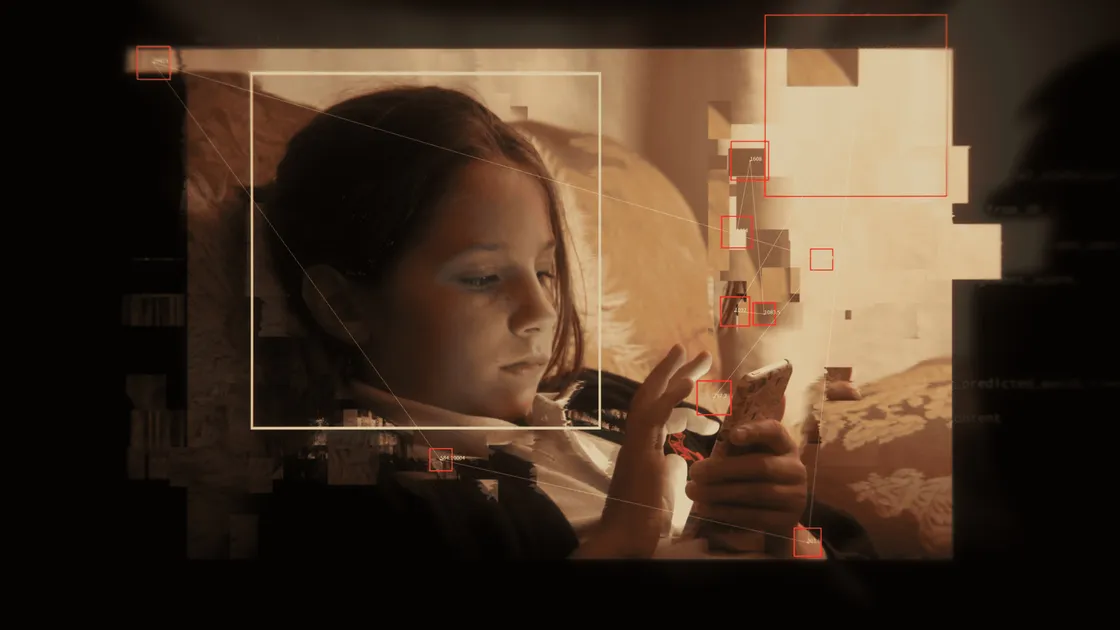
Speaking ahead of this evening’s Channel 4 broadcast of Molly vs the Machines, a harrowing film about 14-year-old Molly Russell, who took her own life after months of viewing social media content about self-harm and suicide, Deputy Rochester said she would ideally like to see technology companies held accountable for the mental and physical harm that smartphones and social media are wreaking on children and young people.
‘It makes my blood boil, it really does,’ she said.
‘First and foremost, these companies are failing us, and then where companies fail us, we have to compensate through regulation.
‘And where regulators are failing us, which it’s abundantly clear that they are, we then have to compensate with further action.’
Since becoming a deputy, she has made it clear that she would like to see the introduction of a ban on social media for under-16s, but she said a more heavy-handed approach of stopping under-16s from having smartphones altogether could be a consideration in the future if there was enough support from the community.
‘I don’t support that right now, but if it becomes clear that the Online Safety Act isn’t doing its job, if it becomes clear that Ofcom isn’t able to regulate the tech companies, then I support removing smartphone devices from our children’s lives until their neurological development has advanced sufficiently that they are able to engage with the smartphone without being damaged for the long term,’ she said.
‘I watch Australia, France, the UK, with great interest, and I really hope that these things work, because I don’t think the heavy-handed approach of bans is necessarily the answer, but I think we have to keep it in consideration.
‘It’s clear that the companies and the regulator are struggling to get to the right place.’
Education, Sport and Culture recently announced that the University of the West of England would be undertaking a survey of local parents, teachers and students to gather their views on smartphone use in Guernsey schools.
Deputy Rochester said that was ‘a great step’ because it would provide useful data, supported by Public Health and Education.
‘I’m really positive about that.
‘But then I come back to the problem of what more should we or could we do in Guernsey, and the only thing I can think about is a ban on smartphones for children under a certain age.
‘But that is quite heavy-handed in terms of government action, and it would make us an outlier in comparison to other countries who haven’t taken such an aggressive stance.
‘But it is an opportunity available for us.
‘We can do it if we want to do it, but until we ask our community what they want, what they support and what they need, I don’t think we have a mandate to act on that for now.’
The survey on smartphones in schools is to be used to inform future States policy. Education president Paul Montague has already said that local schools should be ‘smartphone-free’.
A survey of secondary and special school teachers has already found ‘no educational need for smartphones in schools’.
As a former teacher, Deputy Montague has said he had personally observed the increasing disruption to student concentration caused by mobile phones in classes and supported ‘a community-led ban on smartphones for primary-age children’.
Emma Lawlor, of local campaign group Smartphone Free Childhood Guernsey, would like to see a ‘brick phone’-only policy in all schools, as well as a ban on social media for under-16s.
‘The brick phone policy is the simplest, cheapest, quickest and most effective solution to many of the problems,’ she said.
‘The precautionary principle is vital when it comes to children. As with anything else that children are not ready for, such as drugs, alcohol, driving, and gambling, we take a precautionary approach. If something has not been demonstrated to be safe for children, children should not be able to access it. However, we have let children have unrestricted access to some of the worst aspects of humankind.’
Former data protection commissioner for Guernsey Emma Martins posted about the release of Molly vs The Machines on LinkedIn.
‘We must not forget and we must not normalise,’ she said.
‘Recall that the Prevention of Future Deaths report said: “It is likely that the above material viewed by Molly, already suffering with a depressive illness and vulnerable due to her age, affected her mental health in a negative way and contributed to her death in a more than minimal way”.
‘The documentary has been co-written by Shoshana Zuboff, the author of one of the most important books of this era, The Age of Surveillance Capitalism: The Fight for a Human Future at the New Frontier of Power. The final words of that book are - “The Berlin Wall fell for many reasons, but above all it was because the people of East Berlin said ‘No more!’ We too can be the authors of many ‘great and beautiful’ new facts that reclaim the digital future as humanity’s home. No more! Let this be our declaration.”
‘Please let it be so.’
Molly vs The Machines is showing on Channel 4 at 9pm tonight.