

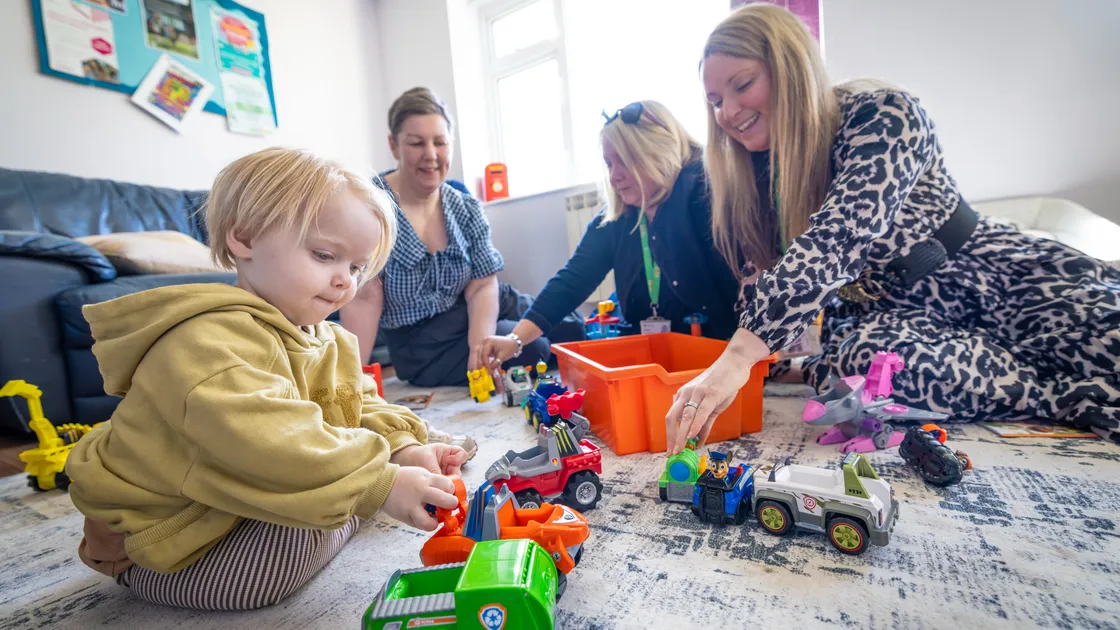
‘SCREENS Away, Time to Play’ has been launched with the latest guidance on screen time for early years children.
The local campaign, built on international research, aims to build age-appropriate screen habits with a particular focus on hand-held devices such as smartphones and tablets.
Experts say that for children under two years, no screen time is best, and for two-to-four years olds, up to one hour a day but split into smaller chunks, and always supervised.
Specialist early years speech and language therapist Zara Betts said there was now enough research and evidence to provide guidance that parents can follow.
‘The advice is to delay as long as possible,’ she said.
‘There are also tips on what content to watch.
‘There has been a lot in the news about YouTube Shorts, which can be harmful content that is quick and fast paced.
‘If you’re watching something with a storyline, that can teach emotional development and storytelling, which is going to be much more beneficial for children, like CBeebies programmes, which are designed by specialists and psychologists to aid child development.’
The exception for children under two is video calls with friends and family, which makes connections and builds bonds.
The guidance is focused on hand-held devices, not necessarily television.
It is considered that TV is a more social thing, children tend to have an emotional reaction and engage in the storyline, whereas when a child goes on a device, the emotion disappears and it is a more solitary activity.
Emotions return when the device is put away, but continued use forms a cycle that proves hard to break.
Stories on channels such as CBeebies have a beginning, middle and end structure to them and it is slower. Early brains cannot take the pace of content on social media, short videos and their overwhelming sounds and lights, and brain activity and connections are not being made.
‘We know that there’s digital technology everywhere, it makes our lives easier, but we want parents to think about those key moments with their children and how they can switch off from technology and model good behaviours,’ said Public Health associate director Alex Hawkins-Drew.
‘What we don’t want is a society that has grown up seeing their parents fixed to devices, whether that be work, checking the utilities or anything that’s important while trying to engage with their child.
‘We need to go back to those basics, the interaction with the child and finding those times in the day to put your device away and interact with your child, but other times where you can do those things and it’s not going to impact on your relationship with the child and their development.’
She added that the more time children spend on screens, the less time they are being active, and when activeness is not embedded, health professionals see the sedentary lifestyle continue and the risk of childhood obesity increases.
The guidance is formed from research discovered about the parts of the brain that light up when on a device.
‘We’re constantly learning about early brain development and with the latest research coming out, it’s really clear how smartphones are changing the architecture of the brain,’ said head of early years Ruth Sharp.
‘In early years, we’re all about laying the foundations of early brain development. It’s not about demonising digital technology, or making parents feel guilty, but we want to give information to parents and carers to make informed choices and giving ideas of swapping them out.’
For children under two years, alternatives to screen time include talking, reading, singing, exploring objects, playing outside, getting them involved with simple chores and planning ahead by bringing toys or books when out and about.
For those aged between two and four, advice is to keep screen time neutral, and not to use it as a reward or punishment, to avoid using screens to calm or distract before bedtime and to model healthy habits, removing screens from mealtimes, bath time, bed time and bedrooms.
Other alternatives include playing outside and encourage waiting and creativity, using free play to develop problem-solving and patience.
In the coming weeks, an independent survey about smartphone usage in schools led by the University of the West of England will gather views from primary and secondary school students, parents and staff across Guernsey and Alderney, informing future policy alongside public health guidance and World Health Organisation evidence.



You need to be logged in to comment.