

The UK needs to become more competitive, and far more business-friendly, if it hopes to escape from a spiral of debt.
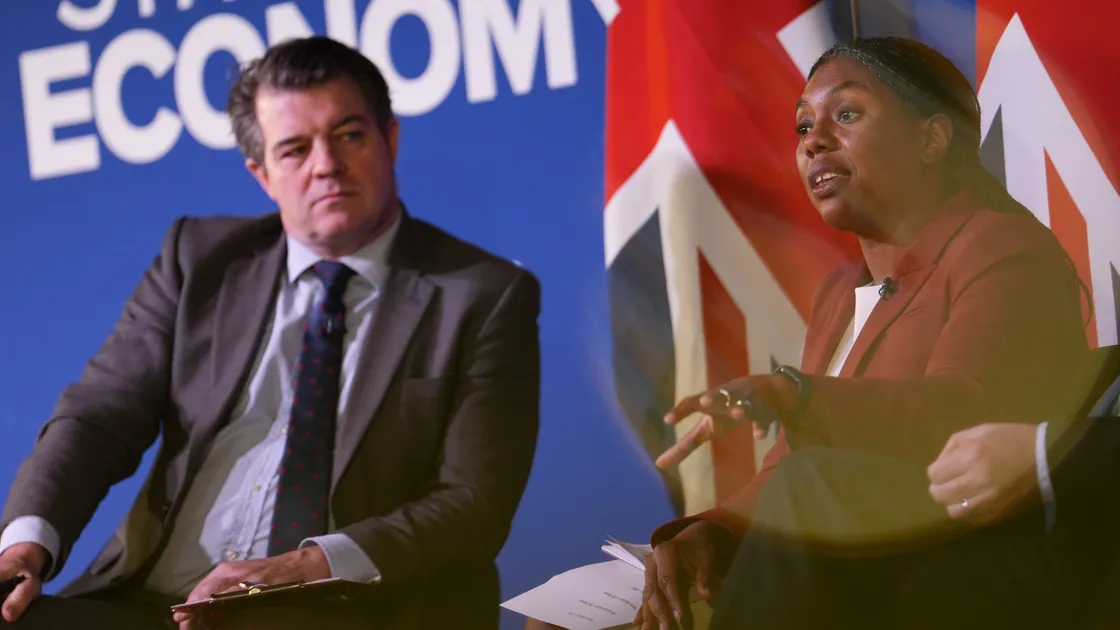
That was the central message from a leading economics commentator during a visit to Guernsey to speak at a lunch hosted by the think tank Gpeg.
Liam Halligan accepts the current Labour administration received a difficult economic inheritance from its predecessors, but is highly critical over the way it has gone about tackling it.
He insists they have made a bad situation much worse.
‘Pretty much their first act in government was to massively ramp up debt and tax levels. Increasing National Insurance contributions for employers – which is a tax on jobs. Labour had a difficult fiscal inheritance, but they’ve made a bad situation considerably worse, and now the UK is in a situation where tax levels are so high that we are actively stifling enterprise.’
The senior economics commentator for the Telegraph Media Group accepted that immediate tax cuts in the UK were simply not practical, given the state of public finances, but insisted that clear messages were needed now that this will be the direction of travel when circumstances allow.
Mr Halligan said that was particularly important in relation to corporation tax.
While he is quite open about the fact that he was not a big fan of George Osborn’s actions as chancellor, he believes this was one thing he got completely right.
‘Osborn said in 2010 that he wanted to get corporation tax down from 27% and he did. Iteratively over the years he got it down to 19%, and guess what? As corporation tax in the UK went down from 27% to 19%, corporation tax revenues went up. Not only in nominal terms, in pounds and pence, but it went up as a share of GDP even at a considerably lower tax rate.’
The man once described by former Chancellor Nigel Lawson as the best financial journalist of his generation would like to see this sort of approach repeated, but he also had a warning for those politicians on the right of British politics.
He urged them not to promise tax cuts before they had clearly demonstrated their capability to slow the rate of growth in public expenditure.
‘We’re in such a fragile situation now that we have to demonstrate our determination to control our public finances, then bring in tax cuts gradually to move to a different path. We need to move to a virtuous circle of falling tax rates, higher growth, and actually more tax revenues to pay for public services.’
One of the UK prime minister’s big ideas for helping to stimulate economic growth is to reset the country’s relationship with Europe and move closer to the EU. But that is not something that Mr Halligan thinks will help to move the dial on growth. He pointed out that the UK’s economic performance had been close to the EU average since Brexit, and that its worldwide exports have held up well.
Rather than any form of reintegration with the EU, he said he would like to see the UK using the freedoms created by Brexit to push for less regulation, and more business-friendly policies, which would help to drive growth.
He was very cynical over Sir Keir Starmer’s reasons for wanting to be closer to Europe.
‘The only reason is he wants to rejoin the European Union,’ he claimed.
‘It’s nothing to do with policy or economics, and it’s everything to do with his own positioning of the Labour Party. Labour is desperate to hold together its very fragile coalition between working people and frankly, educated, but not always very smart people, across some parts of southern England – the university towns – the so-called progressives.’
The economist warned that exactly the same sort of desire to keep all sections of the Labour Party happy, and supporting the current leadership, could lead to difficulties for offshore finance centres like Guernsey.
He said that offshore finance was such a bugbear for the left of the Labour movement that it could come under fire from the leadership simply to appease this section of the party. He compared finance centres to fox hunting, or private education, in warning that it could be used as a pawn to keep Labour’s left wing on board.
Mr Halligan lived in Moscow for a time and keeps an eye on the Ukraine War.
Many commentators have opined that it might well end up being the economic difficulties now facing Russia which forces the country to compromise. Some even feel those economic pressures could spell the end for President Putin’s time in power. But the man from the Telegraph Group sees it rather differently.
‘We talk a lot in the West about how the Russian economy is weak and about to collapse. If you talk to international bond investors, that’s not the case. The Russian balance sheet is pretty strong. They’ve got very little net debt on their balance sheet.’
On the other side of the world, Mr Halligan took a positive view on the ‘Trump tariffs’. He said that he felt that the US president was absolutely right to show his displeasure over countries being far more protective against US exports than America was over theirs.
But he suggests that tariffs were simply too blunt a weapon, which would lead to higher prices in the USA, particularly for important commodities like steel.
‘But I think these tariffs will be much less historically important than we have been led to believe.’
Mr Halligan believes that the real danger for all Western economies, including the UK, lies with China.
‘They’re way ahead when it comes to renewable energy. They’re way ahead when it comes to rare earths and battery technology. Unless we are really careful we’re going to end up giving away our entire car market to cheap, subsidised EVs from China. I think over the next three-to-five years the massive influx of Chinese goods in Western Europe is going to become a major talking point. We’re going to be talking a lot about China’s economic might.’