

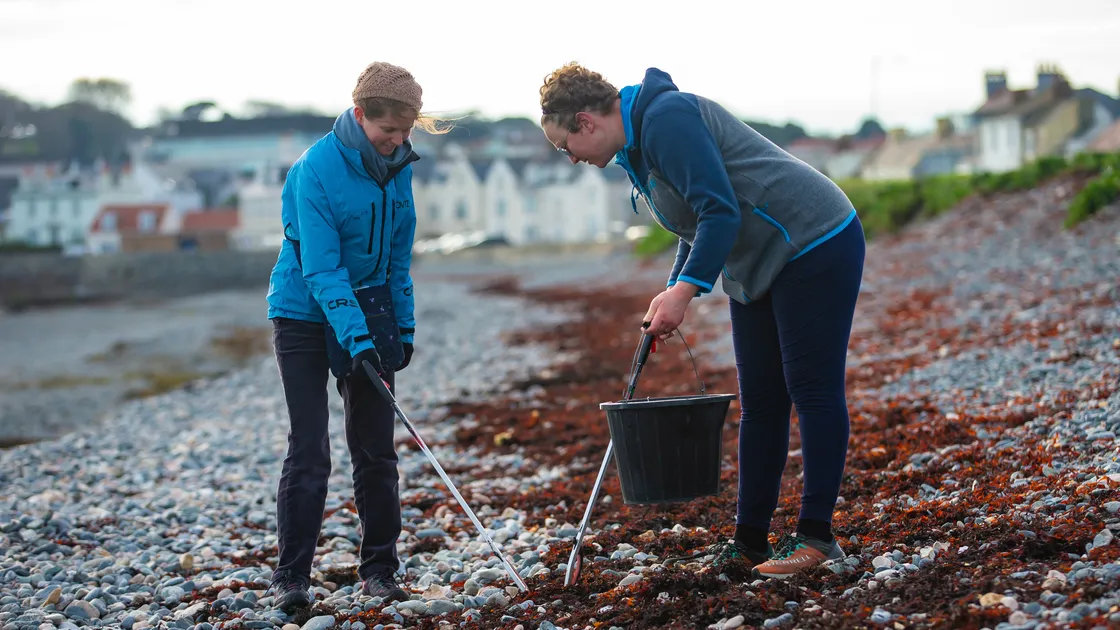
Last year, more than 30,000 items were found around the island’s coastline, with an average of 1,005 items per mile, according to the latest annual report from The Clean Earth Trust.
Nearly half of those items were estimated to be from public littering, and more than three-quarters of it was plastic. The findings came from the local charity’s fifth annual Beach Clean Project, where nearly 1,000 volunteers were involved in beach cleans at 25 different locations.
‘We’ve been doing the Marine Litter Report now for five years,’ said the trust’s policy officer Paul Bugden.
‘It would be lovely if we could say that all our hard work has reduced the impact of litter on our beaches by 50%, but it’s probably not realistic to expect that. The figure is just a little below the average for the previous years, so it’s not really showing a measurable decrease, which is disappointing.
‘But, whether it comes from passing ships, or what we call public source – waste is constantly being produced. So the best we can perhaps hope for is to maintain a balance, and at least we’re doing that. Clearly, there’s more work to do – I think we need to focus on education.’
More than 7,000 cigarette butts were collected, representing a potential £498,820 in littering fines.
‘We need to improve the enforcement of the littering laws,’ said Mr Bugden.
‘Cigarette butts are always in the top five types of items that we find every year, and we do want to explore with States whether things could be done to reduce smoking around our shores.’
The ‘worst’ clean-up saw nearly 50kg of waste taken from the beach at Chouet. Average items collected from a beach clean were 359.
The top five items most collected were cigarette butts, plastic pieces, plastic food wrappers, scrap paper and pieces of polystyrene.
The Clean Earth Trust currently facilitates bi-weekly public beach cleans, and is awaiting planning permission to install four Fill-a-Fish sculptures around the coastline, where people can dispose of their plastic water bottles.
Mr Bugden noted that the report’s 30,156 figure did not include the beach cleaning efforts of other groups or individuals, and that the true amount of local marine litter would be significantly higher.
The full report is available at cleanearthtrust.org/marine-litter-report.
Plans put in for marine-themed bin sculptures on the coast
Planning permission is being sought for four marine-themed bin sculptures for the Fill-a-Fish project.
The project was launched by Suntera Global, sponsors of the Clean Earth Trust locally, in the Isle of Man to raise awareness of protecting marine life and ensure the safe disposal of plastic items.
The sculptures, designed as bins, will receive plastic bottles which may otherwise end up on the beach or in the sea.
A competition entered by local primary school children decided the four winning designs.
Planning permission has been applied for a hammerhead shark bin structure on the grass just north of Mim’s kiosk at Cobo, a hermit crab on the broad boulevard beside the southern car park at L’Eree, a fish at the grassy area opposite the entrance to the slipway at the north end of Belle Greve, and a turtle on the grass north of the car park adjacent to the slipway at Chouet.
The engineering department at The Guernsey Institute has begun creating working drawings of the finished sculptures based on the winning designs and aims to have them completed by the summer of next year.
The sculptures will be made of high-quality materials and will be galvanised to ensure durability for at least a decade.
Government in the Isle of Man accepted responsibility for the bins once they were installed, and the Clean Earth Trust has enquired whether the States would do the same, which would involve States Works periodically emptying them.
The final designs of the bins are not expected to be known until June, based on project scheduling.




You need to be logged in to comment.