
From the early 19th century, the gun was fired at noon and 9.30pm to signal the time, indicating when soldiers of the garrison should return to their barracks.
The practice ended in 1923, and the cannon used for it disappeared over the course of the Occupation.
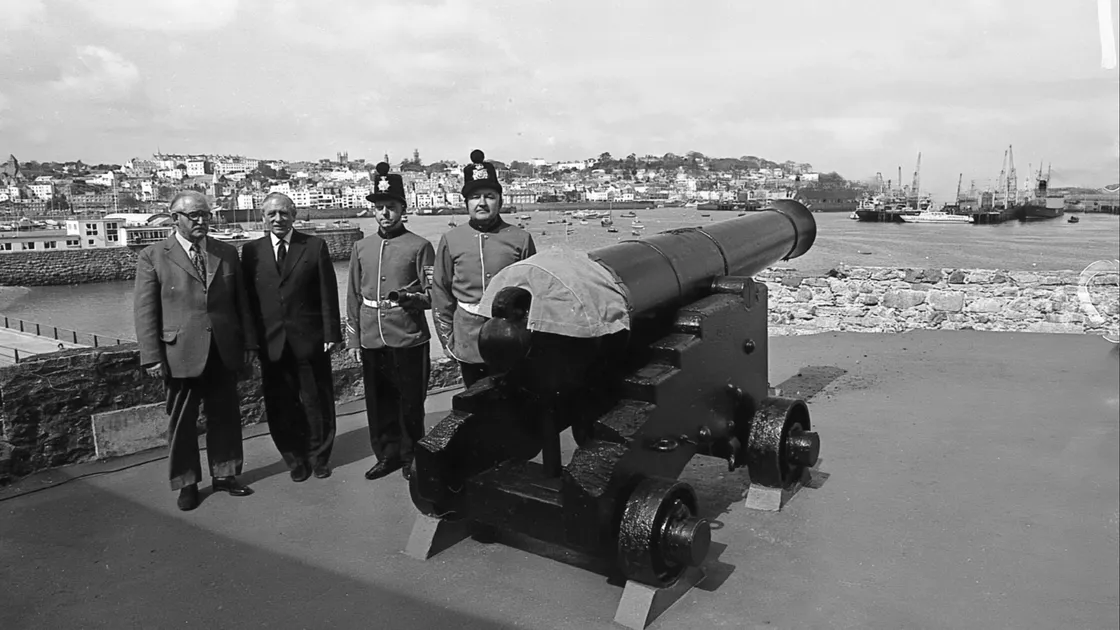
In 1976 the States Ancient Monuments Committee decided to reinstate its daily firing over the summer months, and it has stayed so ever since. Following talks with ‘experts’, the Evening Press of 1976 confirmed, the committee decided to use a cannon cast in 1799 in its stead.
Bailiff Sir John Loveridge was invited to make the first official firing on Monday 5 April. He was accompanied by Arthur Hamon, president of the Ancient Monuments Committee.
The 36-pounder cannon was primed for the occasion by Eric Harradine, formerly of the Royal Electrical and Mechanical Engineers, and Stan Simon, ex-Royal Air Force, who were ceremonially dressed as master gunners of the Royal Guernsey Militia.
Standing guard was 11-year-old Richard Broughton, also dressed in militia garb.
Also to mark the occasion, an RAF Nimrod from 201 Squadron flew over Castle Cornet as the gun fired.
The Press reported that ‘the gun behaved faultlessly’.
The current noonday gun uses a modern saluting charge of about 25g, which is placed 12 to 18 inches down the barrel and detonated electronically.
In service, the gun would have fired a 32lb iron ball to a range of about 2,500 yards.
Organisers are auctioning off the opportunity to fire the noonday gun at Castle Cornet on Liberation Day this year. The auction is now open with a minimum bid of £950.





You need to be logged in to comment.