

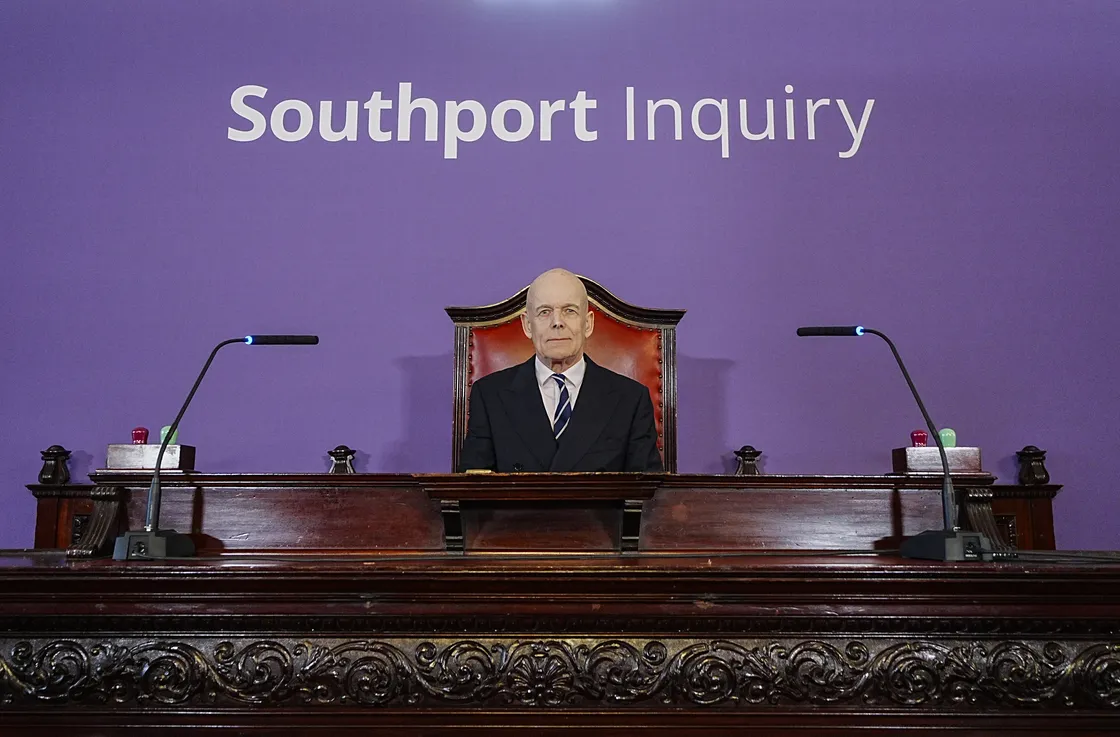
Sir Adrian Fulford said that Axel Rudakubana was able to carry out the Southport atrocity because of the failures of multiple agencies and the ‘irresponsible and harmful’ role of his parents. He said that the culture of state bodies failing to take responsibility had to end.
His public inquiry report concluded that the attack was foreseeable and avoidable, with systemic failure in an absence of risk ownership, critical failures in information sharing, a misunderstanding of Rudakubana’s autism diagnosis, a lack of oversight into the killer’s online activity, and the significant failings of his parents to take action, including over the stash of knives and weapons collected in their home.
Sir Adrian, 73, was a boarder at Elizabeth College from 1966 to 1971, where he was a contemporary of future Bailiff Sir Richard Collas.
He was a few years behind Sir Geoffrey Rowland, whom he followed to Southampton University to pursue a law degree, before being called to the Bar in 1978. He became a Queen’s Counsel in 1994 and a High Court Judge in 2002. He went on to be a judge of the International Criminal Court for a decade to 2012.
He has an extensive legal background, particularly on issues relating to policing and the criminal justice system, and was regarded as one of the most pre-eminent lawyers in Britain operating in the criminal legal sphere.
In 2021 he imposed a whole life sentence on former Metropolitan Police officer Wayne Couzens for the murder of Sarah Everard.
As chairman of the inquiry, Sir Adrian said that the murder of the three girls – Bebe King, six, Alice da Silva Aguiar, nine, and Elsie Dot Stancombe, seven – and stabbing of 10 others ‘had been clearly, repeatedly and unambiguously signposted over many years’.
He said that the attack of ‘unparalleled cruelty’ happened after a complete failure of Britain’s multi-agency model, and urged the government to establish a dedicated agency to oversee complex offenders such as Rudakubana, who was jailed for life last year after his ferocious assault on the young girls at a Taylor Swift-themed holiday club in the Merseyside town on 29 July 2024.
The teenager, who was 17 at the time, had been on the state’s radar for nearly five years by the time of his attack, which sparked racist riots in cities and towns across England.
Sir Adrian said there was a ‘fundamental failure’ by any organisation to take ownership of the risk the killer posed.
‘Numerous systems that should have provided oversight, assessment and protection were ineffective or inadequately used. Some failed outright.
‘The consequences were catastrophic.’
And he said he had profound concerns about the actions of Rudakubana’s parents, who discovered in the weeks before the attack that their son was building an arsenal of weapons, including knives, a crossbow, petrol bombs and material to make the deadly poison ricin, but failed to report it to police for fear he would be arrested or taken into care.
Sir Adrian also said that he accepted that professionals dealt with Rudakubana in good faith, despite many shortcomings.
‘The frankly depressing – and therefore urgent – matter requiring government attention is this failure, at an organisational and individual level, to stand up and accept responsibility for managing the risk that Rudakubana posed.
‘Far too often, the case was passed from one public sector agency to another in an inappropriate merry-go-round of referrals, assessments, case-closures and hand-offs.’
Several instances where Rudakubana, referred to as AR during the reading of the judgment, could have been arrested or referred to the authorities were missed over the period of a couple of years.
The judge concluded: ‘Rigorously putting out of mind the so-called benefits of hindsight, I have no doubt that if appropriate procedures had been in place and if sensible steps had been taken by the agencies and parents, this dreadful event would not have happened.
‘It could have been and it should have been prevented.’
Sir Adrian added that he would consider in the second phase of the inquiry whether there should be a new power to monitor or restrict the internet use of young people who are believed to pose a threat.
His remit for the inquiry was to examine opportunities for intervention in the years leading up to the atrocity, review how state agencies responded to concerns about the individual responsible, and identify systemic failings that allowed risks to go unmanaged.