

The low turnout at Wednesday’s by-election has been blamed on the States by the architect of island-wide voting.
Just 4,759 voters took part, well under one in 10 adults, as turnout sank to 17.32% of registered voters, the lowest for a deputy’s election in modern times.
Carl Meerveld, who finished second in the poll and missed out on a return to frontline politics by just 62 votes, claimed that turnout could have been ‘dramatically increased’ if the States Assembly & Constitution Committee had not scaled back promotion of the by-election in a bid to reduce the cost from about £200,000 to £75,000.
‘There were some people pushing not to have an election to save money, so what came forward was a proposal to organise it on a shoestring by doing the absolute minimum, and there was really no promotion done by the States,’ said the former deputy.
‘With 11 candidates, they could have printed and distributed a 44-page or 22-page booklet of manifestos, probably for an additional £10,000.
‘The States could have done a lot more with a little more investment. If it had produced a booklet and allowed registrations for postal votes after the booklet had arrived at households, I think participation would have been dramatically higher.’
Two-thirds of deputies backed Sacc in February when it proposed less expensive arrangements for the by-election to replace jailed former deputy Jonathan Le Tocq. Without cost-cutting moves, the committee feared that public and political opposition to filling the 38th deputy’s seat could have led to the by-election being scrapped, a move it considered undemocratic.
A recent survey asked for voters’ views about last year’s general election – the second using island-wide voting – and Sacc is currently considering whether to propose another referendum on the electoral system. Most of the committee’s members oppose island-wide voting in its present form.
Mr Meerveld, who was the face of the island-wide voting campaign when it was backed in a referendum eight years ago, hoped the historically low turnout at the by-election would not be used as a reason to return to electoral districts.
‘This by-election has proved that island-wide voting works in a by-election,’ he said.
‘We had a decent selection of candidates, with 11 people competing for one position, representing the full spread of views in our community. It was a legitimate vote that was representative at least of the people who are more politically engaged. The turnout was actually at the upper end of my expectations because of the lack of marketing and promotion by the government.
‘I still completely support the idea of island-wide voting, giving every voter the choice to vote or not vote for every candidate, and having deputies who don’t owe allegiance to a single parish or district, but who represent the whole island.’
Mr Meerveld also saw the result of the by-election as an indication that most voters remained opposed to a goods and services tax.
During the previous political term, he was a prominent face in a campaign to defeat the GST-plus package, which deputies eventually approved in principle and the current Assembly will debate again this summer.
The winner of the by-election, Ross Le Brun, has been more open-minded to GST-plus and admitted he would prefer it to sweeping cuts in public services or other large tax increases which would fall harder on less affluent households.
Mr Meerveld claimed that Mr Le Brun had made himself the distinctive candidate for ‘a pro-GST crowd and those with a slightly more belligerent attitude towards things’, whereas he himself had lost votes to a larger number of other candidates who shared a similar political outlook to his own.
‘There were eight or nine candidates who were more considered in their approach and were either against GST or saying now wasn’t the right time for GST,’ he said. ‘Nine of us were sharing the votes on that side – the centre-right if you like – whereas the left, pro-GST side really had only one viable candidate. Before I turned up at the count last night, that was the risk I was thinking about.’
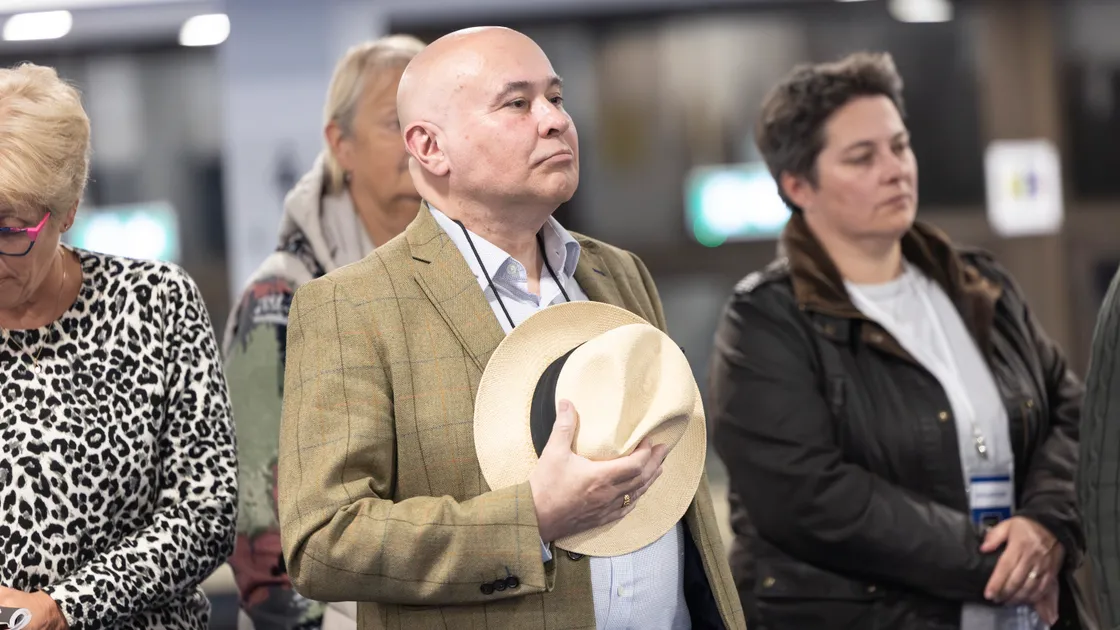
Mr Meerveld arrived at the count, at Beau Sejour, at about 10.30pm, accompanied by one of his closest political colleagues, Deputy Chris Blin, holding one of his trademark hats, and offering to eat it if he was as far away from being elected as the Guernsey Press exit poll had projected earlier in the evening. At that time, officials were expecting the result to be declared within the next half an hour.
The exit poll gave him a vote share of 12%, in second place jointly with Forward Guernsey’s Julie-anne Headington, but a long way behind Mr Le Brun on 26%.
In the hours following, the piles of counted ballot papers, just about visible from the viewing gallery above the Sir John Loveridge Hall, had revealed that the margin between them would be slim indeed. As the interminable half-hours passed, which feel like weeks when you are awaiting your electoral fate, and Wednesday became Thursday, Mr Meerveld’s mood seemed to lighten and Mr Le Brun became visibly more pensive.
When the result was eventually declared, just before 1am, we were both proved right – the exit poll projected Mr Le Brun and Mr Meerveld in the right order, but Mr Meerveld had come within less than 1.5% of winning back the seat in the States he lost at last June’s general election. He was so close he had the right to request a recount.
‘I’m not going to challenge it because I think that would appear petty,’ he said. ‘The likelihood of me gaining 62 votes on this turnout would be very, very low. 62 is a reasonable margin and I just have to accept that as democracy.’
I asked him if the hat he had been saved from eating would ever be seen again at an election, following his two recent defeats.
‘I don’t know,’ he said. ‘I was disappointed when I wasn’t elected at the general election. There were lots of issues I was still very passionate about, such as public sector reform, which has come to the fore recently, the wind farm and fighting against GST.
‘I had been on the inside and able to influence things directly, and since then I have had the frustration of somebody who feels passionately about issues and is on the outside, and your ability to have any influence as a member of the public is extremely limited.
‘That’s why I stood at this by-election. I don’t think my positions and my passion are likely to change. Therefore, it really depends on the circumstances I find myself in at the next election as to whether I want to step back into the fray, if the public want me to at that time.’
Mr Meerveld’s electoral history is unique. Every time he has stood, he has either scraped in or narrowly lost. Nobody else’s political fortunes have depended on such fine margins over such a long period of time.
In 2020, in the first island-wide poll, he survived by 0.5%. Five years later, he lost his seat by less than 1.2%. Yesterday’s by-election is, bizarrely, his most convincing defeat, despite losing by fewer votes than there were spoilt ballot papers.
‘I know that from day one I have been a marmite character, for whatever reason,’ he said. ‘I’m very outspoken, I’m very determined, and unless someone presents a very good argument I don’t change my position.
‘There will always be people in the electorate who disagree with me or dislike me walking around waving flags or dislike the hats I wear.
‘I’m not a broad populist. I don’t pander to populist demands. When I’m campaigning for something, it’s because I fundamentally believe in it.
‘I’m told I lost votes because of my position on abortion laws. But to this day, I would not change that vote, and I still object to the principle that a pregnant woman can self-abort a child up to the moment of birth without it being a criminal offence.
‘I believe the unborn child needs protection from the point where it is viable, and I stand by that.
‘People have attacked me online viciously over that, and I have lost votes, but it doesn’t mean I would ever change my position.’
The issue Mr Meerveld said he would most miss being involved in as a politician this term was the anticipated development of a wind farm off the island’s west coast.
‘My concern is that it has gone completely below the radar,’ he said. ‘This should be the project that the States is emphasising above all else because if it’s successful it takes away the requirement for GST.’
He believes it could generate three times the annual revenue of GST.
Despite his latest electoral setback, he has not given up becoming involved again in that project, or in other States projects. Whether his career as a deputy has been involuntarily retired, or merely paused, he hopes not to be completely in the political wilderness until 2029.
‘I’m now in a position, with three years until the next election, where I intend to approach deputies or groups within the States and offer my services if they’re looking for someone to serve on projects I’m passionate about,’ he said.
‘My desire to do what I believe is right for the community and put my effort into it is not diminished by the fact that I wasn’t elected.’