
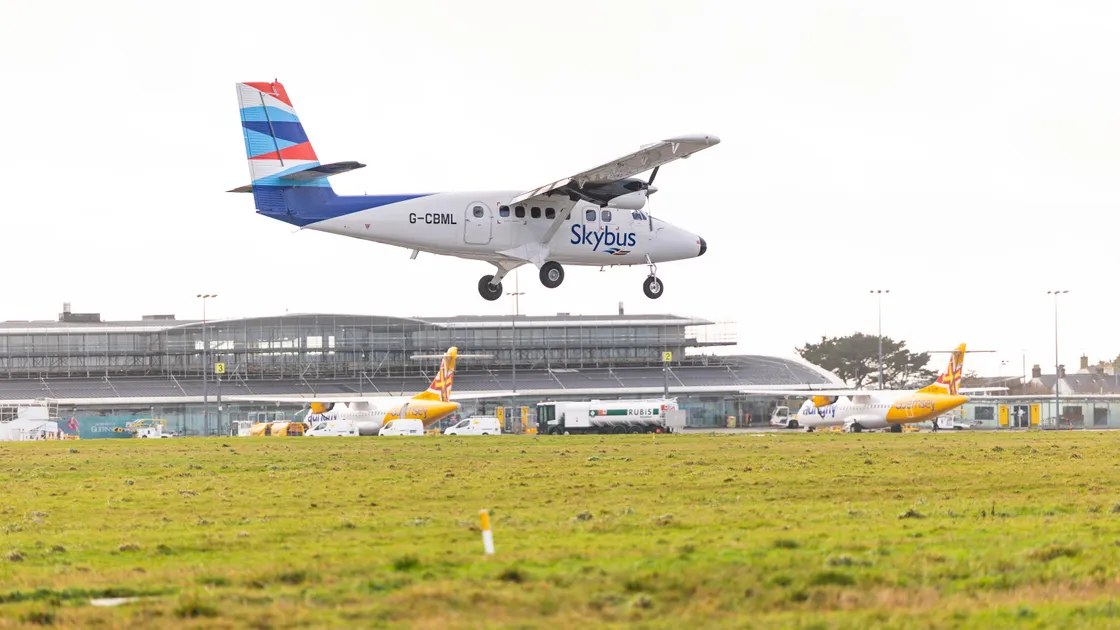
Aurigny CEO Nico Bezuidenhout and chief commercial officer Philip Saunders were joined by Skybus managing director Jonathan Hinkles for an 80-minute interview on internet station Riduna Radio.
‘I can’t give you 100% commitment that every flight will be on time and there will be no cancellations,’ said Mr Bezuidenhout.
‘But we have taken all the steps necessary to ensure a resilient service. I believe we are as ready as we can be for a successful summer.’
The contract between Skybus and Aurigny came into effect in November. The agreement was for Skybus to provide and operate two Twin Otters for Aurigny routes, and both would be permanently based in Guernsey. But Riduna Station manager Ian Taylor pointed out that as of yet, there had only been one in regular use, while the other was used for crew training in Land’s End.
Mr Hinkles said the second aircraft, G-DOYL, has been used in Alderney more since Easter, and would continue to be seen more often. The aircraft is now fully certified, despite initial delays, and will join Aurigny services at the end of summer after being fitted with de-icing equipment.
‘From late summer, that’s when you’ll have both yellow-coloured aeroplanes,’ he said. ‘The paint slots are booked in September and October.’
Mr Bezuidenhout and Mr Saunders both maintained that switching the island’s aircraft from the Dornier back to the Twin Otter was proving to be the right decision, with the aircraft offering increased resilience and reliability. Mr Bezuidenhout said that compared to this time last year, there has been the same amount of delays recorded – 31 flights – since switching aircraft, despite ‘exactly double’ the amount of medevacs, which take priority over scheduled flights, and weather disruptions.
‘Excluding weather disruptions, the service has been on par,’ he said.
‘We have control over crew availability and technical dispatch reliability, so we don’t get a “get out of jail card” for those types of measures. But when it comes to weather – there’s not much we can do. So that is differently measured. And this year’s weather disruptions more than doubled – that’s about 180 flights, purely down to the weather.
‘In the last two months, I think we had 17 medevacs. Exactly double the amount in the first five months of this year compared to the same period last year. But the impact of weather conditions plays a much more significant role in cancellations. The Twin Otter has been a more reliable asset that the Dornier, from both a technical and flight operations perspective.’
Mr Hinkles said that he had been surprised by the amount of medevacs in Alderney, and that it might be worth having a dedicated medevac aircraft in the future.
‘As a relative newcomer to the air service here, the frequency of medevac operations is greater than I would have ever anticipated,’ he said.
‘And to me, that is the largest single cause of the issues that we have that actually impact on customers. If frequency is going to remain at this kind of level, I think that launching a dedicated medevac service is a discussion we do need to have. But that’s an affordability question within government.’
He agreed that the introduction of the Twin Otter had improved Alderney’s connectivity.
‘If you look at a typical day, it’s not uncommon to see the last flight arriving into Guernsey before it was scheduled to actually leave Alderney,’ he said.
‘The schedules are entirely realistic. The performance of the service has been strong.’
To combat a global shortage of pilots, Mr Hinkles said there was a long-term plan to base the crew for the Skybus services, operated by Aurigny, in Southampton. He said the first group of Southampton-based pilots were ‘already feeding through the network’.
On top of this, Mr Bezuidenhout said the airline was considering launching an Alderney route that starts from Southampton.
‘Pilots are highly mobile professionals,’ he said. ‘We’re finding it really difficult to attract pilots to relocate to the island due to a number of issues – including the cost of living, availability of housing etc.
‘We are competing for the same pilots in the global pool of airlines, so that is why we implemented a commuting scheme across ATRs and why we are looking at the same kind of structure for the Twin Otters, and whether or not we can launch a schedule starting from Southampton. There’s a commercial benefit there.’
Mr Saunders said the winter schedule was set to be out within the next few weeks, and that it would include promotional offers. In the midst of the ongoing crisis in Iran, he said the airline was in ‘a secure position’ with jet fuel supply and able to work out future pricing by simply adding a £2 fuel surcharge.
‘We have responsible hedging processes as well,’ he said.
‘So we’ve certainly not passed all of the costs of fuel onto our customers. Looking at the winter schedule provides us with more opportunities to be more creative, and making sure there are also attractive options on a promotional basis.’




You need to be logged in to comment.