
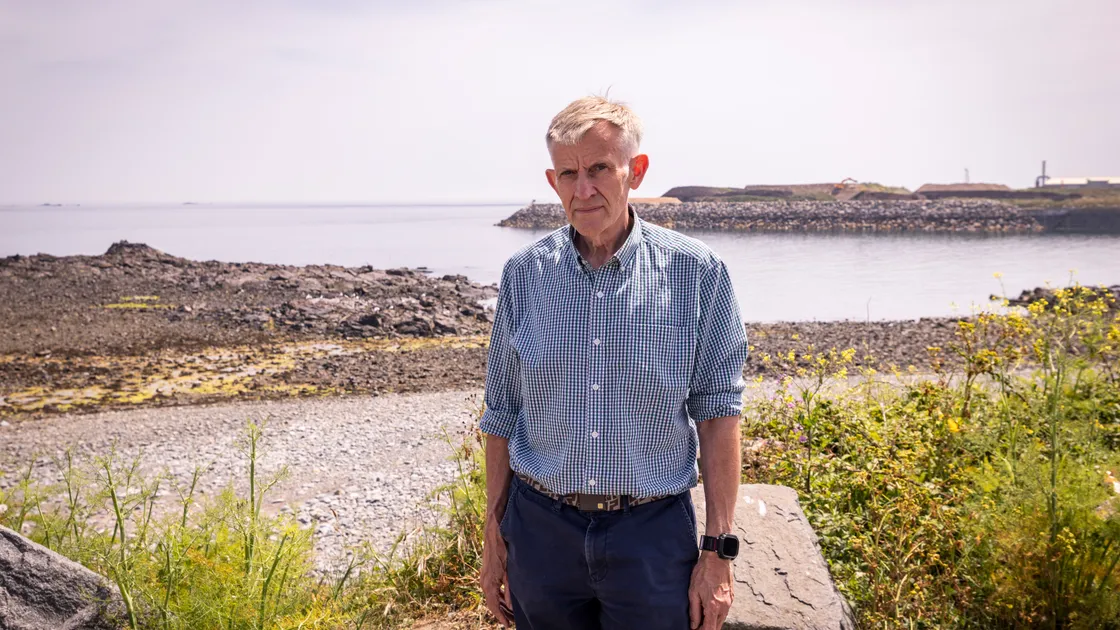
In a strongly-worded letter to the Policy & Resources Committee, Peter Watson has laid bare his deep frustration at what he sees as the anomalous status of the GDA and its relationship with the States.
‘I accepted this role with the understanding that it would be a lean, empowered vehicle for change. Instead it has been relegated to the status of a government quango, hamstrung by the very system it was designed to improve,’ he wrote.
A previous P&R came up with the concept of a development agency five years ago.
Mr Watson has led the GDA for the past three-and-a-half years, during which time it has drawn up an ambitious master plan for the regeneration of the area around St. Sampson’s Harbour.
But he said that if any of it was to be delivered, then the whole mandate of the GDA, its powers, and the way it operates, need to change.
Indeed his resignation letter carries the blunt title: ‘Set up to fail, strangled by process, the Guernsey Development Agency’s impossible mandate, a letter in hope of change.’
The outgoing chairman said that while his fellow directors on the GDA may not yet have reached the point of resignation, he knows that they shared his frustrations. And he is particularly worried that if something does not change soon, there could be an irreparable loss of talent.
‘We are fortunate to have two fantastic engineers, one who is Guernsey-born, and the other a civil engineer, who have done prior work on marine and seafronts, both have managed £500m. contracts. That is a skill set that is very rare, and we will lose them if the situation does not change,’ he said.
He goes on to outline what he believes those required changes are, highlighting the need for the GDA to have custodianship of the relevant land assets, more autonomy and delegated powers to act, under its Political Oversight Group.
Mr Watson has also singled out a lack of consistent funding as being a big problem.
His resignation letter highlights that ‘despite being tasked with major development, the agency holds no property assets and has been forced to fight a continuous, exhausting battle for every penny of its agreed budget. Even then, it is not delivered on time, forcing the delay of vital planning works.’
Mr Watson’s resignation letter contrasts that situation with how he believed things should work.
‘The GDA needs a mandate that aligns with physical, financial, and political reality. In an ideal world, the GDA would have shovel-ready, commercial projects to progress with private finance, the profits from which would support the development of public infrastructure.’
Despite stepping down, Mr Watson, who has lived in the island for more than 30 years and is best-known as the founder of Vets4Pets, said he still hoped that the GDA can deliver on its vision.
But he stressed that for this to happen it would need a fresh mandate from the States and a debate, pushed by Policy & Resources.
He said that he hoped his resignation would act as a catalyst to bring this about, claiming it would be far more likely to achieve progress than the States taking responsibility for development on the east coast back in-house. ‘For 46 years, the States and the civil service have not managed to produce eastern seaboard development,’ he said.