

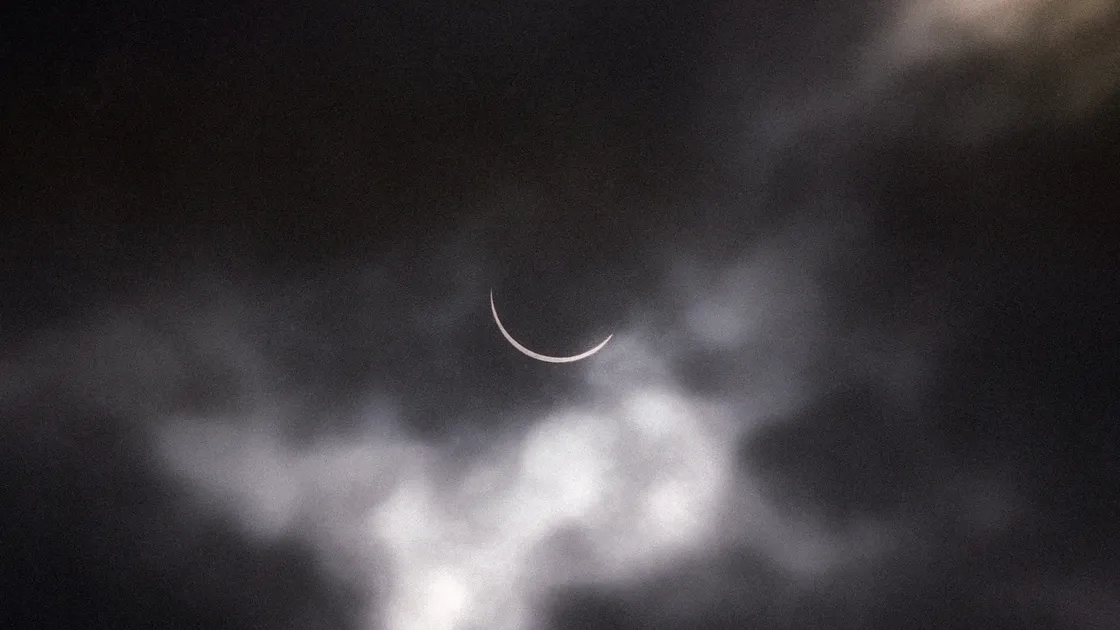
Elaine Mahy, secretary of La Societe Guernesiaise’s Astronomy Section, is particularly looking forward to witnessing the transition.
‘I think it will look really cool,’ she said.
‘To still see that tiny crescent as the moon moves from the left, over the top and down to the right. It will be a nice transition, you will get to see most of the circumference of the moon’s crescent.’
The partial eclipse will begin at 6.20pm, with the moon gradually moving across the sun before reaching its maximum at 7.17pm.
While the islands will not experience totality, the depth of the eclipse means the sky is expected to darken dramatically, taking on the appearance of deep dusk, and – depending on conditions – the air temperature may drop and wind speed may pick up.
For the best view, Ms Mahy recommends finding somewhere with a clear western or north-western horizon. Elevated and open locations with limited artificial light pollution will provide the best conditions.
‘Anywhere you can normally watch the sunset from,’ she said.
‘I expect the west coast is going to be totally manic, if you can see it from you are, I’d stay and watch from home. You don’t need to get to the coast. Just anywhere where you can see low-lying land, with not much in the way.’
Areas between Pleinmont and Pembroke should offer good vantage points, although a spring high tide means beaches will not be available.
La Societe has shared another reason to keep looking skyward tomorrow night.
As night falls, the Perseid meteor shower will be reaching its annual peak – bringing the sky alive again in ‘one of the year’s most reliable and impressive displays.’
From late evening into the early hours of tomorrow, observers may see between 60 and 100 meteors an hour, while those with a good, dark view south may also be treated to the Milky Way.
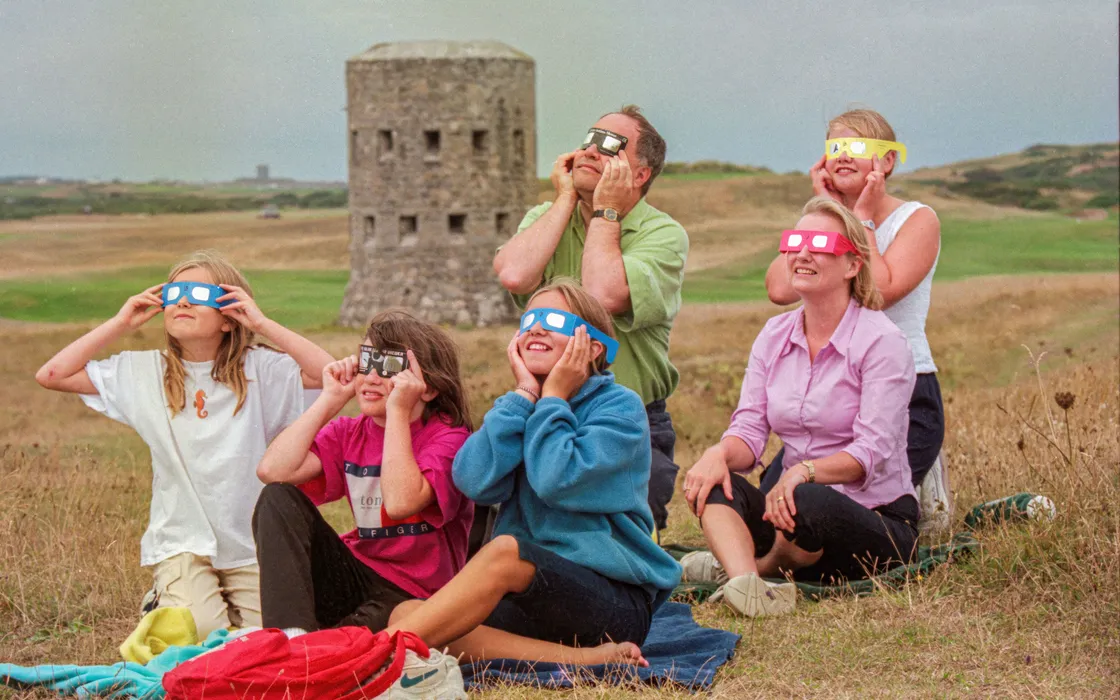
The 2026 eclipse is the most significant partial eclipse visible from Guernsey since the event of 1999, when the eclipse was total in Alderney and reached up to 99.9% in Guernsey. Ms Mahy remembers it well.
‘I was stood on the breakwater in Alderney,’ she said.
‘There were lots of people around with their cameras. I took lots of pictures too, but of course they were all printouts and I have no idea where they are now. I remember there was a mackerel cloud over the sun, which remained there throughout, and it actually worked out quite well. I had glasses on, but it helped us to watch without worrying about too much about the damage. It was very exciting, and I’m looking forward to seeing it again. We’re just hoping that everything will work out.’
Guernsey’s next total solar eclipse is on 3 September 2081.
In the meantime, the island can expect partial solar eclipses next August, in January 2028, and again in June 2030. An almost total lunar eclipse is due in just over two weeks’ time, an hour before dawn on 28 August.
Tonight’s eclipse path
At 6.20pm, the sun will be due west and around 20 degrees above the horizon, when observers using safe viewing methods will see a small ‘bite’ appear in its lower-right edge.
By 6.50pm, the sun will be visibly misshapen and the growing shadow of the moon may bring sharper-looking shadows. There might be a drop in temperature and birds might fall silent.
At 7.17pm, the eclipse will reach its maximum. At that point, the sun will be low in the west north-western sky, just 11 degrees above the horizon. The slight crescent will appear to rotate briefly.
After maximum eclipse, the crescent will gradually widen until the sun becomes whole again at about 8.10pm, when it will be only three degrees above the north-western horizon. Sunset follows at 8.33pm.

You need to be logged in to comment.