

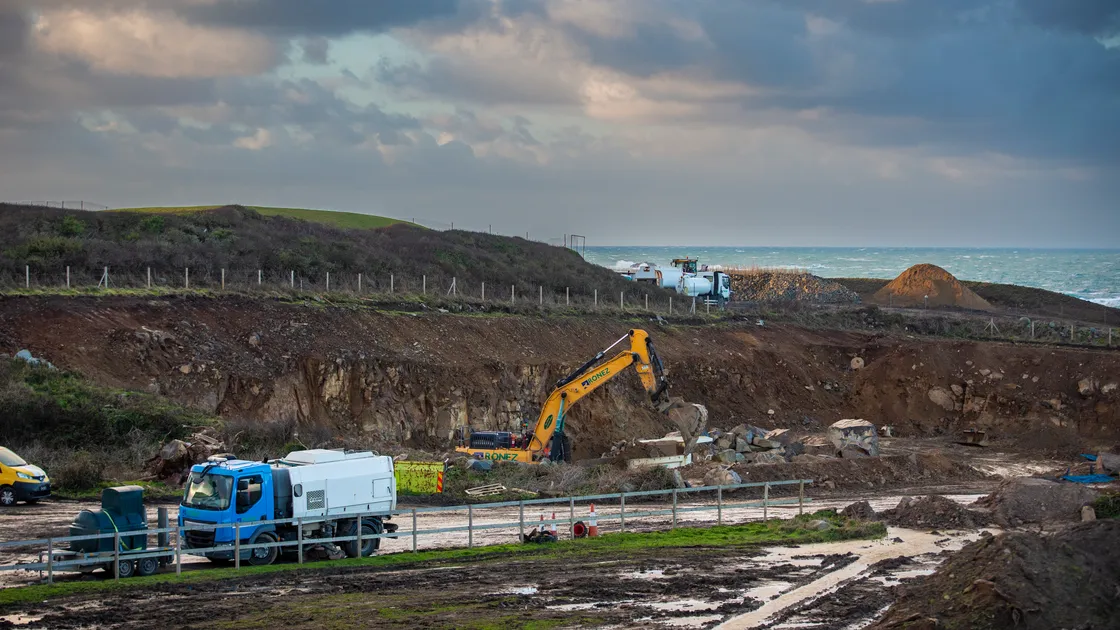
The price of concrete products in Guernsey can be double that which would be paid in the UK, the Guernsey Competition and Regulatory Authority has found.
But, it said, higher prices alone do not mean unfair prices. And higher did not automatically mean ‘excessive’.
It said that Guernsey suppliers faced structurally higher costs than their UK counterparts, including shipping raw materials, higher labour costs, smaller production volumes with no economies of scale, and a lack of quarry infrastructure.
The GCRA was directed to carry out the review by the States. It accepted that concrete and aggregates played an important role in the construction sector.
‘Concrete and aggregates sit at the very start of the construction supply chain, so when prices are high, the effects are felt everywhere – from housing affordability to the cost of public infrastructure,’ it said.
The GCRA said that the question it sought to address ultimately was not whether prices were higher, but rather whether prices were ‘excessive and unfair’.
COMPETITION LANDSCAPE
Ronez is the only supplier of ready-mix concrete in the island, owning and operating the only concrete batching plant, producing RMX, which needs to be used within two hours of being mixed, and so cannot be imported.
Concrete blocks and other concrete products are seen as no real substitute, leaving the company as the dominant player in the market.
Back in 2002 the States considered whether a second entrant could come into the market locally and found against the idea. Those views still pertain today, given the lack of scale and consistent throughput of construction projects locally.
Self-supply of RMX could be an option, and was used by Lagan Construction while building at Guernsey Airport, but such major projects are few and far between locally.
Ronez faces more competition for other concrete products, but benefits from the cost advantage of manufacturing locally rather than importing, and there are alternative suppliers available for aggregates, both locally and imported.
Prices
The GCRA investigation found ‘substantial differences’ in the prices of building materials locally compared to the UK, and were often linked to production costs in Guernsey being higher than those in the UK.
It found that eight of 15 concrete and aggregate products were at least 100% more expensive in Guernsey than in the UK. Ronez blamed economies of scale in the UK, higher labour costs in Guernsey, and additional shipping costs.
The GCRA found that the returns earned by Ronez were well above its cost of capital, approaching double what would be expected, but could not say this was ‘excessive’ pricing. It assessed the economic profits of Ronez across the Channel Islands – it also has a significant presence in Jersey – using Roce (return on capital employed), which measures how efficiently a company generates operating profit from its total capital base, and Wacc (weighted average cost of capital), the average rate of return a company is expected to pay to all its security holders to finance its assets.
It found that the company’s Roce was often 10-20% ahead of its Wacc and that its operating profit had increased, but the difference between the two was unlikely to be significant enough or to have persisted long enough to support a finding that the prices charged by Ronez could be considered excessive under local competition law.
Although prices had increased well ahead of inflation – typically between nine and 20% a year – this was ‘materially’ lower than would be seen in cases of excessive pricing, and were at least partially attributable to rising unit costs.
‘While profitability exceeds the estimated cost of capital and the market is structurally concentrated, the scale, tempo and economic context of the price increases differ materially from cases in which competition authorities have found unlawful excessive pricing,’ the GCRA said.
GCRA’s summary
Ronez’s returns are well above its costs of capital, with a high level of profitability on what were likely to be already-high costs of construction materials coming into the island.
The impact of high margins together with high initial material costs gets compounded at each stage of the supply chain. Margins on margins cause a ‘snowball’ of costs leading to high end-user prices.
But the GCRA said that there was no pattern of behaviour that is anti-competitive under competition law, and instead policy interventions would be the best way to look to drive down prices.
‘Ronez’s position is not the result of exclusionary behaviour – it is the result of geography, scale and economics,’ it said.
What can the States do?
The GCRA suggests two ways that the States can positively influence market outcomes in this sector – as a policymaker, where it could use regulatory-type tools; and as a customer of the construction sector, where its influential position as a large purchaser it could influence market conditions by being a standard-setter.
It said it had tested its ideas in the sector with other parties interviewed as part of its work.
They include pushing for greater transparency around costs, volumes, capacity and delivery performance; considering market access, strengthening resilience and reducing reliance on a single operator and widening sourcing options; and taking a new approach to procurement, addressing concrete costs directly and specifically with a main contractor rather than just as part of a contract price.
Ronez's view
The company said it was unsurprised by the regulator’s findings.
‘We welcome the conclusion that Ronez’s market position is not the result of exclusionary behaviour, but that we face structurally higher costs than UK suppliers, that our prices are not excessive and have generally increased in line with or more slowly than for comparable products in the UK. These are the realities of operating in a small island market, rather than anti-competitive behaviour.’
The company said it had invested millions locally over several decades to provide an essential service to the local building industry and economy, including with the development of the new quarry at Chouet.
‘All commercial businesses will require a return on investment as a profit level above their cost of capital to sustain further investment. This allows Ronez to continue to invest in Guernsey for the benefit of the island’s economy.’
It said that the cost of concrete and aggregates would typically make up between 5 and 15% of the build cost of a new-build residential unit and less than 5% of the sale price, and that other significant cost elements would impact the overall delivery cost of any development.
The company said that it would be pleased to be involved in the development of any future proposals to achieve better outcomes for the local community across construction in the island.