

An issue is creeping up on States members which most of them will probably never have even thought about.
Thirty years have passed, and the Cold War has ended, since deputies last had to worry about defence spending, but it is now set to return to the local political agenda.
For some time, a small group of senior politicians and officials have been quietly preparing for a possible approach from the UK government about Guernsey’s contribution to the national defence budget.
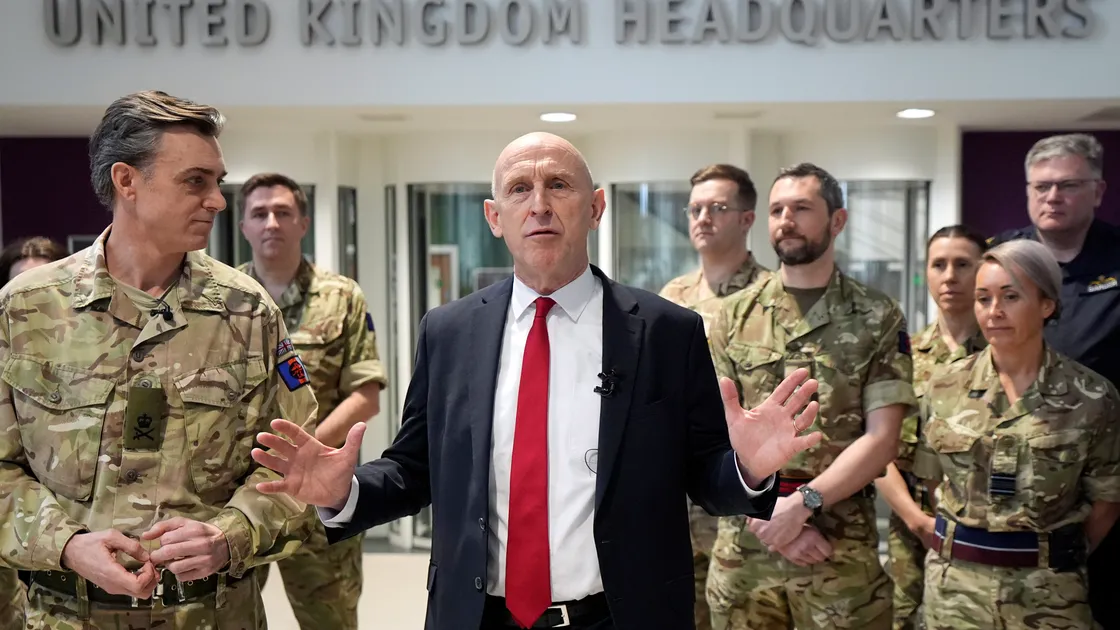
An approach now looks even more likely, and may happen sooner rather than later, following the surprise appointment as chancellor of John Healey. He walked out of the previous government in despair at inadequate defence spending and is expected to throw the Treasury’s weight behind a new era of rearmament.
‘You heard the prime minister say this afternoon that in this more dangerous world we will meet our commitments on defence to our international allies,’ said Healey on Monday evening, hours after Andy Burnham had moved him into Number 11.
Healey’s resignation as defence secretary, six weeks earlier, followed Keir Starmer’s refusal to back his request for an increase in the defence budget to 3% of GDP by 2030 and uncertainty about funding an earlier commitment to hit 3.5% by 2035. Defence spending will need to increase by about £15bn. a year by 2030 and £30bn. a year by 2035, if Healey is now to fund the gap he resigned over.
Investors believe he will. Babcock International, which builds frigates, saw its share price rise more than 7% the day after Healey’s appointment, and stock prices were up more than 3% in BAE Systems, nearly 2% in Rolls-Royce and 4% in QinetiQ, another global defence and security company.
Healey has previously advocated issuing a new era of ‘war bonds’, a form of borrowing reserved to finance defence spending, but cautious fiscal rules which the new prime minister has inherited and already pledged to maintain may force his chancellor to look for spending reductions elsewhere, in particular the welfare budget, to help fund military expansion.
Guernsey ‘ready to respond’
The Policy & Resources Committee knows that Guernsey’s financial contribution, which has long been seen as favourable to the island, is unlikely to escape attention.
‘In this era of geopolitical instability, defence is an increasing priority, and as a small island with a living memory of occupation it’s something we take particularly seriously,’ said P&R president Lindsay de Sausmarez.
‘Our contribution to defence has not been on the agenda in discussions with the UK government in recent years, but we need to respond to what is going on globally in this era of radical uncertainty.’
Her words were carefully chosen, but ‘responding’ implies change, and Guernsey’s responsibilities and financial contribution are clearly not going to reduce, and may increase significantly.

Tellingly, one question this newspaper put to P&R went unanswered, which was whether it was confident that the island’s defence contribution would remain at roughly its current level. Privately, it is not.
‘The States will need to work closely with the UK to ensure that our defence takes into account the risks to and needs of our community, as well as our economy,’ added Deputy de Sausmarez. Which, essentially, is the basis of a case to keep the island’s financial contribution well below what it would be if worked out per head of population.
The Crown Dependencies – Guernsey, Jersey and the Isle of Man – were expressly referenced in the UK government’s landmark strategic defence review last year. ‘The armed forces must also be able to defend and protect the Overseas Territories and Crown Dependencies and be ready to deploy globally to support British nationals overseas during crises,’ it said. The States welcomed this commitment. It knows the quid pro quo may be paying more for it in the future.
The islands’ favourable terms
Guernsey’s contribution to the UK for defence and international representation was agreed in 1987 following decades of discussion between the Crown Dependencies and the UK. Each Crown Dependency agreed its own way of contributing, taking into account the constitutional sensitivities about paying UK taxation.
Guernsey took ownership and responsibility for Alderney’s breakwater from the UK government, it having been built and previously owned by the admiralty, and agreed to transfer to the UK income raised from passport fees. It also agreed to host a Royal Navy listening post at Castle Cornet, which was closed at the end of the Cold War.
Jersey agreed to host a territorial army unit, the Jersey Field Squadron. The Isle of Man agreed a direct cash payment on an annual basis.
In recent years, Guernsey’s defence contribution has totalled in the region of £1.5m. a year, which as it happens has been divided broadly equally between transferred passport fees and breakwater maintenance. Last year, transferred passport fee income fell slightly, to £627,000, and the cost of maintaining the breakwater increased marginally, to £761,000.
Passport fee income foregone is more predictable and less risky than covering the cost of the breakwater, which includes underwater inspections by a diving contractor, re-pointing and concrete repairs. Repairs to damage caused by Storm Goretti are likely to push this year’s costs higher than in the previous three years. This is also the final year of a four-year contract with the diving contractor, adding more uncertainty to future costs.
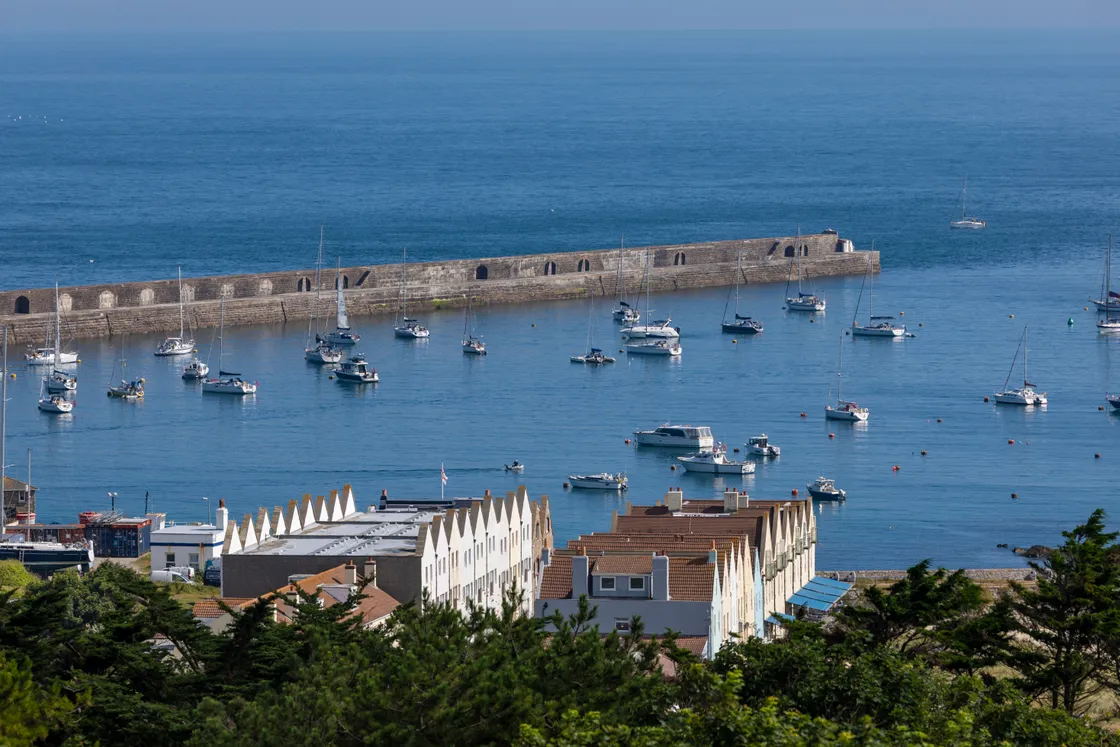
At the time the breakwater was taken on by Guernsey, there was some concern about the cost risk of catastrophic failure, but up to this point the deal negotiated by the States has worked out well for the bailiwick.
The annual cost of Jersey’s defence contribution, through the maintenance of its Royal Engineer sub-unit, is very similar to Guernsey’s, having risen in recent years to £1.3m. in 2023 and just over £1.4m. in 2024.
Jersey seems more confident than Guernsey that its current arrangement, including the financial value, will survive the sharp growth of the national defence budget.
‘The operation of the Jersey Field Squadron fulfils Jersey’s defence contribution in line with the 1987 Inter-Governmental Agreement,’ said a spokesman. ‘There is no indication or expectation that this long-standing arrangement will need to change in light of the UK’s position.’
The Isle of Man may start any budget discussions in a more advantageous position, as by far the largest contributor among the Crown Dependencies. Its annual contribution has now reached nearly £3.5m., though it is not an exact like-for-like comparison with Guernsey and Jersey. The Isle of Man was also optimistic about avoiding renegotiation.
‘The Isle of Man government’s financial contribution is set out in the Isle of Man Contribution Agreement 1994 which relates to defence and includes other common services, for example, consular services,’ said a spokesman.
‘As the contribution agreement sets out, it is important to recognise that the amount payable by Isle of Man government does not and will not reflect either the range or the net true cost of services provided.
‘We are not aware the UK government wishes to raise a matter with the Isle of Man concerning our contribution payments and we have no indication of any intention by the UK government to do so.’
New national security approach likely to affect the islands
Even if Guernsey and the other Crown Dependencies can escape increasing their contributions towards ‘core’ defence, there is another, related UK government initiative on the horizon in which they – indeed, each of us, individually – are very likely to need to play their part.
The UK has committed to a Nato target to spend 5% of GDP on national security by 2035. That will involve spending 1.5% of GDP – not far off £50bn. a year – on civil preparedness, critical national infrastructure, supply chain resilience and cybersecurity, in addition to the 3.5% on traditional military forces. The UK government calls this a ‘whole-of-society approach’ to national security. It may involve a massive expansion in trained civil defence and civil protection units, and many other developments.
‘In a world where the impossible today is becoming the inevitable of tomorrow, there can be no complacency about defending our country,’ it stated in the strategic defence review. ‘Defence can no longer be seen as contracted out only to our armed forces, good and brave as they are. With multiple threats and challenges facing us now, and in the future, a whole-of-society approach is essential. Everyone has a role to play and a national conversation on how we do it is required.’
This ‘whole-of-society approach’ to national security is in its infancy in the UK. The Joint Committee on the National Security Strategy, a parliamentary scrutiny body, has called for greater clarity about its scope and funding. There is, though, an emerging expectation in Guernsey that the islands will be expected to play a full role, whether financially or in other ways.
The UK’s work on this initiative is likely to develop in this parliament, which could last until 2030, and be finalised in the next parliament. The States’ external relations lead, Deputy Steve Falla, and his small team of officials want to be involved in those discussions at an early stage.
The States agreed a Bailiwick Security Policy in 2019. Responding to the UK’s latest thinking on defence, including at a civilian level, may require an extensive rethink locally, and a new, wider security strategy, later in the current States term or early in the next term.
Opportunities for the local finance industry
When General Sir Richard Barrons, one of the co-authors of the strategic defence review, spoke at a Guernsey Finance event earlier this year, he warned that the island’s size, geography and affluence were no defence against the increasing threat of modern warfare, which he said was ‘a bigger problem for humankind to manage than it has ever confronted before’.
He also asked Guernsey to think about ‘the deterrence premium’ – the financial and human costs which are avoided by averting war – which he described as ‘the bargain of the century’.
‘If deterrence fails, exactly the sort of thing you see happening around the world in places like Ukraine can happen here, in terms of military capability, or in London or elsewhere,’ said Sir Richard.
‘There isn’t enough public money, so we must find ways of getting private capital into defence now, for innovation, infrastructure and equipment. This is a multibillion-pound proposition, and I would love for you [Guernsey] to be part of that.’
Around the same time, a review of the island’s finance industry identified ‘promoting and positioning Guernsey as a hub to respond to emerging asset class trends, such as defence and infrastructure financing’ as a potential key area of growth in the medium term.

Henry Freeman, a strategic adviser to Guernsey Finance, said last week that the island had ‘moved early’ and was already ‘fast becoming a go-to hub for defence investment’.
‘Over the past year, the Guernsey Financial Services Commission has authorised three new defence funds which, according to its director-general, William Mason, plan to contribute to rebuilding Nato capabilities through their investment in defence technology,’ he said.
‘In April the island convened a round table on private capital for security and resilience, attended by Lord Peach, former UK chief of the defence staff and chairman of the Defence, Security and Resilience Bank Development Group.
‘As UK public budgets strain against the scale of the task, this is another area where private capital will have to do part of the work and where a credible, well-regulated conduit and member of the British family earns its place.’
Deputy de Sausmarez said Guernsey could ‘play an important role in the growth of defence investments in the UK and EU’.
The States would like this business driven through Guernsey to be seen by the UK as a major part of the island’s financial contribution to strengthening national defence and security.
That would help limit, but is unlikely to avoid, additional demands on the island’s public finances and population, in response to defence threats almost unthinkable for decades.