

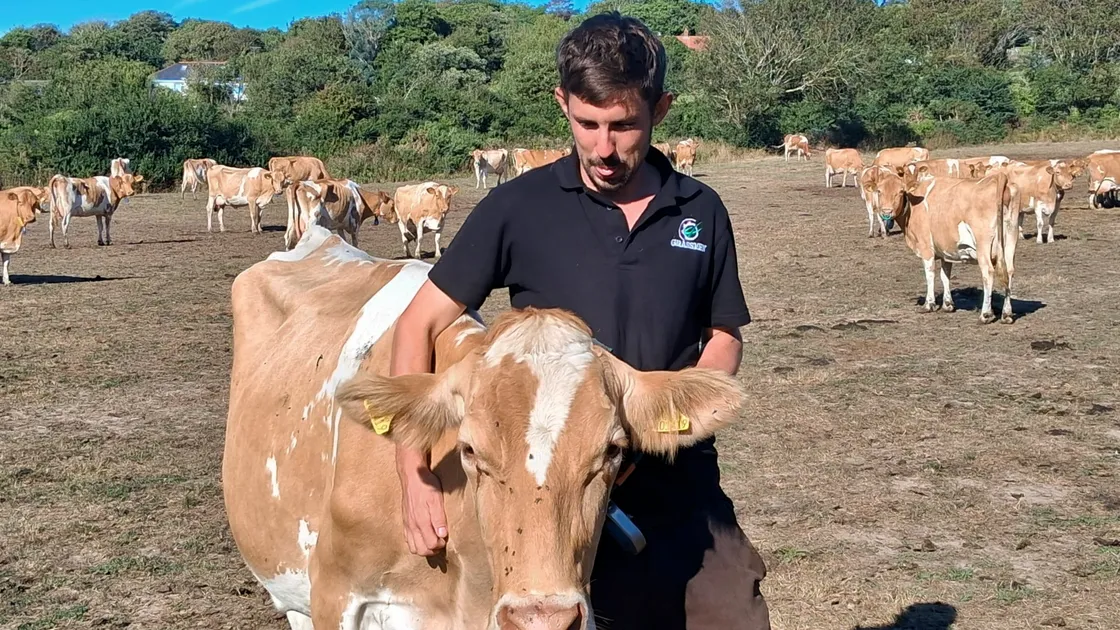
If there are no autumn rains then many local farms could completely run out of feed, and have to look at the expensive option of importing it.
Josh Dorey, who is one of the island’s largest dairy farmers, with 190 milkers and 100 ‘followers’, admitted that the situation was concerning.
‘Basically the grass hasn’t been growing for a couple of months now, so there’s been no grazing and no ability to cut silage to make feed. So we are having to use the feed which was meant for next winter. The cows are out in the fields but they are just eating from feed trailers.
‘Everyone is hoping they’ll be rain in the autumn, which would mean some winter grass growth, but the other day I heard it could be dry up to October.’
At the end of the summer farmers will harvest their crops of cattle maize, but while this will provide some respite, the traditional feed crop is also being affected by the exceptional conditions.
Mr Dorey says he was actually luckier than most in this respect because his farm is on low-lying land and he planted his maize early.
‘I got 150 vergees of maize in, and it has done reasonably well,’ he said.
‘Hopefully that will see me through to next March or April but we will have to make a judgement call during the winter. I think some farms are worse off than me because I use wetter land than some, like those on high ground, or up near the cliffs, so some will have a real problem.
‘Maize yields are going to be down. If you look around it’s going to be average to poor, with the drier fields being poor.’
Mr Dorey said 2026 was the second dry summer in a row, which meant that Guernsey farmers were not starting from a good position this spring.
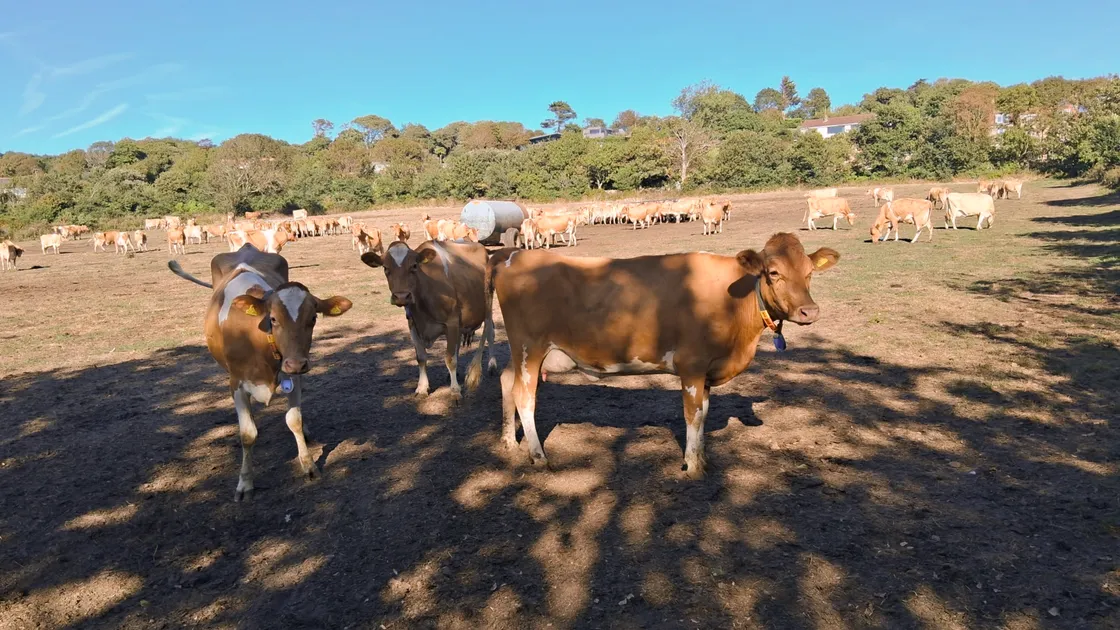
Last year there was also restricted grass growth due to hot and dry weather, but most farms had very good stocks of feed following a fairly wet summer in 2024.
By comparison this year they are struggling to manage, with some at risk of running out of silage altogether.
Other impacts of the exceptional conditions could include less milk going into the Dairy as farmers seek to conserve what feed they have by culling animals towards the end of their productive lives.
The baking hot weather [sometimes as high as 38C in the milking parlour] has led to farmers implementing some unusual measures.
At Mr Dorey’s farm the stalls where the youngest calves are kept have been fitted with fans. If the dry weather really does persist into the autumn, it will pile problem on problem for the local dairy industry.
After the maize harvest is complete farmers would usually resow those fields with grass, but there is no point in them even trying to do so in completely arid conditions.
He said there was little that local farmers could do about it but keep going and try to adapt.
‘We have to manage and carry on and deal with it the best we can. Normally you can manage with one dry summer but if it becomes a pattern it will be very difficult.’
Mr Dorey was full of praise for the new package of States’ support for the local farming industry brought in last year, saying it had made a real difference to the sustainability of the industry.
The States agreed an uplift from £1m. a year to £2.35m. at the beginning of 2025, following a review of support payments requested in 2022.
The review noted that costs were historically high, influenced by Brexit and the Ukraine war, and a lack of confidence was seeing herd sizes fall which could ultimately have jeopardised operations at the Dairy.
The dairy farm management payments had not been cut since 2014 and held static from 2019, meaning that the farming industry had to absorb a real-terms decrease of more than £1.75m.


You need to be logged in to comment.