

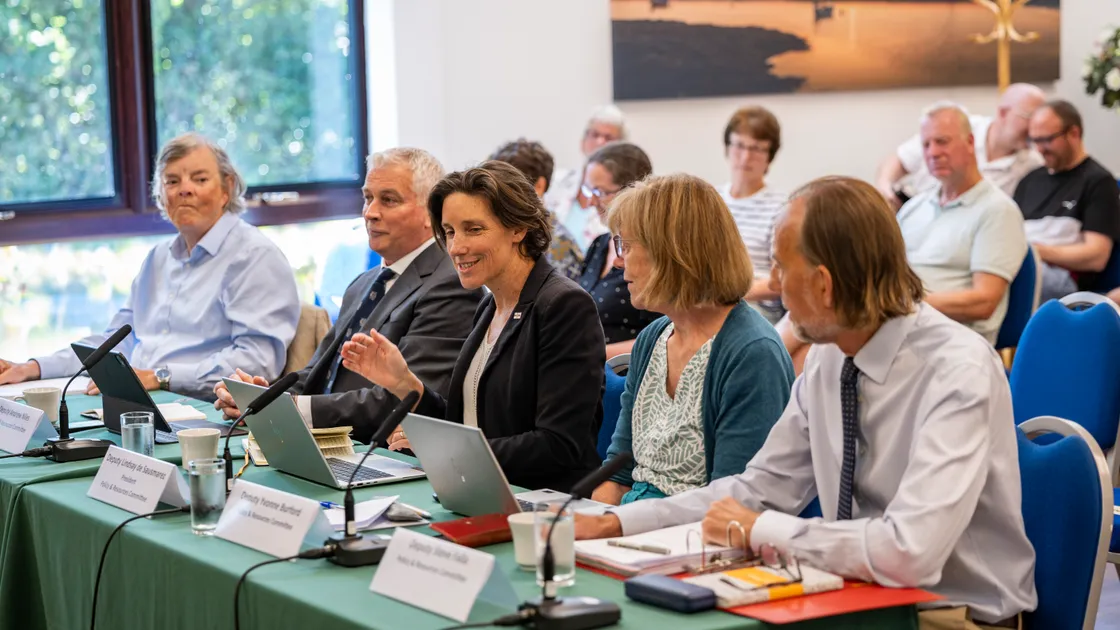
In a lengthy statement it has outlined the S&P position and said that the committee felt that its own was being misrepresented.
It followed dozens of questions from Garry Collins to the committee asking for evidence to support comments made during debate by three P&R members which suggested that the island’s credit rating could be downgraded if the States did not accept GST and the wider reforms.
His questions focused on statements made by Lindsay de Sausmarez, Andrew Niles and Yvonne Burford.
He asked if any of these members had direct contact with S&P, and called for details of any meetings, calls or correspondence of what was actually said by the ratings agency about GST and tax reform.
In particular, Deputy Collins questioned figures quoted by Deputy Niles, and asked where these had come from and if they were checked independently.
P&R said it was not practical to reply to some 70 questions directly and so issued an overview of the review process and a statement from the committee.
It said that S&P conducted its reviews via visits to the island, looking at published information, and answers to questions and data requests, talk to officers and external stakeholders who could provide insight into economic conditions and local trends,
The committee had no direct contact with S&P, and all comment in relation to its assessment were drawn from its published evaluations.
‘There has been no misrepresentation of S&P’s position by our committee – however, we are increasingly concerned that our position is being misrepresented.’
Deputy Collins said his main issue was whether or not P&R accurately represented S&P’s position.
‘S&P has since stated that it does not express a view on which specific tax or spending measures Guernsey should adopt,’ he said in his questions.
‘Does P&R accept that Standard & Poor’s did not require GST specifically?’
In response, P&R quoted S&P’s view on how it could take a negative rating action if the government, for example, substantially increased plans for capital expenditure without sufficient revenue-raising measures to offset this.
‘S&P are agnostic on how we address our fiscal challenges, and we have never claimed otherwise, but they are building their rating on the assumption that we will implement the tax reform measures, variations of which have now been under discussion for many years,’ said P&R.
The questions from Deputy Collins also included reference made during debate to borrowing of up to £250m. for new housing and a new electricity interconnector with France, and he asked where this figure had come from.
P&R said that £150m. of this had been agreed for housing last term while the rest was for the agreed second French connection. The committee also had the authority to continue with a £200m. borrowing facility for a period of up to 40 years.
‘Any borrowing would only occur if circumstances required it and would be considered in light of the States’ overall financial position,’ it said.
Deputy Collins asked if P&R was more interested in maintaining the island’s credit rating or securing approval for its tax reforms.
The committee replied: ‘The primary objective is to create a secure and sustainable tax base which meets our long-term needs.
‘The reference made to the risk posed to our credit rating was made to highlight one of the many consequences of not addressing issues that successive assemblies have now been discussing for more than a decade.’
Deputy Collins said he was not surprised at the committee’s responses.
‘This P&R again haven’t arranged any meetings or workshops with political colleagues ahead of September’s debate, and are likely to see even more amendments now to the tax debate,’ he said.
‘Plus with the 2027 Budget timings, we could see the Assembly in total disarray, in my view, from October to December this year.’




You need to be logged in to comment.