


Were it not for the size of an application form for a job at the European Court of Human Rights, Bailiff Sir Richard McMahon may never have come to Guernsey.
At the time in 1995, Sir Richard was an academic, lecturing in law at the University of Reading.
He had been called to the English Bar, Middle Temple, in 1986 after being educated at Emmanuel College, Cambridge and the Inns of Court School of Law in London.
But after about eight years at Reading he had reached a point in his career where he realised that he would have to wait a long time for promotion if he carried on down that path.
The alternative was to look for a job in another institution, but he said that he did not want to go to another university.
Looking in The Times for jobs, he found two. ‘There was a job in Strasbourg at the European Court of Human Rights, and there was a job in Guernsey,’ he said.
‘The application form for the Strasbourg job was 20 pages long. The application form for Guernsey was four pages long. So I applied to Guernsey, I didn’t apply to Strasbourg. Sometimes it is literally as simple as that.’
That job was for a legislative draftsman with the Law Officers, a role that he had previously sought in the UK without success, trying twice to get work drafting bills for the House of Commons.
Despite quite liking the idea, he said that it was a very difficult job.
‘I have huge pride for those who manage to do it easily.
‘Some days, the only thing that would be full in my room at St James’ Chambers would be the waste paper basket. In those days we drafted handwritten stuff, largely, and at the end of one day I could just have nothing to show from my day’s efforts.’
At that time he said there was a team of five, including the two Law Officers – HM Procureur and HM Comptroller. Today, there are more than 30 people in St James’ Chambers, with five working on drafting legislation.
His career in Guernsey saw him made a Crown Advocate and director of civil litigation in 2000, before he switched to Frossard House to become external relations policy and legal adviser in 2008.
Then he became HM Comptroller in 2009 and was also made Queen’s Counsel.
It was in 2012 that he was appointed Deputy Bailiff, before taking on the role of Bailiff in 2020.
Sir Richard said he always saw the role of Deputy Bailiff as being ‘Bailiff in training’ and for eight years he was able to watch as his predecessor Sir Richard Collas went about his duties, since many of the functions were the same – with one or two differences.
‘As Deputy Bailiff, you do more judging, you spend less time in the States, and you don’t have the patronages and presidencies and so on that go with the office of Bailiff.’
Many of these visits in the community and outside of the Royal Court or the States take place in the evenings and at weekends.
Overall, Sir Richard estimated that he spent about a third of his time sitting as a judge and although he has presided over criminal cases and the family court, he had chosen largely to concentrate on civil cases.
There was also quite a lot of trusts work, but most of this was carried out in private.

When looking back on the most pleasing aspects of the role, he said it was the duties as patron that he thought most Bailiffs enjoyed the best. ‘You get out and about and you see real people doing real things, making a difference for the benefit of the community.
‘I think it’s actually interacting with members of our community that is the real bonus to being Bailiff.’
He would miss this interaction most, he said, as well as ‘potentially’ sitting in some court cases.
He has spent a lot of time chairing States meetings, too.
‘There have been plenty of good moments in the States. One hopes that, being the presiding officer in the States of Deliberation, you can bring a little bit of humour from time to time to try and lighten the mood, particularly when members might be getting touchy with one another. But presiding in the States of Deliberation is, on the whole, pretty enjoyable.’
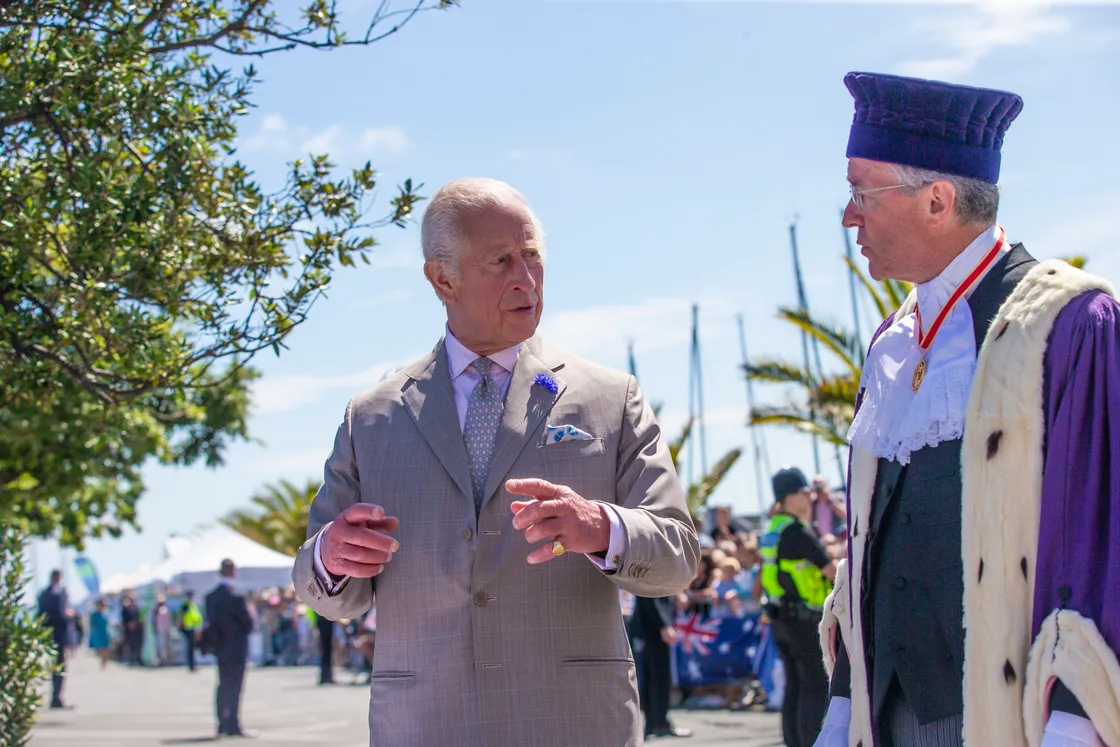
There were some surprises during his time in office, he said, such as the death of Her Majesty the Queen, but that led to one of the highlights, the visit to the island by King Charles and Queen Camilla.
‘It is comparatively rare for the reigning monarch to come and visit the Bailiwick and it was just such a delight,’ he said, ‘particularly after Jersey had the rain, for us to have a dry day for the King and the Queen.’
He also noted how the Queen had chosen a photo of herself at Hauteville House to send out on her birthday, the day after the visit to the island.
‘Then of course we had the Princess Royal here for the 80th anniversary of Liberation Day, which was another highlight.’

One issue that arises from time to time is whether or not the Bailiff, the head of Guernsey’s Courts, should also be the presiding officer in the States.
However, Sir Richard thinks there is a benefit of the dual role.
‘They have no political baggage. That potentially means that they are simply there as a neutral arbiter as to the rights and wrongs of abiding by the rules of procedure.
‘But if you have somebody who is a person who is sat in the States of Deliberation and may have forged friendships and possibly created enemies during their time as an active politician, then it is possible – I put it no higher than that – that they will be tainted by their likes and dislikes from their time as an active politician. So that’s one of the reasons that I think there is a benefit for the presiding officer being ex officio.’
However, he said he did not think it impossible for a politician to chair an Assembly meeting, citing the example of House of Commons’ Speaker Sir Lindsay Hoyle.
‘He is a role model when it comes to speakers, and he demonstrates, even though he came with the political baggage to which I was referring, that when you become speaker, you have to put aside your previous roles.’
He said his six years in the role of Bailiff had been a ‘huge privilege’.
‘It’s a great job, and it mixes so many things. So you don’t just sit as a judge. You preside in the States, you get out and about and see a lot of different people, you get the benefit of all of that, and that is what makes the office such a joy.’