
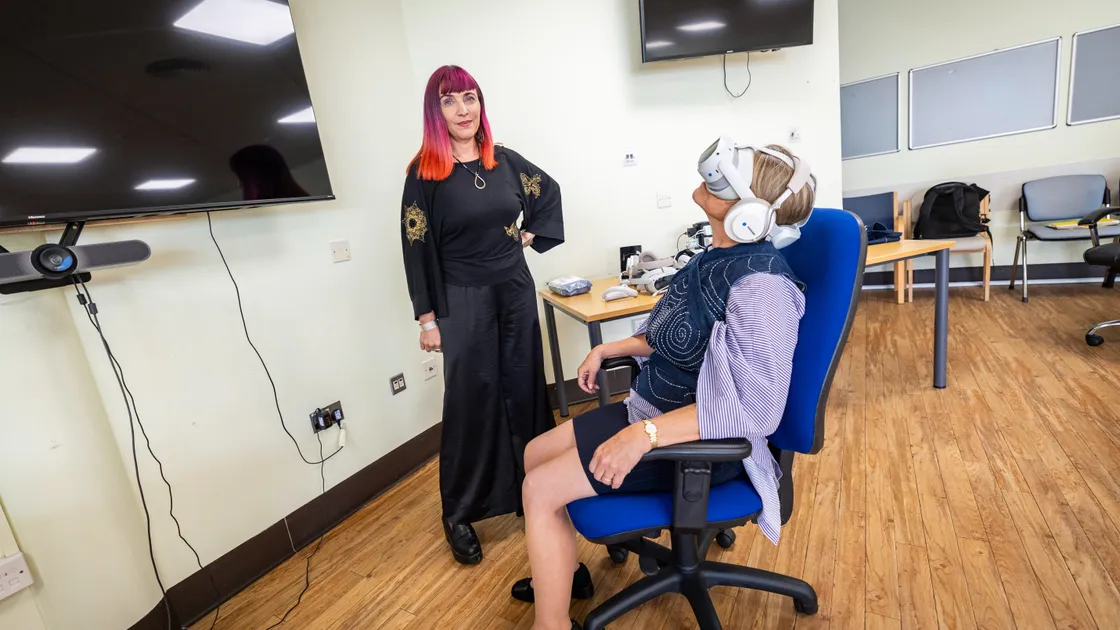
Professor Camille Baker specialises in immersive and interactive digital art curation that explores women’s healthcare experiences, a focus informed by her own lived experience with ovarian cancer.
‘It’s a way of embodying somebody else’s experience, stepping a little bit closer into their shoes,’ she said.
‘You can never exactly experience what anybody else is experiencing, but it’s very much that idea of trying to enable people to understand illness in a slightly different way, almost as if they were experiencing it.’
She described XR works as having the potential to incorporate ‘everything, as well as the virtual reality’.
‘It’s not just going into a virtual reality, but layers of the real and virtual together.’
‘Sometimes it means props and costumes. Sometimes it means there’s actors.
‘Sometimes there’s an element of theatre in it and you have live performers live in the headset.’
Mammary Mountain, the XR work Professor Baker has brought to share in Guernsey, focuses on the experience of being diagnosed and treated for breast cancer and involves both a virtual reality head set as well as custom ‘haptic’ vest garment.
‘Haptic means like the vibration in your phone. It acts on the body.
‘It it does something to us that we feel,’ she explained.
‘We’ve got a fairly inexpensive micro-controller that controls three areas of actuation, which is vibration.
‘And so, depending on what’s happening in the story, different vibration motors will vibrate, and they’ll vibrate in different patterns and sequences.
‘So, for example, in the chemotherapy, which is the most radical treatment of all and the most difficult for people, you have the most intense vibration in the storytelling on the garment.’
Professor Baker’s visit to Guernsey has been funded by the RCA in order for her to explore the potential value to be found in incorporating such XR art works within healthcare settings.
As a result, healthcare professionals in the island have been invited to experience Mammary Mountain for themselves and also provide feedback to Professor Baker on how and where within healthcare settings they think such XR experiences could be used to bring positive impacts.
‘Ultimately, what she’s doing is a consultation on how this piece of work might sit within healthcare,’ said Lottie Rowan, head of creative health at the States, who was key in facilitating Professor Baker’s visit to Guernsey.
‘What I’m interested in is the role of creativity and arts within healthcare.
‘That can be everything, including using the arts to explore going through the lived experience of having a particular health condition and treatment and things like that.
‘And Professor Baker is doing some really fascinating work, which combines art and technology.
‘I think that’s a really interesting thing for us to explore.’