

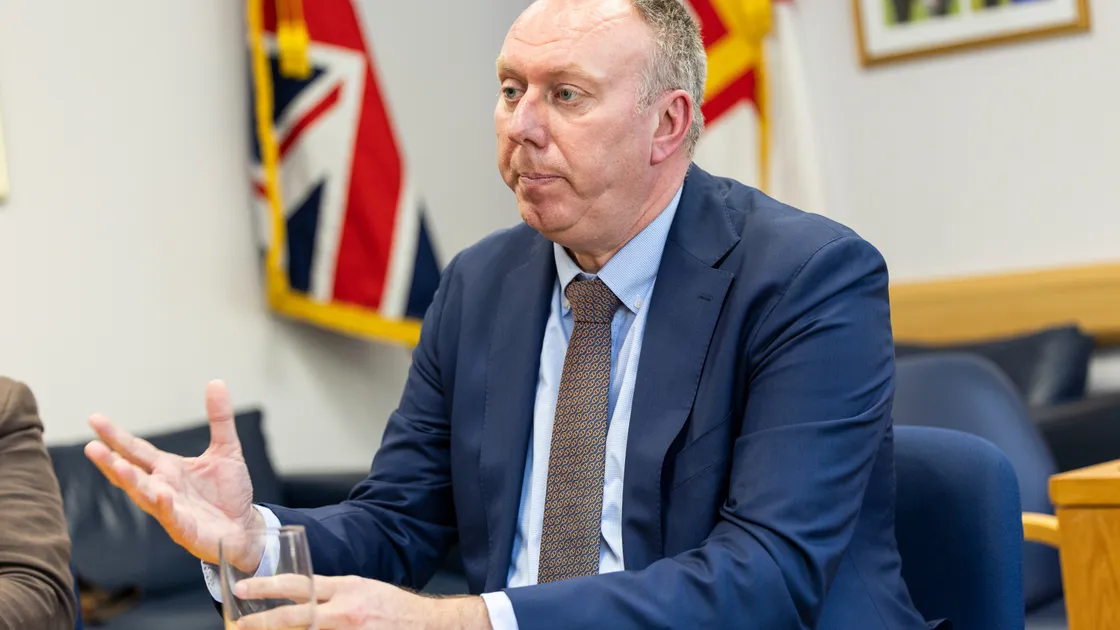
The States moved to a multi-vendor model, and Ge Drossaert, chief digital and information officer, said that the first year of implementing the new model had been dominated by the drive to stabilise services.
A programme of work has been focused on reducing the most immediate risks created by technical debt, including ageing infrastructure, unsupported components and resilience weaknesses in critical services.
Bringing in the multi-vendor model had, he said, allowed the Digital & Technology team to hold vendors to account and allowed for a quick change if there was a need.
It also helped identify gaps in the services and allowed for greater knowledge-sharing and planning to close these gaps.
Flexibility was the word, he said.
‘They supply services, and if the services are according to the service level agreement, we’re happy.
‘What we want to see is proactiveness. We want to see that behaviour change and not be waiting and always telling them what we want, but they can also tell us what they see, and make suggestions. When you have a flexible model, you have the flexibility to always find the right partner for the purpose.’
Among the providers who are now working directly with the States are Microsoft, Google and HP, the latter of which has provided laptops at a time when prices had risen due to AI technology around the world taking up many of the chips used in their manufacture.
‘We have luckily selected HP as a partner, and they secured a couple of thousand laptops for us and ringfenced those at a fixed price,’ he said.
‘So we were lucky.’
Mr Drossaert said that coming from the private sector, never having worked as a civil servant, he had two main drivers.
‘Risk is my first one and my second driver – a very, very close second, being Dutch – is value for money. If you add the two up, the conclusion [regarding Agilisys] was very simple.
‘I’m now three years with this organisation and all the Policy & Resources Committees we’ve had have supported the conclusions and the need for change.’
The stabilisation programme spanned every committee area, as well as the network, cyber defences and laptops.
‘We wanted to get more control. Obviously, it’s a never-ending story with cyber security, but stabilisation is very much our focus.’
Mandatory cyber security training for all staff was introduced to improve organisational awareness and resilience.
It was recently revealed that the States spent almost £4m. transitioning from Agilisys to the new model.
The project itself cost some £3.3m., and more than £600,000 had been paid to lawyers, but Mr Drossaert said some £5m had been saved.
‘We saved £5m., and we paid £600k for lawyers.
‘That’s a bargain.’
Having come from the ‘land of bonuses and celebration’ in the private sector, he said that working for government was very different.
‘Success is private, and failure is public.’
But the transition from one model to another had gone well and he praised the work done by the team within the States. ‘We have done a great job. The lights never went out.
‘We have a great team together now.’
This team is shortly to increase with the addition of a new chief technology officer who will work under Mr Drossaert, and this will form part of a simplification process.
‘I think the role of the CTO is actually the simplification programme,’ he said.
‘Do we still need 26 case management systems, or do five suffice? So the CTO will have the drive for the simplification of our landscape.’
Then there is a digital academy being initiated to develop staff and build skills for the States.
‘We will be working and learning from it and developing our staff, but we could also open it up to the public,’ he said.
‘Most of our vendors, including Google and Microsoft, are investing in it, so they’re bringing something to the island that is positive.’
Early conversations have taken place with The Guernsey Institute.
There could be courses for so-called silver surfers, or others focused on AI.
‘I think if it’s good for us, why not for the island?’ Mr Drossaert said.
Chief technology officer is being sought to provide strategic direction and leadership
A NEW States chief technology officer role is being advertised.
The new recruit will join the States Digital & Technology team and be expected to provide both strategic direction and technical leadership, helping senior leaders make informed decisions about technology, risk and investment.
The role has been created to work with chief digital and information officer Ge Drossaert.
He said that in his role he was accountable for all elements of IT infrastructure, technology solutions, cyber security, digital transformation, contract management with external partners and the delivery of day-to-day ‘service desk’ support for staff.
‘Following our move last year away from a single external provider to a new model of IT delivery, we have continued to develop our in-house capability and the structure of the Digital & Technology function,’ said Mr Drossaert.
‘As part of this work, we identified the need for a leadership role within D&T focused on technology solutions, which led to the development of the new chief technology officer post.
‘They will be responsible for ensuring that the States of Guernsey’s technology services are secure, resilient, affordable and fit for purpose, and ultimately ensuring our technology supports operational priorities and improves services for users.’



You need to be logged in to comment.