

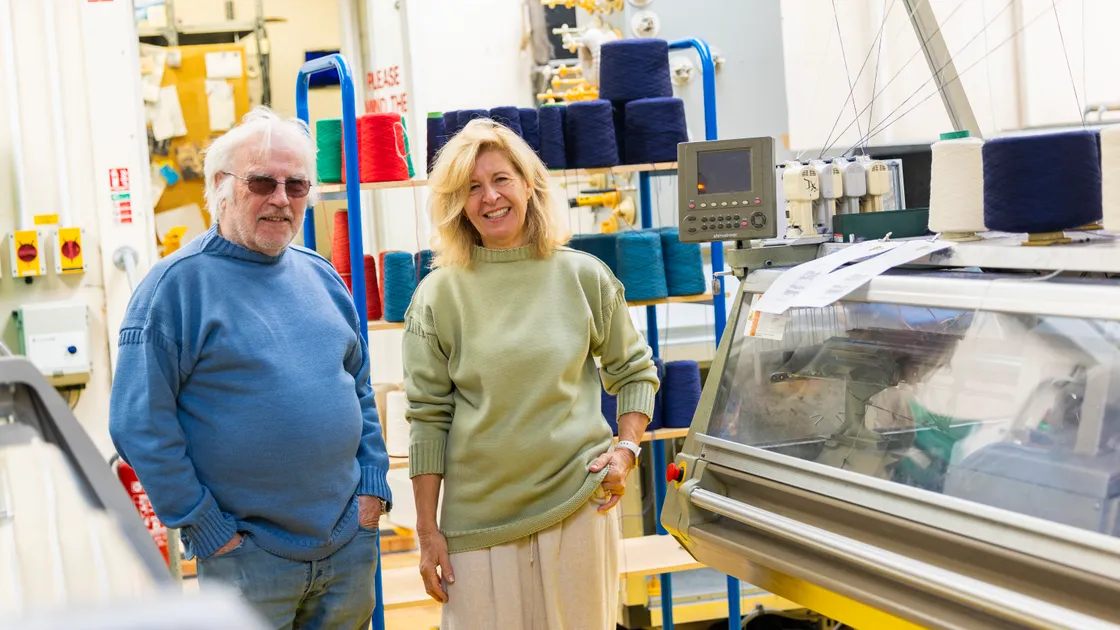
Cotton is not entirely new territory for Guernsey Woollens. The company made cotton garments previously, but production fell away around the time of Covid as soaring demand for its other products took priority.
The re-introduction is a direct response to continuing customer demand and adds another strand to a business which now sends the vast majority of what it makes off-island.
‘The demand has always been there,’ said Mr Eldridge, who has been at the helm of the business for around 20 years. ‘It’s just that the demand for our product was such that we couldn’t re-establish the cotton at the time.’
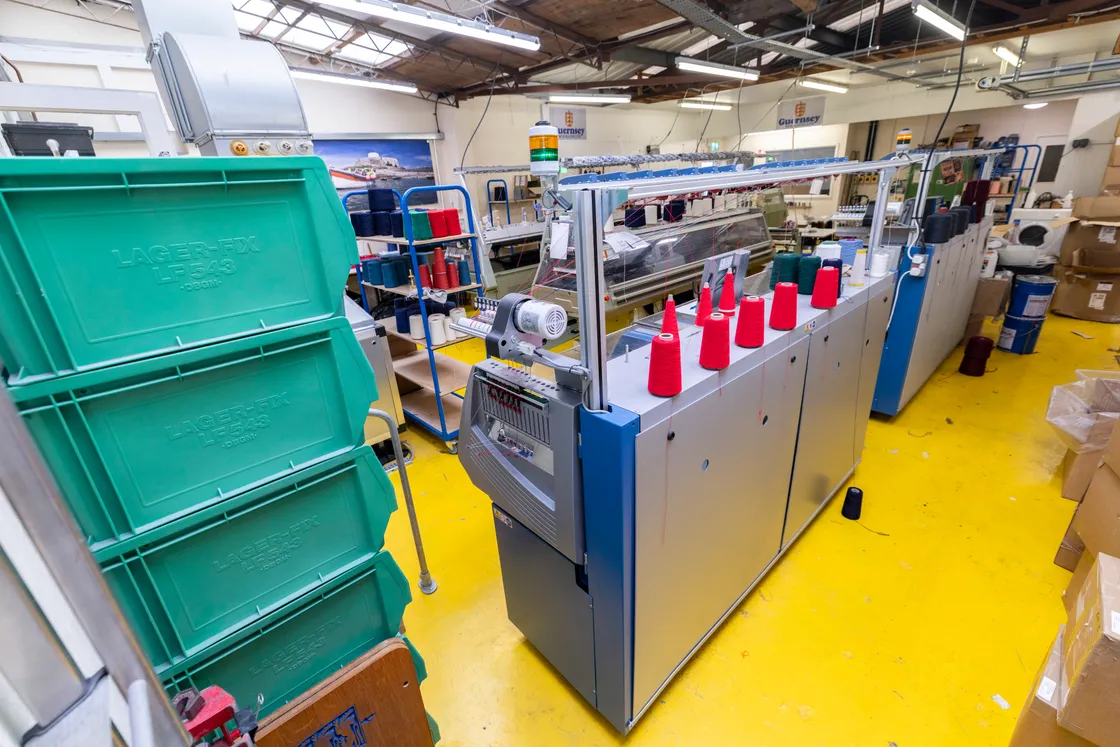
Changes to machinery were another factor, but investment in different equipment has now given the company the capacity to bring cotton back.
For the moment, Mr Eldridge estimates it represents just five to 10% of production, with garments being knitted for stock in a selection of colours. But the business is ready to pivot further if customers respond.
‘If all of a sudden cotton was the thing, we would up the amount because we can,’ he said.
That ability to adapt has characterised his long career in the textile industry.
He first encountered knitting machinery at the age of 14, when pupils at his secondary modern school spent time learning about local industries. Despite his father having already lined up a job for him in engineering, he was fascinated by knitting machines and chose a different path.
By 23, he was working as a freelance technician around the world, describing his role as ‘turning designers’ nightmares into fabrics’, finding practical ways to translate their creative ideas into finished products.
He later established his own company, which he sold to Next in 1985. He stayed on as managing director before buying the company back in 1990 and subsequently tripling it in size.
Mr Eldridge came to Guernsey in around 2005 intending to retire and brought a couple of knitting machines with him. Retirement, however, never happened.
His willingness to embrace new technology has remained an important part of his approach. Having started his career working with machines that operated using systems he likens to ‘music box technology’, he has watched computerisation transform the industry.
Today, modern knitting machines can precisely control the amount of yarn fed into a garment and automatically compensate for variations, helping Guernsey Woollens combine the heritage of a traditional island product with sophisticated manufacturing technology.
That combination has found customers far beyond Guernsey.
Mr Eldridge estimates at least 80% of the company’s production is sold off-island, with international markets including Japan and South Korea.
Remarkably, the business has largely grown its international customer base without actively seeking it out.
‘We’ve never gone out and sold a garment,’ he said. ‘People have come to us because of seeing them.’
South Korea is a particularly interesting market. A Korean customer first approached the company after seeing its garments in Japan, and Guernsey Woollens subsequently developed variations specifically for that market, including cardigans featuring an anchor motif and thumb holes.
It is a reminder that successful manufacturing is as much about listening as it is about tradition.
‘Our opinion matters not one iota,’ he said. ‘It’s whatever the customer wants.’
And that philosophy extends to the future.
After two decades in Guernsey, he sees no reason why the business should not continue to thrive, provided it maintains its standards while continuing to evolve.
‘Why would we expect it to slip away?’ he said. ‘Provided we keep doing the same quality standards and keep an eye on whether we can do little tweaks.’
The return of cotton is the latest of those tweaks: another evolution for a business that has made adapting tradition part of its success.

You need to be logged in to comment.