

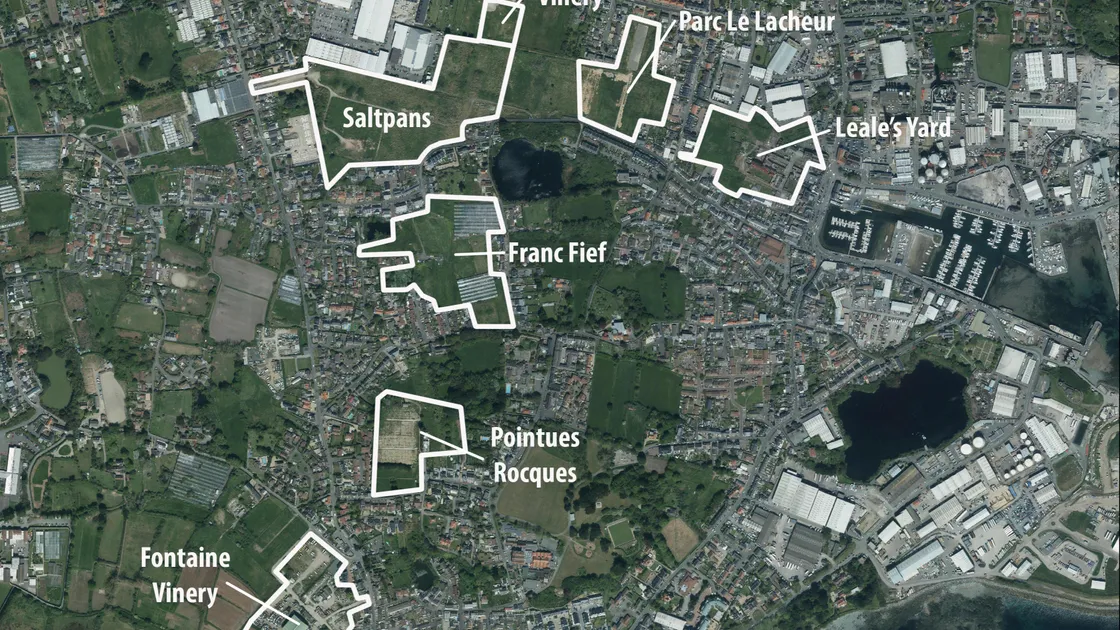
The douzaine has spoken out to reiterate its concerns about the impact of new housing development on the infrastructure of the area and criticised the lack of any proper assessment in the run-up to a States debate later this month on new housing sites to be added to the Island Development Plan.
While there is already a significant amount of housing land in and around the Bridge main centre, the review also proposes six new sites for affordable housing in other parts of the island, plus at a new local centre at Vazon.
‘Unfortunately, these proposals do nothing to address the concerns expressed by St Sampson’s douzaine over a protracted period regarding the implications of major planned developments in the north of the island,’ it said.
With about 1,400 new homes suggested for St Sampson’s and Vale, it said the issue was one of volume and the impact of these plans on the existing infrastructure, such as roads and drainage, and the water and electricity supplies.
‘The risk of infrastructure failure remains a very real issue,’ it said.
The douzaine said that it did not object to the former Fletcher’s Freesias site in Route Carre being used for affordable housing, but thought that this was going to be instead of homes being built at Collingwood Vinery off Route Militaire. The douaine said that it understood that the Development and Planning Authority still wanted to go ahead with Collingwood, a move it would oppose.
It has also opposed the idea of redesignating the Saltpans Key Industrial Area as a Mixed-Use Development Area, which will add about another 70 units to housing in the Braye du Valle area, taking the total to about 1,000 and increase the burden on infrastructure.
Creating a key industrial area and expansion area at Belgrave Vinery and expanding light industry sites at Lowlands and Longue Hougue will add to the number of heavy lorries on northern roads.
But St Sampson’s has backed the prospect of allowing housing at the King Edward VII Hospital, Castel Hospital and Perruque House – all sites in the Castel.
It said that while it supported a new local centre at Vazon it was disappointed that this would be smaller than originally suggested, partly due to traffic concerns.
‘This is particularly disappointing, not because those grounds were necessarily invalid but because similar concerns that have been voiced about large areas of St Sampson’s for many years have been ignored,’ it said.
‘Until such time as the States takes the concerns regarding potential over-development in St Sampson’s and the Vale seriously, the risk of traffic saturation, road safety issues, flooding, loss of amenity value and utility infrastructure overload in the north of the island remains a very real possibility.’
It said it wanted to see a more equitable redistribution of housing allocation sites around the island, along with work to assess the existing infrastructure in the north. No new housing stock is being targeted for St Saviour’s, Torteval and St Andrew’s, while the DPA is proposing 1.5% in St Peter’s, 6.6% in Forest, 7.6% in Castel, 10.3% in St Martin’s and 16.7% in St Peter Port.
St Sampson’s is due to take 31.9% and Vale 25.4%, the combined figure amounting to more than half of the total.
Speaking after the recent St Sampson’s meeting, douzenier Karl Guille, the parish’s planning committee lead, said the lack of protest from those living in the north of the island was more indicative that people in the area had given up, rather than that they were happy about it.
‘The parishioners don’t really stand up and argue so we fight for them,’ he said.
‘We’re not saying no to all development but there comes a point where you saturate it.’
The impact on the roads was one of the main concerns, he said.
‘No one’s done a proper assessment of all the traffic. The traffic report wasn’t worth the paper it was written on.’
He said his own attempts at carrying out a traffic survey had shown it was a much bigger problem than the official survey stated.
He also cited flood risks as another issue.
‘The States seems to like low-lying areas,’ he said.


You need to be logged in to comment.