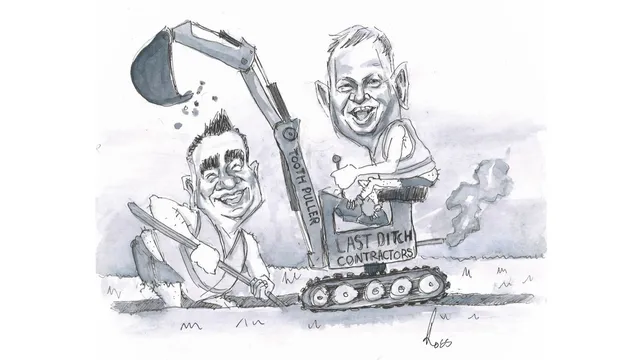
Accountability lies at the heart of a healthy democracy. It is the foundation of trust in the government. Without good accountability there are risks that the extraordinary powers granted to both unelected and elected officials can be misused; or, as we have been reminded recently, risks that resources can be wasted through inefficiency and poor management of public money.
Yet, there appears a stubborn lack of accountability in local government. In an era of rapid change, complex decisions, and an ever-growing number of committees, sub-committees, boards, and statutory authorities, the problem we have is in identifying exactly where the buck stops. This has contributed to repeated failures, which harm the public and undermine the trustworthiness of public institutions.
If something goes wrong which involves civic funds or citizen’s futures, the public rightly want to know about it. One big problem is the constant shifting of responsibility from one individual to another, one department to another, one committee to another, and so on. One after another disclaiming responsibility for particular conditions or outcomes, attributing the authority for change to some other force. The result is a bureaucratic haze in which no single person or body can be held to account.
In a corporation, situations can arise where the CEO claims she does not have the responsibility; that it is up to the board of trustees or the board of directors; the board of directors can shift it over to the shareholders etc.
The same goes for appointments made during States Assemblies. Where one committee is empowered to select nominees to sit on boards and authorities for the Assembly (for example, the Committee for Home Affairs nominates candidates for the Office for Data Protection Authority), and the Assembly has the legal power to accept or to reject the nominees.
When something goes wrong inside one of these entities, the committee president may argue that elected members had the opportunity to reject the appointments in a democratic process, therefore absolving himself of any responsibility. In turn, the Assembly can argue that responsibility lies with the president because his committee alone selected the names in the first place. The president may well say it is not the fault of elected members but unelected members, who selected and then presented the nominations to elected members. And so it goes, like a game of ‘under which shell is the pea hidden?’
The result is a circular routine that leaves us guessing where real accountability can be found. The haze only thickens when a committee claims that a body operating entirely within its mandate, funded entirely by the taxpayer, is somehow ‘independent’ and therefore beyond its responsibility. Such an argument may be convenient, but rarely is it convincing.
In every organisation there is a natural temptation to dodge blame. It is, after all, human nature. Whatever or wherever the case, it should be borne in mind that the target is mostly always trying to shift responsibility to get out of being the target. There is a constant squirming and moving and strategy – purposeful, malicious at times, other times just for straight self-survival – on the part of the designated target. The forces for change must keep this in mind and pin the target down securely.
In other words, responsibility must be clearly located and clearly owned. If an organisation permits it to be diffused across numerous committees, boards, and authorities, accountability evaporates – and with it, the possibility of lessons being learned and changes being made.
To make improvements, we must know where the problems lie and understand why. Clear lines of authority are a must – they are a requirement for good governance. Until we insist on them, the buck will continue to move and never stop moving.