
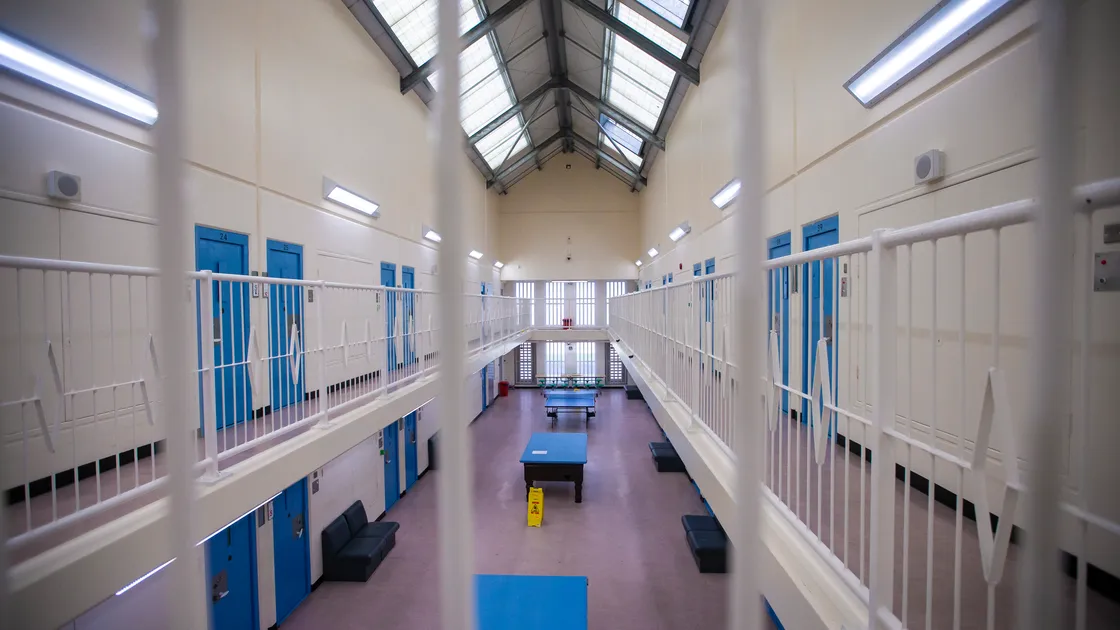
Guernsey’s prison finds itself facing a convergence of failings and accusations that stretch well beyond the norm. So what is being done about them?
Ongoing criminal proceedings against senior prison staff. The criminal conviction of Les Nicolles head of security. An officer arrested or suspected of dealing drugs. Allegations of rape in custody. And the recent deaths of not one but two vulnerable inmates, to name but a few of the problems plaguing Les Nicolles, paint a picture of a prison falling to pieces.
This is a picture which the president of the Committee for Home Affairs, Deputy Leadbeater, does not share. When addressing the Assembly last October, Deputy Leadbeater said he was ‘absolutely, totally proud of our prison’ and went on to say neighbouring jurisdictions ‘are jealous of what we do. They are jealous of how we do it.’ Quite how the president came to his conclusions, and what data he relied upon to form them, was conspicuously absent.
What the Assembly was shown and what others see are noticeably different pictures. The Assembly was presented with a carefully-curated painting, produced by prison staff and related bodies, using colours and canvas of their own choosing. For everyone else, the scene is rendered in pigments drawn from voices and experiences outside the institution’s walls – and from those who were incarcerated within.
First and foremost, Les Nicolles struggles with the rising number of inmates, pushing the prison’s staff turnover higher still and adversely affecting discipline and rehabilitation efforts, as the latest Prison Service Annual Report and others have noted.
Concerns over how Les Nicolles manages a mixed population of men, women and young offenders in a comparatively small space are nothing new. In the words of the most recent annual prison report, this has ‘presented a number of safeguarding challenges’ for the ‘long-term care of children in the adult custodial environment’.
Female prisoners were said to have been subjected to verbal abuse from male prisoners. Concerns around how minors are placed in proximity to adult prisoners, particularly adult sexual offenders, have also surfaced.
Separate reviews have identified deficiencies in mental health care provision and a lack of sufficient rehabilitative support for inmates, particularly those with complex or additional needs. While isolated improvements appear, the overall picture suggests inconsistent services that risk undermining safety by leaving reintegration inadequately supported.
In 2024 alone, nearly half of all inmates were considered to be at risk. Thirty-one cases involved actual self-harm.
The prison’s own report is candid on this point, acknowledging that ‘gaps are currently still present in the prison’s mental health provision, especially at a primary care level’.
These failings likely contributed to the death of a vulnerable inmate in the care of Les Nicolles only last month. Prison staff also appear to have made a number of errors when communicating with the mother of the deceased, who later told the Guernsey Press how upset she was by the way staff handled the matter.
This raises further questions over whether Guernsey’s prison applies safeguarding policies appropriately, consistently and fairly.
An ‘all-deputies’ email dated 9 February sparked further worries. Allegations were made that a convicted paedophile had been released from prison on health grounds. The prisoner was said to be located within a local hospital setting where children are present on visiting wards, without apparent custodial supervision, electronic monitoring or security controls.
Not only did this turn out to be partially true, but deputies also discovered that the prisoner had died, allegedly of natural causes, while in the care of the state – the second such death in the space of a week or so. Up until this point, and only in direct response to this email, Home Affairs had not felt it necessary to share any of this information with either deputies or the public.
A recent report also noted the serious challenges faced by inmates re-entering society, such as access to housing, banking or social support networks, and the lack of appropriate assistance available to them. Some former inmates, it is said, leave prison with little more than a sleeping bag.
But the problems do not end here.
Around mid-2025, the former head of security at Guernsey Prison, Jason Tardif, was convicted of sexual assault and indecent behaviour.
Separately, Wayne Le Cocq, understood to have served as a senior prison officer at Les Nicolles, appeared before the Magistrates’ Court in August 2025. The case is ongoing in the Royal Court.
At the tail end of last year, another prison officer was arrested on suspicion of supplying illegal drugs.
No workplace is immune to the failings of individuals. However, the fact that prison officers have either been convicted of, or charged with, serious criminal offences within a short period makes people wonder about recruitment, vetting and supervision. These are not isolated incidents to be easily explained away – they form a pattern crying out for attention.
Which brings us to oversight.
Any credible system of oversight depends on true independence between those who govern an institution, and those who scrutinise it.
Yet the President of Home Affairs, which has political responsibility for the prison, is understood to be a close personal friend of the prison governor. Neither is known to recuse himself from meetings or declare any conflicts of interest.
Whether this relationship has any bearing on the discharge of either individual’s duties is neither here nor there: the perception alone is damaging enough.
The prison governor expressly thanked Home Affairs for its ‘positive and supportive approach to the Prison Service’ in his annual report. In ordinary circumstances, a constructive relationship between a department and its oversight committee is welcome. In circumstances where the political president and the governor are close friends, however — and where Les Nicolles faces a mounting volume of serious allegations – comments like these cause readers to question whether this relationship is one of genuine oversight; or one of mutual backslapping. Comments from Deputy Leadbeater claiming Guernsey’s prison is ‘ahead of the game’ and that other jurisdictions are jealous, do little to reassure us.
The appearance of impartiality matters as much as impartiality itself, and this relationship, at the very least, reinforces the argument for oversight of the prison to be placed in different hands.
Electronic tagging is another issue worth noting. Tagging is not only beneficial for those accused or convicted of minor crimes, or for the younger or more vulnerable among us, but also beneficial for the taxpayer – it saves money, for incarceration is not cheap.
Had electronic monitoring been available, the situation described above, in which a convicted paedophile was placed unsupervised in a hospital setting, might have been handled very differently.
While pilot schemes existed earlier, the nationwide roll-out of electronic tagging in England and Wales began in 1999. Despite Deputy Leadbeater’s statement last year that the introduction of electronic tagging in Guernsey ‘is right up there. Tagging is one of our priorities’, the only substantive piece of work to emerge from Home Affairs is a requete led by Deputy Leadbeater seeking to place the future of cannabis policy in Guernsey firmly within his committee’s remit.
Whether this reflects a considered assessment of priorities or something else entirely is a question the public is entitled to ask.
Taken together, these issues point to systemic weaknesses regarding governance, safeguarding and accountability.
An independent audit, carried out by experts from outside Guernsey’s establishment, is needed; and would serve four principal purposes.
It would assess compliance with international standards for prison safety, human rights and rehabilitation – something not done since 2010.
It would examine recruitment, supervision and disciplinary processes for staff.
It would review complaints, whistleblowing and oversight mechanisms.
And it would provide a transparent basis for reform and for restoring public confidence.
Internal reports and official statements are not enough. Institutions cannot convincingly investigate themselves – which Guernsey’s long-suffering residents are well aware of.
This is not an attack on the hard-working individuals working within the system. Rather, it is a recognition that the system itself must change: it must be tested by those with no stake in its reputation.
An independent audit is not a bureaucratic exercise. It is a necessary step towards restoring trust, improving safety for inmates and staff alike, and ensuring that the rule of law applies as firmly inside the prison walls as it does outside of them. And if the taxpayer saves a bit of money along the way, that’s the cherry on the top.
James Collings
Deputy Marc Leadbeater, president of the Home Affairs Committee, replies:
Thank you for the opportunity to respond to this letter regarding Les Nicolles Prison, which contains a series of allegations and inferences and highly inflammatory language which, in my view, does not reflect the full or fair position. It is noticeable that the same narrative has been advanced repeatedly from different angles in recent months yet appears to originate from a very small group of individuals. Repetition does not turn speculation into fact, nor does coordinated amplification convert allegation into evidence.
What concerns me most is not the political criticism, that is part of public life, but the effect that continued public commentary of this nature can have on the families and others directly affected. There are grieving relatives. There are victims. There are individuals who did not ask for their most painful experiences to be relived repeatedly in headlines and across social media. None of them benefit from partial information, conjecture and insinuation being recycled in the public domain. All this risks prolonging suffering and re-traumatising those at the centre of deeply distressing events, and that alone should give us all pause for thought.
There are formal processes underway, as there must be in a jurisdiction governed by the rule of law. Inquests are ongoing and independent investigations are being conducted by the Prison and Probation Ombudsman. Where relevant, matters will be before the courts, as some already have been. These processes exist precisely so that facts can be established independently, thoroughly and fairly.
Publicly speculating on causes, motives or systemic failure before those independent processes conclude is, in my view, irresponsible and potentially damaging. If we genuinely care about accountability and improvement, then we must allow those mechanisms to do their work.
Let me be clear: if there are failings, they will be identified. Where lessons must be learned, they will be learned. If change is required, it will be made. But that will happen through proper process and not through trial by media, and not through narrative-building that risks causing further harm.
No institution is immune from the failings of individuals, and it is a serious step to move from a series of isolated incidents to sweeping claims that an entire system is ‘falling to pieces’. Such language is sensationalist and does nothing but add further challenge to those working professionally and diligently in complex circumstances.
We owe the families and individuals involved in these incidents dignity.
I would therefore ask those who continue to promote this narrative to reflect carefully on the consequences of their actions, particularly for those who are grieving.
Allow the inquests to conclude, allow the independent investigations to report, and allow due process to run its course.






You need to be logged in to comment.