It was good to have time over the festive break to sit down and relax over some films, old and new. They were quite an eclectic mix that in turns made me laugh, cry, jump out of my seat and fall asleep. But there were two that came to mind when I recently read a couple of policy papers that will be coming up for debate shortly, and both published by the Policy & Resources Committee.
The first was Love Actually, a 2003 British romantic comedy where everything turns out wonderfully for everyone just in time for Christmas. The second was Oppenheimer. Made 20 years later, it is a gritty dramatisation of the life of Robert J Oppenheimer, the ‘father’ of the nuclear bomb and where things don’t end so well. Both excellent films with brilliant scripts and fantastic actors but, I’m sure you’ll agree, decidedly different.
On the States’ front we have the Government Work Plan – the Love Actually of policy papers. It gives you a warm glow inside reading the glorious projects the States will undertake to make all our lives better. Then there’s the Fiscal Policy Framework, the Oppenheimer if you will, that hits you with the stark reality of the States’ finances.
The titles of both policy papers make them sound as if they are dull affairs. However, don’t be fooled, they will have a big part to play in determining the course of this term and, as such, deputies need to be on high alert. It’s important to understand what they are, how they impact each other, and the implications of what they propose.
Unlike its beefy predecessors, the GWP fills just 36 pages and focuses on five ‘super priorities’. They are: decide and deliver tax reform; clear and commence development at Leale’s Yard; agree and advance a sustainable health and care system; shape and strengthen the focus on early years and families; and determine and design future harbour requirements. These are the projects that are hoped to define the political term and it’s an impressive list.
Alongside the GWP sits the newly updated FPF which lays out the financial rules the States must follow. Now, the States does love pillars. Read a public sector strategy and, more often than not, you are likely to come across a number of pillars which are meant to hold it up accompanied by an illustration of a Greek temple. In this case there are four pillars: balanced budgets, sustainable infrastructure investment, sensible debt, and healthy reserves. The temple has been replaced with interlocking circles demonstrating how everything links up to provide long-term stability.
However, for two pieces of work that are supposed to guide the same government, the GWP and the FPF often feel they had a different production team. The GWP arrives in full cinematic widescreen, bursting with ambition, colour, and sweeping story arcs about transformation, regeneration, and long-term wellbeing. The FPF, meanwhile, is firmly in black and white, shot on a tripod, and narrated by someone who has spent a lifetime balancing ledgers and has no intention of letting anyone add special effects to the budget.
The conflict between them isn’t subtle. The GWP says: ‘Let’s build, reform, modernise, and deliver visible progress this term’. The FPF replies: ‘Lovely ideas, but only if you can pay for them without borrowing for day-to-day spending, draining reserves, or pretending depreciation doesn’t exist.’
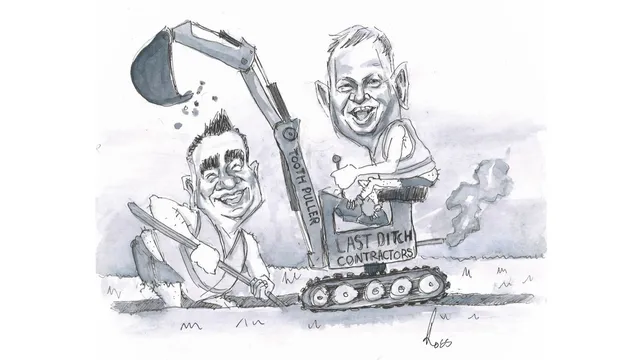
At the heart of the clash is the £98m. structural deficit identified in the FPF. It’s the financial equivalent of a giant ‘You are here’ arrow pointing at a hole in the ground. The GWP, however, is written as if the hole is merely a minor landscaping feature that can be dealt with later, preferably after the ribbon-cutting ceremonies.
Four of the GWP’s five ‘super priorities’ require significant spending. Only one, tax reform, goes some way to bringing in the revenue needed to fund the others. Of course, this makes the GWP structurally dependent on a political decision that has eluded the States for years, and more on that later. The FPF, by contrast, is the adult in the room, quietly pointing out that the GWP’s shopping list is longer than the island’s bank balance.
The tension becomes even sharper because the GWP is being debated without another dull sounding, but equally important, policy paper called the Funding & Investment Plan. Its absence is a big issue as it would show whether the GWP’s ambitions are financially deliverable. Instead, deputies are being asked to approve the equivalent of a blockbuster script without checking whether the studio can afford actors, cameras, or electricity. This is a real issue recognised in the FPF itself where it is acknowledged that, if nothing changes, the proposal to keep reserves at a minimum of 43% of GDP won’t be achievable. Indeed, the unallocated funds held in the General Revenue Reserve, effectively the States’ operating capital, could be exhausted by 2032.
Looking beyond these inherent tensions, the Policy & Resources Committee also proposes major changes to how the GWP is scrutinised. As things stand, and as set out in the Rules of Procedure, it should be debated annually. This gives deputies, the media, and the public, a regular chance to ask awkward questions like, ‘Why is this project delayed?’, ‘Why has this cost doubled?’ or, ‘Why are we still talking about the same issues as last year?’. Now it is proposed to remove the annual debate entirely. Instead, the GWP will be debated once at the start of the term, then revisited only through a mid-term and end-of-term report.
Not only that, but committee work plans – what committees want to spend time and money doing – will also no longer be debated, just published. The Policy & Resources Committee argues that this will streamline government and reduce bureaucracy. Whilst it has certainly reduced the size of the policy paper, others will argue that it reduces transparency, weakens accountability, and makes it harder for the public to see whether the government is actually doing what it said it would and what the Assembly wants it to do.
Both have a point, and it may be considered an abstract issue now, in the early months of a new term when everyone is full of hope and thinks everything is possible. But, when committees start to find they’re not getting the resources they need from Policy & Resources, and States members want to know precisely what is going on, it will become very real.
Guernsey is at a crossroads. The challenges are real, the stakes are high, and the decisions made in the next few years will shape the island for decades. The Government Work Plan sets out an ambitious vision. The Fiscal Policy Framework sets out the financial discipline needed. But ambition and discipline are not enough on their own. They must be accompanied by transparency, accountability, and open debate. Islanders deserve to see the full picture – not just the plans, but the costs; not just the priorities, but the trade-offs; not just the commitments, but the progress. If Guernsey is to navigate the challenges ahead, it will need not only strong plans, but strong democratic oversight.
Without it we risk drifting into a kind of policy-making theatre that feels uncomfortably like Dr Strangelove, a classic that is nothing like Love Actually or Oppenheimer but combines something of both – a comedy and impending Armageddon. Much of it focuses on everyone around the war room table insisting they’re calmly in control while the machinery rumbles on in a direction nobody quite intended. It might make a good film, but isn’t something that we’d want to see become reality. Of course, reality will hit when the policy letter on future tax reform is debated in the second quarter of this year. Whether it will be worthy of an Oscar, or a Golden Raspberry, time will tell.
If you’re interested in hearing more, join Michelle and me for our next podcast when, amongst other topical subjects, we’ll be providing insight and analysis on these important policy papers.