
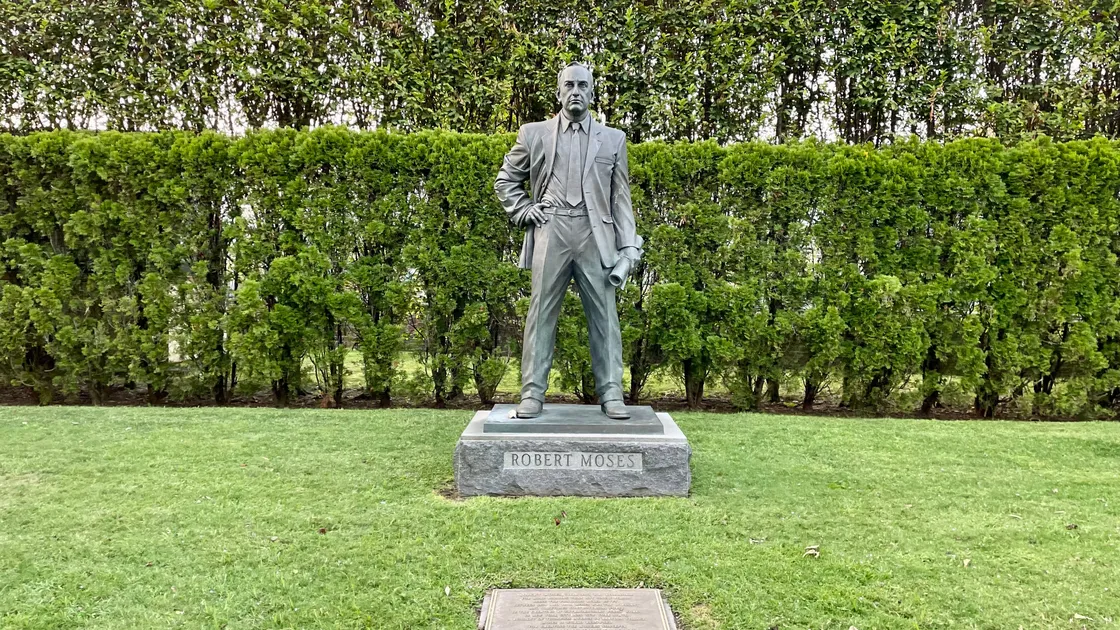
In a previous article, I wrote about Robert Moses, the unelected official who built nearly every major road, bridge, tunnel, public beach and park in New York City. During his reign, spanning over four decades, Moses wiped out entire neighbourhoods in his unrelenting pursuit of putting up infrastructure, displacing thousands of families and consistently bending the law to do so.
Understandably then, Moses is often remembered for what he built. Yet his real legacy comes not from concrete or asphalt, but from the way in which he was able to build. It is a set of political lessons that remain relevant today, wherever and whenever governments undertake capital projects.
Moses’s first lesson was this: ‘Once a legislature gave you money to start a project, it would be virtually forced to give you the money to finish it.’ In other words, once you physically begin a capital project, there will usually be some way found of obtaining the money to complete it. ‘Once you sink that first stake,’ Moses said bluntly, ‘they will never make you pull it out.’ The initial funding decision for a project is rarely the real decision; it is merely the first stake. Moses said: ‘The stakes you drove should be thin, pointed, wedge shaped. In fact, on the end, once you got the end of the wedge for a project into the public treasury, it would be easier to hammer in the rest.’
Moses knew that once money has been spent and construction begun, the political cost of stopping (wasted funds, public embarrassment, reputational damage and so on) becomes far greater than the cost of continuing.
Consider the long-running debates over the island’s hospital modernisation. Initial figures rarely remain initial for long. As plans evolve, so too do costs. Yet once a direction has been agreed and money committed, the question shifts from ‘Should we really be doing this?’ to “How can we afford not to finish it?’
A similar pattern can be seen in the reorganisation of the education estate. What begins as a proposal grounded in efficiency or necessity becomes, over time, a project that must proceed because too much has already been invested, politically and financially, to turn back.
The second lesson Moses understood is more troubling – large projects are rarely approved on the basis of complete honesty. According to Moses, when building public projects, the ends always justified the means. And if the ends justified the means, and if the important thing in building a project was simply to get it started, then any means that got it started were justified. Furnishing misleading information was justified. So was underestimating costs. Misleading and underestimating, Moses truly believed, was in fact the only way to get a project started. Since his projects were so complex and so vast, one of the biggest difficulties in getting them started was the fear of elected officials that the state could not afford projects which, although beneficial, would drain off a substantial share of the state’s wealth incommensurate with their benefits.
This was recognised, but from a different perspective, decades later by the economist Albert Hirschman, who coined the ‘Hiding Hand’ principle. Hirschman argued that ignorance of obstacles can be a good thing: it ‘tricks’ planners into starting ambitious projects they might otherwise fear. When problems inevitably arise, human creativity, which Hirschman posits is underestimated, kicks in to save the project.
Hirschman’s theory was later renamed the ‘Benevolent Hiding Hand’, and another theory sprang up in its place, one much more aligned with Moses’s experience: the ‘Malevolent Hiding Hand’. Proponents argued that Hirschman’s happy endings are the exception. In most instances, the Hiding Hand is malevolent: it conceals the obstacles to get the project started, but creativity fails to emerge, leaving the project to sink under massive debt or poor performance.
Moses, if not in words, then certainly by his actions, made it clearer still: What if you did not tell elected officials how much projects would cost? What if you let them know about only a tiny fraction of what you knew would be the project’s ultimate expense? Once officials had authorised that small initial expenditure and you had spent it, they would not be able to avoid giving you the rest when you asked for it. How could they?
If officials refused to give you the rest of the money, what was already given would be seen as a waste, making them look bad in the eyes of the public. And if officials claimed to have been misled, well, public officials are not supposed to be misled. For if they had been, would that not mean they had failed to investigate the projects thoroughly, had failed to scrutinise them appropriately, and had therefore been derelict in their own duty?
This is not theoretical. It appears through many of the island’s major spending decisions, where revised estimates, updated projections and overspend stretching collectively into the tens of millions have become the norm. Nor is it restricted to Guernsey. The UK’s Lower Thames Crossing, for example, is £3.85bn. over budget with a delay of nearly 2,000 days.
The third lesson covers the power of the state and the extraordinary latitude provided by its possession. Despite numerous legal challenges while serving as an unelected official, many of which were judicially successful, Moses faced little meaningful consequence. Part of the reason was power itself; specifically, the power that came with the money he could dispose of as a state official, effectively insulating him from the law’s retribution.
When challenged, which was often, Moses was able to employ enough lawyers to frustrate the intent of the law, to throw enough grit into the machinery of justice, to slow its gears sufficiently so that they could not mesh and produce the conclusion which its spirit demanded.
Moses learned that as long as he had public money, as long as he was representing the state, he would have the means of employing as many lawyers as he needed, of delaying and thereby denying justice to his opponents, and of shielding himself from punishment. Moses proved beyond doubt that he could, with far more impunity than any private citizen, defy the law.
Though few would suggest foul play in the realm of Robert Moses, the States of Guernsey as a collective of individuals nevertheless has, rightly or wrongly, a somewhat adversarial reputation, and one for using the courts to deal with its mistakes. And who can blame the decision-makers? When it is not your money or reputation on the line, when there is no way of holding you to account, why would you not throw tens or hundreds of thousands of other people’s pounds at lawsuits in the hope your actions never come to light? It is a rational, if morally questionable, decision.
We habitually see how public projects, coupled with the way in which government operates, diffuse responsibility. Decisions are made collectively, over time, for the most part in four-year cycles, across multiple departments, committees and assemblies. Accountability dilutes. By the time problems become clear, there is rarely a single point at which they can be decisively addressed.
Instead, momentum carries the project forward. Problems arise, and are exacerbated by, an adherence to secrecy and a lack of timely data accessible to scrutineers.
Of course, none of this is to argue that Guernsey should not invest in infrastructure. Hospitals must be built. Schools must be maintained. Public assets do not renew themselves. But we should be clear about the incentives at work. The system does not reward realistic costings or worst-case scenarios. It does not encourage risk and, as a by-product, kills creativity. It rewards projects that can secure initial approval; and once that approval is granted, it rewards their continuation and, conversely – perversely – punishes scrutiny.
The result is all too predictable: projects that grow in scope then drift in cost and become politically impossible to stop. The problem is not that things go wrong. It is that, once started, they cannot easily be allowed to be seen to have gone wrong.
And that is a lesson Robert Moses, if not most governments, would recognise immediately.





You need to be logged in to comment.