


While you’re still getting your heads around the dog’s breakfast that is the latest sleight of hand, sorry, iteration of the tax reforms being proposed by Policy & Resources, I’m going to give you a glimpse into the workings of Guernsey’s bureaucracy. How Mr Prodnose, that highly-paid official really running the island, actually thinks.
Before we do, it’s worth reminding ourselves that we’re doing this because of the remarkable chain of failures Mr P and his colleagues have helped the States of Guernsey to achieve while simultaneously screwing the island’s finances for the last 20 years or so.
This, we note, is a rare achievement given they and their ilk cost the island more than a million pounds a day – fast approaching half a billion a year – and you as a taxpayer about £9,230 per annum before a single pothole is filled, hospital extended or weeds cleared from the side of the road.
And because there are now so many of them they are now about to be joined by 30 or so HR experts to help control them. And since the average cost of a States employee has now risen (2025 accounts) to £61,300, that’s an extra £1.8m. a year you’re having to find for no tangible benefit to you or your family.
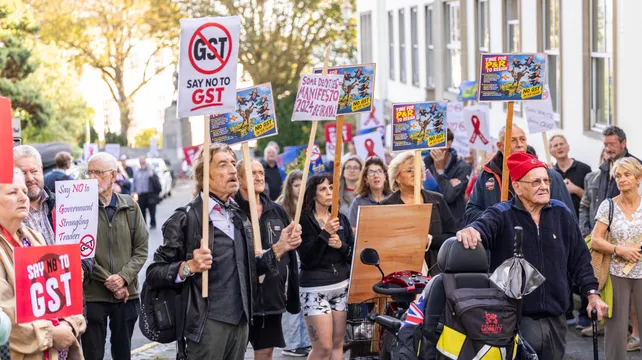
The tax reforms are designed to sustain this level of expenditure because the only visible growth strategy the States appears to have is in its own headcount. And while the GST-based tax rises are claimed to be ‘progressive’, they’re actually biting on the not-that-well-off.
That definition, I know, is subjective but 25% of the island’s households will be made worse off for the benefit of the remaining 75%. So where’s the cut-off? I can tell you. From Policy & Resources’ own charts it’s £75,000. Per household. You on £50k and the missus on £25k? Hand it over. You’re high income – even though it jolly well doesn’t feel like it – and you’ll be paying for more civil servants and (if you’re of that mindset) ‘benefit scroungers’.
I’m pushing this because all the thinking from recent States – which have been serial underachievers and lamentable in improving the lives of islanders – has been how to raise more money for itself while overseeing you becoming worse off, not least because of rocketing house and accommodation costs and the States’ own charges, like electricity.
Which brings us on to Prodnose. As you know, had things worked out, we’d be getting close to the point where the States could take possession of 90 one- and two-bed apartments at Leale’s Yard for around £378,000 a unit under the Omnibus/Coop proposals. Something that really would have put the heart back into the Bridge.
That States’ injection of £34m. (less than a collective month’s salary for government) would in turn have unlocked something in the region of £150m.-worth of houses, apartments, retail and light industrial/data park type offices. All paid for by the private sector.
Omnibus, I gather, was fully funded with a mixture of private equity and loan. It was, however, a requirement of its lending bank that a large pre-sale was secured before the money could be released, by the States or someone else buying the initial 90 units. Classic government pump-priming.
So why did your beloved States back out at the last minute? Brace, brace. According to a detailed analysis which the Scrutiny Management Committee has and is considering for investigation, it’s because the land on which these much-needed apartments would be built has no value. It’s worthless.
Yes, mouths closed please. And unbelievably, that’s the same property the States then went on to buy behind Omnibus’s back from the Coop for £4.5m. for a smaller area. Impressive, eh?
How did this happen? What Scrutiny may, or may not, look at is a claim the States advisory Prodnoses challenged the valuation of the 90 apartments.
Each unit should be £100,000 cheaper at a total cost of £25m., they reportedly said. That was based on valuations they refused to share with Omnibus and later went on to say that further valuations put the land cost at zero, hence scaling back the original £34m. asking price to one of their choosing.
I don’t believe P&R ever gave any formal reason for pulling the plug and my guess – reinforced by the MyGov, IT and hospital issues – is that civil servants hate the private sector, don’t understand it and, worse, don’t control it. It’s the enemy and must be destroyed. Much like, from the latest tax reform proposals, the self-employed facing a near 15% social security hit, but that’s another story.
Anyway, whether Scrutiny will pick this up is anyone’s guess. The buzz is that the committee has found pretty much what it expected to find plus a couple of surprising titbits on the way but its president, Andy Sloan, hasn’t come back to me on that. Possibly because he was preparing for yesterday’s savaging of the States’ 2025 Accounts, which show that pay costs have risen by 14% over the last two years.
If you wish you’d had pay or pension increases of seven per cent a year, that’s because you’re in the wrong job and not one of the 6,775 in the States or one of the favoured 300 ‘senior employees’, who are now on £115,000-plus.
It’s worth noting, too, that just five years ago the benchmark for salary seniority started at £80,000, about the same level as P&R today says makes your household wealthy enough to subsidise the rest of the island.
Anyway, you still have time to join this gravy train if you’re so minded – there are plenty of vacancies as the hiring spree hasn’t finished. And that’s the point here. If you were seeing some benefits like rising living standards, affordable house prices or rents, improving services, an airline that actually worked and had reasonable prices, or you didn’t have electricity costs that are an estimated £530 more per year than in Jersey despite being the same ‘French’ power coming through the same cable, perhaps you wouldn’t mind GST.
As it is, what’s the point? Who’s really benefiting from transferring money from the (alleged) top 25% to the rest? Your kids or grandkids won’t get a better education (unless at the colleges) and your knee replacement won’t come any quicker.
I note in passing that P&R is offering a pretty derisory 1% per annum in efficiency savings on total spending last year of £965m. (near £3m. a day) which will reduce expenditure by £20m. per year by 2029. Hardly breaking into a sweat compared to hitting you with car tax, you might conclude.
In short, all take, take. No right-sizing government. No asking, ‘What happens if we stop doing this and how can we mitigate the crippling loss of not employing (actual post) an invasive non-native species policy and coordination officer?’
So you might think that the quickest way to save twenty million is don’t take on the 30 new HR wallahs. But that’s crazy talk. Whatever Lindsay de Sausmarez tells you, GST’s not coming to make your life better but to make hers easier.





You need to be logged in to comment.