

This controversial amendment states: ‘To agree that, as a matter of fiscal policy, growth in total States expenditure (revenue and social security spending) should not exceed inflation over the financial years 2027, 2028, and 2029, save where the States expressly resolve that exceptional circumstances justify a departure from that principle.’
I originally misread it, and did not realise it capped budgets. It was only when re-reading I grasped the enormity of the proposals.
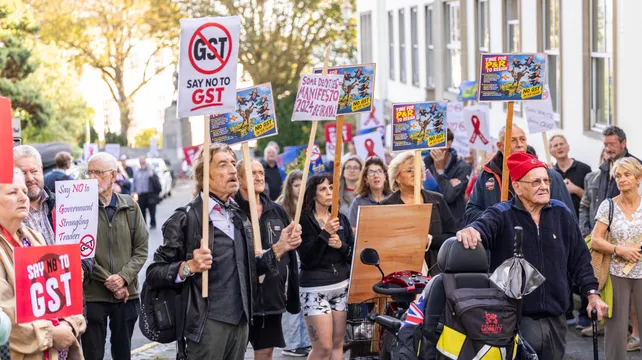
During the debate there was some controversy over what was included and what was not. To my surprise the amendment passed, albeit very close, 15 to 12, with seven abstentions and five not voting.
The amendment was originally drafted by Deputy Sloan, however due to family commitments he was unable to be present during the last day of debate, therefore it was presented by Deputy Helyar (who has stated he is not opposed to means-testing pensions) with Deputy Camp seconding. It was therefore left up in the air following a heated debate in the Assembly – as well as worrying, rather nasty, follow-up on some social media sites as to whether the social security contributory insurance funds were included or not. These are the Guernsey insurance fund, which includes state pension, sickness benefit, bereavement benefit, etc. and the long-term care fund, which covers the grant for admission to care homes.
Guernsey Press readers will know from his recent column that Deputy Sloan did indeed intend the amendment to include the contributory funds to limit growth in overall States expenditure. He says he was not proposing cuts in the ‘old age’ pension but wants demand-led expenditure, whether they are contributory or non-contributory benefits, to also be subject to spending restraint. This would include the state pension, incapacity benefits and maternity benefits funded by the insurance funds, but also income support and other non-contributory benefits such as long-term sickness benefit etc. funded from general revenue (taxes rather than insurance contributions). I think he feels everyone, including our older demographic, should shoulder the burden of cost constraints. He might be right, however there are unintended consequences of policy made on the hoof. This is where so many of the amendments fell short as there had been little or no consultation with either the public or the responsible committees.
What does the amendment in its current form mean? I say current form, as the debate was adjourned to September and as more information comes to light and the full impact of the amendment sinks in, I expect there will be further amendments superseding this one.
I spent eight years on the Social Security Committee, four of those as president of Employment & Social Security. During those years I met each year with pensioner groups ahead of the presentation of our annual uprating report which asks the States to agree the budget and rates for the following year across all benefits. Those meetings were important to both parties. Without a doubt the biggest question was always what will the pension increase be for the following year? We were unable to give a definitive answer as the final decision was made by the States during debate, however we usually looked at RPIX for June of that year (if available) or looked at what the March RPIX figure was to give a reasonable indication. The groups were usually comfortable with what we were hoping to achieve and for them to retain their spending power in real terms. Since my time we now have what is called the double lock which is a more complex calculation (see below).
So here comes the maths. Pension payments paid out each year are based on the number of contributions paid in. To get a full pension you need to have paid in an average of 50 weekly contributions per year over a 45-year period or received credits (for example if a parent is in receipt of family allowance and not in work they receive a credit towards their pension, until the child reaches 18 years of age; the States used to pay a grant (approx. £16m.) into the fund, to cover this type of contribution but this ceased in 2022). Many pensioners are below the contribution requirements to receive a full pension and therefore receive only a part-pension and if necessary, receive a top-up from income support. Figures indicate that 882 pensioners (27% of claimants) receive top-ups from income support. This figure will most likely increase if the state pension is not uprated by double lock and if the budget is capped to inflation, not a combination of inflation and demand. The amendment did not indicate what inflation rate or date was to be used. Inflation is calculated on a quarterly basis. RPIX excludes mortgage costs. The States of Guernsey has used RPIX since 2009 as its preferred measure.
Spending on pensions last year was approximately £177m., to 19,155 pensioners, approximately 13,653 living in Guernsey or Alderney and approximately 5,502 living away. It is worth noting that Deputy Collins has suggested we freeze pensions paid to those living off island. There are reciprocal agreements in place with many countries and there are some where no agreement is in place where the pension is frozen, Australia being one notable example. However, we must not forget that many local pensioners are also in receipt of pensions paid by other jurisdictions. I will be eligible next year for my Guernsey Pension as well as a UK pension for when I lived and worked in the UK for 10 years. I missed out on my Guernsey contributions for 10 years so I am not eligible for a full Guernsey pension, so my UK pension will make up for the shortfall – the same will be true for many people living on the island.
The double lock policy is a complicated calculation which takes the higher of RPIX at 30 June, or RPIX as at 30 June plus one third of the difference between the RPIX figure and nominal median earnings for the year ended 31 December of the previous year. For more information on the complex calculations and history please look at the policy letter entitled Contribution Benefits And Contributions Rates For 2024. If we take the last available RPIX figure at the time of writing, which was 4% in March 2026, the budget under the amendment would allow an increase of approx. £7.1m., taking it to £184.1m. for 2027. The number of additional pensioners in 2027 is difficult to retrieve from statistics but if we estimate the birth rate from 1959/1960, the cohort who will be eligible for pensions in 2027 will increase by approximately 732 (ESS have given a figure of approximately 4% over three years or 700) and this is the problem – the actuals are very difficult to calculate. There will be some deaths, on average around 600 a year, but no data on how many fall into the pensioner bracket and even looking at the latest Public Health report it is difficult to obtain an accurate figure. I expect a net increase of around 132 in 2027. My own thoughts are that many of those passing away will be in the older age bracket, probably not on a full pension, and those coming into pension age will have much longer contribution records and therefore a larger amount of funding will be coming out of the fund for these new pensioners. A full pension in 2026 is £292.09, if that is uprated at 4.0% it will be £303.77 for 2027 so the additional 132 (approx.) would cost approx. £2m. If the budget is capped at £184.1m., divide this by the number of pensioners 19,155+132 = 19,287 you have more pensioners taking from a capped pot which must result in a freeze, if not a cut, in pensions to ensure the new cohort receive a pension.
The amendment proposes spending should not exceed inflation for three years (2027-2029) so the cumulative effect of the yearly number of pensioners increasing over the period will mean that the value, buying power, of the States pension will decline over the next three years. Any cut or freeze in States pension will hit those on a partial pension much harder, and I believe this will increase the number eligible for income support, which will also be capped under this amendment, and/or drive more to the already under-pressure food banks.
Some have argued that the recent performance of the fund and increases in contributions means that the fund is more stable and can accommodate the extra spending, but that misses the point of the amendment, which is to limit the actual annual budget over the next three years. ESS can of course come back each year and argue its case as being exceptional. How many other committees will do the same? Health & Social Care will certainly bring along arguments that certain services are exceptional (prescriptions/drugs, off-island care) but that brings uncertainty. Which comes back to my meetings with pensioner groups. They worry about uncertainty at a time when the cost-of-living is increasing. I expect there will be a lot of conversations going on at Wheadon House over the next few weeks around the ESS committee table as it prepares its contributory uprating report for October. They will have to probably present figures for the double lock proposals alongside the potential figures under the amendment. I do not envy them and hope that they do present both as they will have more accurate figures than those available to me.
My next report will cover long-term care as that will also be affected by this amendment. In 2026 the rates grew by more than RPIX at 4.7%, as the rate was core inflation at the end of June 2025 plus 1% to help stabilise the fund and maintain the number of beds in the care industry. Additional pressure will also come on this budget when a care home is opened at the former King Edward VII and much-needed capacity is increased.




You need to be logged in to comment.