
In the sixth form I fell in love with politics. I used to drive to school in my mum’s clapped-out banger, reciting John F Kennedy speeches at the windscreen in what I took at the time to be a flawless Bostonian accent. It will come as no great surprise to anyone reading this that I spent most of my adolescence single.
But the politics I fell for was always somebody else’s. Washington, Westminster, anywhere but here. Of Guernsey politics, happening about two miles from that car, I knew close to nothing. In retrospect that is a shame, and I do not think I was unusual. Island politics is hard to follow, and a politics that is hard to follow is a politics that is hard to judge.
Accountability is everything in politics. If a candidate’s words do not count for something, there is no way to judge performance, and an election stops being a contract and becomes a personality contest with a four-year gap in the middle.
Most places have machinery for this. In Britain and America there are parties, whips and a national press, and a politician who says one thing on the doorstep and votes the other way in the chamber can expect to be reminded of it, loudly and by name. In the extreme, they lose the party label they needed to get elected in the first place.
Guernsey has none of that.
Our system of independent deputies is in many ways its great strength. No whip decides how an islander’s representative votes, and nobody’s conscience is the property of a party machine. But it carries a cost that is rarely said out loud. There is no organisation whose job it is to hold a deputy to their manifesto. There is no brand to be thrown out of. Once the count is done, the manifesto has served its purpose and can be quietly filed.
The only backstop is a small local newspaper. And no small local newspaper, anywhere, has the staff to read 38 manifestos, extract 532 individual promises, and match every one of them against 246 recorded divisions.
So one weekend, with the help of AI, I did it. Work that would once have taken months of full-time effort took a few days. That is not a fact about me. It is a fact about what these tools can now do, and about what a community of 64,000 people can now hold its government to.
The questions I wanted answered
I did not build this to catch anyone out. I built it because I wanted to be able to answer, from a single place and without taking anybody’s word for it, the questions every islander is entitled to ask: Is my deputy doing what they said they would? Are we, as a community, getting more prosperous or less? Will my children ever be able to buy a home here? If I am taken ill, will I be seen faster in Guernsey than in Jersey? And are our schools serving the next generation, or failing them?
Every one of those has a published answer somewhere. Not one of them was easy to find.
Getting the facts should not be this hard
Guernsey does not have a Freedom of Information law. We have a Freedom of Information Code, a voluntary arrangement with no statutory right behind it. The States considered a real right-to-know law and shelved it in 2021. Jersey has had one since 2011. Requests under our Code hit a record last year, and the States are now working to cut the delays in answering them. That absence has consequences, and I ran into them repeatedly.
Committee attendance is the clearest case. In March 2022 the States passed a resolution rescinding the requirement for committees to compile and publish their members’ attendance. The reasoning was that electronic voting already showed who was in the chamber, which confuses two entirely different rooms. The only figures that exist for this term exist because the Guernsey Press asked for them, twice, and printed them. Everything you can see on my site about which deputies turn up to their committees is downstream of that newspaper’s persistence.
It is not an isolated case. Recorded crime has never, as far as I can find, been published as a single continuous series; I had to rebuild it from 11 overlapping annual reports, and in 18 years no source has published a rate per head of population. The GCSE measure that ran until 2022 was discontinued and replaced with a different one, and some 2023 figures appear in two different versions across two releases with no correction notice attached to either. A&E performance sits in a contract appendix. Life expectancy sits in a wellbeing bulletin. Nobody in the States publishes total spending as a share of the economy at all, so I had to calculate it.
None of this is hidden, exactly. It is just scattered, inconsistent, and effectively out of reach for anyone with a job. AI is what closed that gap for me in days. It should not have needed to.
What the facts actually say
Public finances. Before 2013, the States of Guernsey had never borrowed a penny. Not once in our history. Since then we have taken on a £330m. bond that does not mature until 2046, and opened a £225m. credit facility in 2020.
The economy. Real growth has averaged well under 1% a year in the decade to 2023, and in 2023 the real economy did not merely slow, it shrank by 2%. Had we simply grown at Jersey’s pace over that same decade, our output in 2023 would have been around £683m. higher. On the States’ own ratio of spending to output, that gap is worth roughly £109m. a year of spending power, or close to three times the cost of rebuilding a high school. Every year. Meanwhile finance and insurance alone now account for 37% of everything the island produces, which is a strength and a concentration risk in the same number.
The public sector. The States employed 5,154 full-time staff in 2024, up 374 in five years, on a pay bill that has risen to £317.6m. In fairness, 341 of those additional posts are in health and social care, and an ageing island genuinely needs them. But the States’ own accounts still record a structural deficit of roughly £56m. a year, and the public administration sector has grown from £281m. of output to £351m. in five years. On one measure cited by the BBC, government now accounts for 18% of the island’s workforce against 17% for finance.
Housing. We built 62 net new homes last year against our own target of 313. That is not a near miss. It is a fifth of what we said we needed, in the worst year of the decade, against a 10-year average of 106. Owner-occupation has barely moved in a decade, from 60.1% in 2016 to 61.2% in 2025, while median earnings actually fell 0.7% in real terms in the year to June 2024.
Health. Here, in fairness, is the good news, and I want to be as quick to report it as the bad. Guernsey saw 89% of A&E patients within four hours in 2024. Jersey managed 77.9% in April 2026 and NHS England around 71% in December 2024. On that measure we are ahead of both. But we have now missed the 95% standard for seven consecutive years, the share of patients seen within the contractual waiting time for a consultant referral has fallen from 81.5% in 2018 to 62% in 2024, and delayed transfers of care ran at 338 days a month in 2024 against a target of under 100, a target missed every single year since 2018.
Schools. In 2018, 68.4% of our children left with five good GCSEs including English and Maths. By 2022, the last year that measure was published, it was 67.2%. The measure was then discontinued. On its replacement, Attainment 8, the island scored 47.6 in 2023 and 44.7 in 2025.
Those two years matter. 2023 was the last GCSE cohort that still contained grammar-selected pupils. 2025 was fully non-selective. My own site says plainly that you cannot attribute that fall to the end of selection without evidence it does not have, and that caution is right. But it is a question worth asking out loud, and I do not hear anyone in the States asking it. What I do know is that Les Varendes, the school that was until 2023 the Grammar School, was inspected in November 2025 and judged to require improvement on the quality of education it provides. And that whatever else selection was, it was one of the few engines of social mobility available to a bright child whose parents could not buy one.
Crime. Recorded offences have risen from a low of 1,389 in 2016 to 2,215 last year. Two changes in counting rules over that period mean the two ends of that run are not strictly like for like, which is precisely why somebody should have been publishing it properly all along.
And then there is what the manifestos actually said
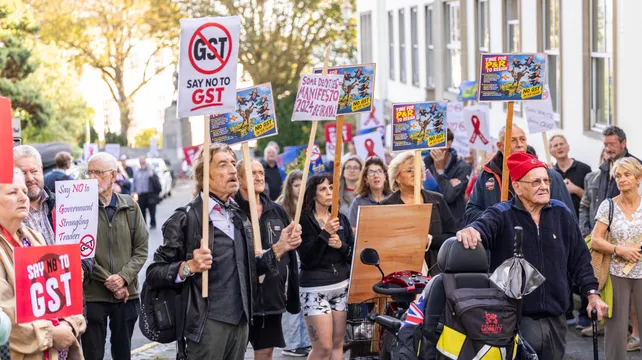
Reading the 2025 manifestos back, alongside the votes that have since tested them, is a dispiriting exercise. Twelve deputies set themselves against GST in one form or another. On the words they actually published, only two committed to anything a vote can test.
The rest wrote statements of past record, preferences, or conditions attached to somebody else’s behaviour. One deputy wrote ‘GST: NO thank you!’ and, in the very next bullet, recast it as a question of timing. Another wrote ‘I have never voted for GST’, a statement about yesterday, immediately followed by a sentence contemplating that GST might survive. A third wrote: ‘While I’m not ruling out GST forever, it must be the last resort, not the first.’
In that respect the election was a masterclass in spin – saying just enough to be heard as anti-GST while committing to almost nothing. I am not going to accuse anyone of setting out to deceive, and I do not think most of them did. Hedged language is often honest language, and a candidate who genuinely does not know what they will face in four years is right to be careful.
But the effect on a voter reading that booklet at the kitchen table is the same either way. You come away believing you have a promise, and you do not. What looked last summer like a stalwart anti-GST bloc turns out, on the page, to be a handful of firm commitments and a great deal of careful wording.
That is not a scandal. It is something worse – it is normal, and until now it was invisible. It is the single best argument I can make for why this island needs a scorecard, and why candidates should expect their next manifesto to be read this closely.
What I think follows
The answer to all this is not to borrow more and tax more. It is to get back to the position this island used to occupy and prospered in – lower taxes, a smaller state, and an economy growing fast enough to pay for the services we actually want.
I firmly believe Guernsey’s best days are ahead of it. But that is a choice, not a forecast. It requires us to build the homes that let the best and brightest stay, or come back. It requires us to bring the tax burden down rather than reach for the easiest new one. And above all it requires us to rein in a public sector that has become larger, more expensive, and no more accountable.
That last word is the whole reason the scorecard exists. It is free, it carries no advertising, nobody commissioned it and nobody is paying for it. Every figure links back to the source it came from, and every deputy can add their own response to any verdict without the verdict changing.
One last hope for it. Somewhere on this island there is a sixth-former mangling a Kennedy speech in a car that probably would not have passed an MOT. The turbulence and drama they are reaching 3,000 miles to find is happening two miles from their school, in a chamber whose decisions will settle whether they can afford to live here at all. I would like them to look closer to home. That is a great deal easier to do when the facts are in one place.
Deputies return to debating GST on 30 September. Their manifestos are now a matter of public record, division by division, and so is every vote they have cast against them.
Check yours before then at bridgeheadcommunications.com/guernsey.
Will Walter grew up in Guernsey and is the founder of Bridgehead Communications. The Guernsey Deputy Scorecard is free to use, carries no advertising, and was not commissioned by any deputy, committee, party or client.



You need to be logged in to comment.