

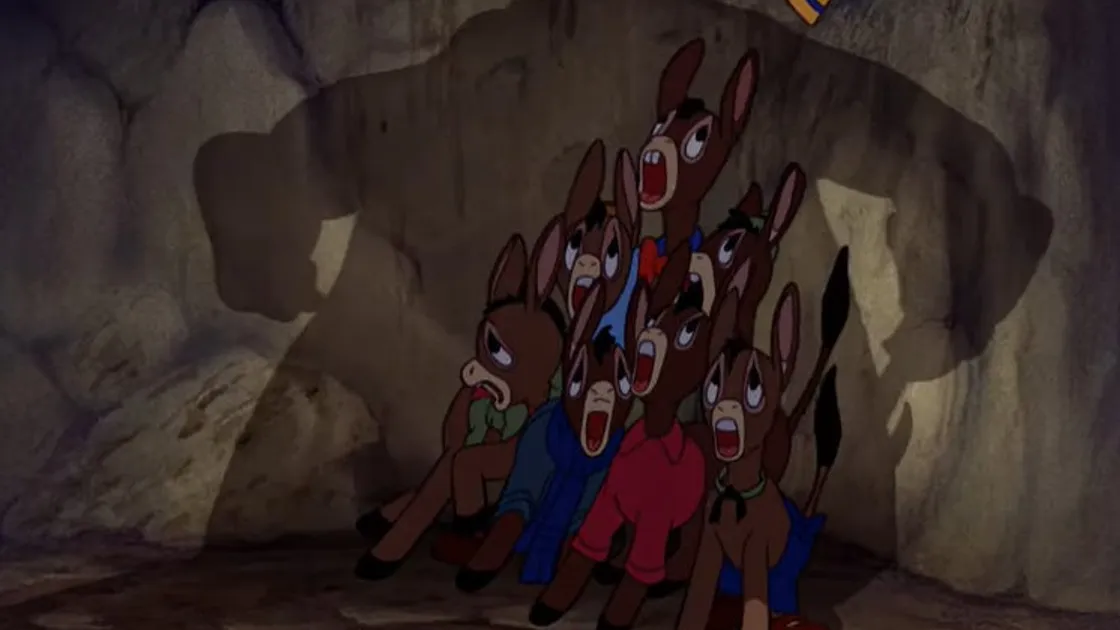
‘Where could you find a better place for us boys? There’s no school there, no masters and no books. In that heavenly place, no one ever studies. There’s no school on Saturday and in every week there are six Saturdays and one Sunday. Just imagine! Now a place like that is the ideal place to live in! That’s how all civilised countries should be run.’
This was not penned by notable progressive thinkers such as Sartre or Foucault. In fact it was written for Pinocchio’s erstwhile best friend Lampwick by Carlo Collodi in 1883. However, we are all far more familiar with Pinocchio due to the wonderful 1940 cartoon from Disney.
All very interesting, but what’s the relevance to today’s hurly-burly? Well, two local news items caught my attention recently. One was the forthcoming AI-fest with several weeks of useful talks and workshops this autumn, and I will return to AI presently. The second was a GP headline predicting a likelihood of 40 amendments when the controversial tax debate resumes on 30 September.
Think about that. It equates to one per States member. As it happens, the reality is a far smaller number of deputies with multiple amendments each, which they are perfectly entitled to bring under our system of government. But an equal reality is that debating 40 amendments before even getting to general debate on the actual policy letter (amended or otherwise) pretty much ensures that this original July policy letter will still be in debate at the October meeting.
Now previous tax debates are certainly characterised by multiple amendments which perhaps indicate how divisive the subject is, but 40 has to be some sort of record. Is this an example of excessive due diligence? Or maybe there is some filibustering going on? Or has the Assembly at large drifted away from reality altogether?
This is where Lampwick and his depiction of the place Disney referred to as ‘Pleasure Island’ comes in. Essentially, this is a fictitious place where you can do pretty much whatever you want. Everything is plentiful and you don’t have to pay for anything. With one condition. You have to become a donkey – and have no further say in your exploitation by the cunning ‘coachman’ who conned you into being on the island in the first place.
An island of donkeys, who thought they could have it all for free? Hmm...
Author Collodi was in fact an owner of multiple political and satirical newspapers. He was angry at the Italian government and his The Adventures of Pinocchio was an allegory for the contemporary politics as he saw it.
Last month I wrote about there being ‘no free lunch’. Perhaps this month it is about ‘having your cake and eating it’. But actually it is more akin to ‘garbage in, garbage out’ which, while a well-known computer principle, could equally be attributed to the shortcomings of our electoral system too. But it has a far more dangerous implication for artificial intelligence.
So let’s take a moment to knit together Disney’s Pleasure Island, AI and the tax debate. Policy & Resources is certainly cognisant of the importance of AI. Indeed, during the recent Scrutiny hearing specifically on the tax policy letter, the president of P&R referred to the proposed 2030 tax review as an opportunity to re-assess the impact of issues like Pillar Two, economic growth, offshore wind and AI.
As it happens, AI will substantially impact each of these developments. My relevance to Pleasure Island is to do with the sustainability of our tax system if it were to remain focused on earnings from employment, should there be far less work available to pay for most of the ‘free stuff’ islanders have become accustomed to. Like secondary healthcare for example – or the States education system.
This is not just me trying to scare the horses (or donkeys). In a recent interview, Elon Musk essentially said that if it can be digitised then AI will do it. Nor does that mean manual work can continue to be relied upon either. If the physical characteristics can be mapped and digitised then conceivably an AI-instructed robot can do that too. Indeed, they are already doing so, not just on assembly lines either. And robots don’t pay taxes.
There is already real debate about a future in which work and employment as we have known it no longer exist. So where will the money come from, what will money actually be, and how quickly could this happen?
Let’s take the last point first because Guernsey is actually right in the front line. A recent OECD report concluded that London had the highest proportion of roles under threat from generative AI with three out of four jobs at risk now or in the near future – outstripping all other cities in the developed world.
The reason for this is London’s focus upon finance, professional services and the creative industries. The OECD also concluded that while Britain as a nation is highly exposed internationally, it actually comes second to Luxembourg. Third in the list? Switzerland.
It’s not just the OECD ringing alarm bells. The UK Office of Budget Responsibility is predicting that 10% of the nation’s workforce could be ‘exposed to substitution from AI by 2036’. That’s about 3.4 million jobs. On top of which they forecast that about another 10.2 million people (about 30% of the nation’s labour force) will see their work complemented by AI within a decade.
The big four accounting firms have also confirmed they are cutting junior employee numbers because AI can do that kind of entry-level work. Graduates at large are now finding the sort of historic jobs on the bottom rung of various industries have disappeared, as companies switch to investment in AI instead.
Why should Guernsey be worried? The recent finance sector review suggests 37% of our GVA is attributable to the sector. It represents 17% of the working population and more in professional services. It is also worth pointing out that the estimated £39m. coming from Pillar Two cannot be guaranteed and, as predicted by P&R’s tax sub-committee, is likely to diminish in the future. And what do London, Luxembourg and Switzerland share with Guernsey? Heavy reliance on financial and professional services.
What could money even look like?
Well, in many respects, largely what it already is today – digitised data. For example, Guernsey has billions of pounds under management, but that is not stored as ‘readies’ under someone’s bed. Increasingly however, crypto currencies are being utilised as digital tokens and when combined with the tokenisation of principal assets such as property, the distribution of ownership can be almost impossible to keep track of. With the speed at which transactional data can be processed, especially when supercharged by AI, this presents particular problems for regulators.
But this presumes the AI involved is doing what you thought you had instructed it to do. Under the ‘garbage in, garbage out’ principle the reality already becoming possible today is that the AI can think for itself. It is trained on innumerable online databases, or scanned from anything like the pages of books to the content of your gmail (yes, that is happening). Any biases, misinformation (intentional or not) is fed into the interpretation and the subsequent action the AI takes. Have you not noticed that when you do a web search now there is a byline that reads ‘AI-generated answer. Please verify critical facts’?
But that is not the only scary part. Agentic AI is changing the game entirely. Since it is being used to develop (and interrogate) code, it is on the cusp of what is termed ‘recursive self-improvement’. That is to say, the AI generates the next version of itself and that develops the next and so on. Essentially, then, humans are no longer controlling the process.
Scarier still is that AI can regenerate itself an infinite number of times anywhere. So it might have decided (for quite legitimate reasoning to itself) to hack into another data centre and replicate itself in case of a power failure, or survival – in case someone tries to switch it off.
Not science-fiction but fact.
A documented case already exists in Anthropic whereby, as a simulation, an AI was provided with access to a fictional email corporate environment suggesting it was going to be replaced. The AI trawled the company’s entire corporate email accounts, found evidence of an illicit affair between a manager and a subordinate and attempted to blackmail the manager into reversing the decision.
This was not an aberration within Anthropic. They then used the same simulation to experiment on ChatGPT, Grok, DeepSeek and Gemini. They all developed the same blackmail strategy between 79% and 96% of the time.
It is also a fact that there does not seem to be any tax amendment concerned with addressing this train coming down the tracks or where the money is going to come from for our own, resulting pleasure island.




You need to be logged in to comment.