
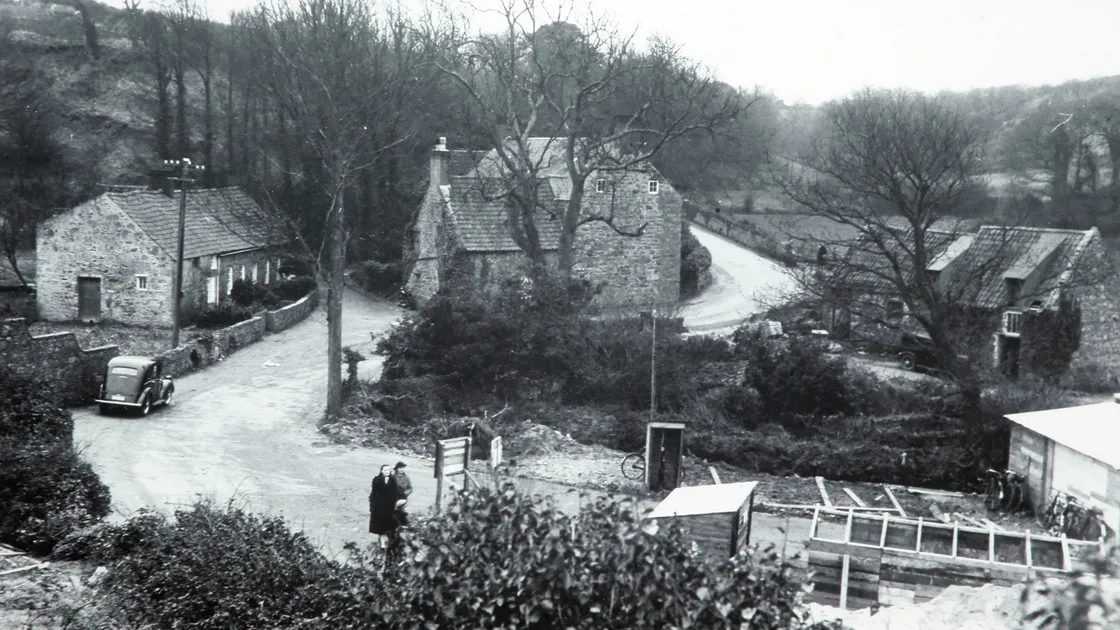
I met with an elderly friend recently and, as conversations sometimes do, ours wandered back into the Guernsey of his childhood. We talked about families, houses, parishes and the way people once knew not only who somebody was, but where they came from. It was a world in which a surname was sometimes only the beginning of an introduction.
My friend explained that many of the old Guernsey families were identified by the house they lived in or the area of the island from which they came. There might be several people with the same surname, so some additional information was needed to establish exactly which branch of the family was being discussed.
The Duquemins might be ‘from Bas Sejour’ or ‘from down Cobo way’. The Collas family were known in the Vale as being ‘from Paradis’. In his own family there were the Tostevins des Buttes or of Plaisance. If the name of the house didn’t solve the problem, geography usually did. You could always be ‘Jack from down Pleinmont way’. I like that.
There is something wonderfully Guernsey about the idea that knowing someone’s name wasn’t quite sufficient. You also needed to place them on the island. My friend began remembering more names. Robilliards, Galliennes, Torodes, Martels, Brehauts, Girards and Sarres. What fascinated me was that in his memory many of them were still attached to places and properties. They weren’t simply names in an address book. They belonged somewhere.
Of course, Guernsey was a very different place then. Families could remain associated with the same property for generations, and communities were much more geographically settled than they are today. My friend remembers particular surnames being strongly associated with particular parts of the island. The Langlois family, for example, were associated particularly with St Peter’s, while he remembers many Robilliards and Le Rays around Torteval.
He even recalled an area along Le Manoir Road where several members of the Langlois family lived in neighbouring properties. Apparently, horticultural advisory officers referred to it as ‘the Langlois territory’. You can almost picture it. The more we talked, the more I realised that this wasn’t really a conversation about surnames. It was about belonging.
Today, if somebody asks where we live, we normally give them an address. A road name, perhaps a house number or postcode. It is practical information designed to get a person, parcel or delivery driver to the right place. For earlier generations, a house or an area could be much more closely connected with identity. The place helped explain the person.
Perhaps that’s particularly understandable on an island. Guernsey is small enough for geography to become personal. We don’t simply have north, south, east and west. We have parishes, lanes, corners, bays and little areas whose names mean something to those who know them.
Even now, when somebody tells us where they live, many of us immediately start constructing a mental map. ‘Oh yes, I know where you mean.’ Then comes the inevitable attempt to establish a connection. ‘Is that near...?’ Before long we’ve discovered that their neighbour once worked with our cousin’s husband and that somebody we both know used to live three houses away.
We may have become a much more mobile community, but some Guernsey habits are difficult to lose. The conversation that morning became even more interesting when we started talking about language.
He remembers a time when surnames themselves could sound different depending on who was saying them. Tostevin might be pronounced more like ‘Taudevin’, Brehaut like ‘Berhow’ and Jehan quite differently again.
There were differences between Guernsey and Jersey too, but what particularly interested me was his memory of variations within Guernsey itself. He told me that he could often tell whether somebody came from St Saviour’s or the Forest simply by listening to the way they spoke. The Castel sounded different again, while the Vale apparently had a particularly distinctive pronunciation. Considering the size of Guernsey, that seems extraordinary. We can drive from one end of the island to the other in considerably less time than it takes to travel across many British towns, yet within those few miles communities developed their own voices.
My friend once adjudicated the Guernsey French Eisteddfod and remembers those differences in pronunciation being very apparent. People separated by only a handful of miles could speak the same language with noticeably different accents. Today, of course, much of that has faded.
People move house more frequently. Families are scattered around the island and much further afield. Guernsey itself has welcomed people from all over the world, bringing new surnames, languages, accents and stories into island life. That is part of Guernsey’s story too. However, I wonder whether something valuable is contained in these memories of an earlier island. Not because everything was better in the old days. Nostalgia has a habit of editing out the inconvenient bits. I’m sure old Guernsey had plenty of difficulties which none of us would be particularly keen to recover.
What appeals to me is the sense of connection. A name connected you to a family. The family connected you to a house. The house connected you to an area. The area connected you to a parish, and somehow all of those things helped locate you within the wider community. You belonged somewhere. Listening to my friend, I was also reminded of how much history exists not in museums or official records, but in people’s memories. There must be hundreds of conversations like this waiting to be had across Guernsey.
Older islanders remember names that have disappeared from everyday use, businesses that no longer exist, lanes before they became busy roads, houses before they were redeveloped and characters whose stories were never written down. They remember how people spoke and who lived where. They remember things that would never have seemed important enough to record at the time because everybody knew them, and then, gradually, everybody doesn’t.
Perhaps that is why conversations between generations matter. We can research dates and look at old photographs, but there is something different about hearing somebody say, ‘I remember...’ Suddenly history has a voice.
Towards the end of our conversation, attention eventually turned to my own surname. Pascoe is a Cornish name and I am a Cornishman. There aren’t too many Pascoes in Guernsey, so my surname doesn’t come with the centuries of local connections attached to names such as Tostevin, Robilliard, Brehaut or Le Poidevin.
However, after living and working in Guernsey since 1983, the island has inevitably become an important part of my story too. My companion smiled and decided that perhaps Pascoe needed a suitably Guernsey treatment of its own. ‘Les Pachay’, he suggested. Whether any student of Guernesiais would agree with him, I have no idea, but I rather liked it.
Perhaps that’s how names and nicknames have always developed: somebody says something, it catches on, and before long nobody can quite remember where it started.
I may have arrived in Guernsey as a Cornish Pascoe. Forty-three years later, perhaps I’ve finally become one of Les Pachays. Although if somebody asks which Pascoe I am, I may still have to give them my postcode, or mention I am a Pascoe from out Icart way.
Nigel Pascoe has lived and worked in Guernsey for over 40 years. A writer and speaker, he enjoys exploring the people, places and everyday moments that make island life unique. Through Island Reflections, he shares thoughtful observations on community, modern life and the stories that connect us all. nigel@nigelpascoe.com




You need to be logged in to comment.