

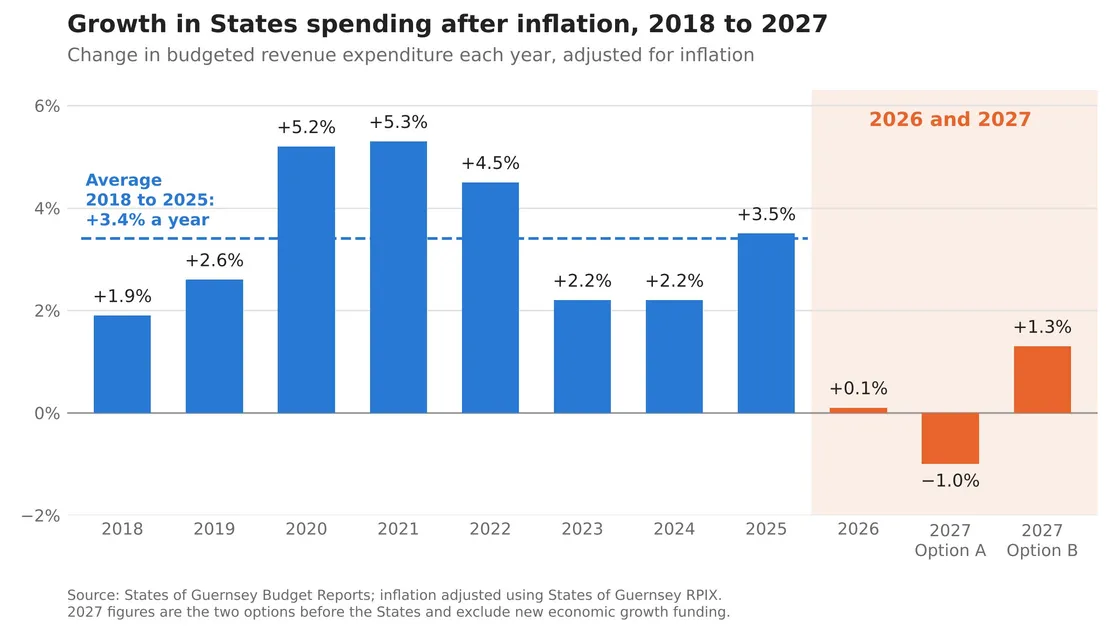
When the States debates the 2027 Budget tomorrow, deputies will face a choice that is simple to state and hard to make. 'Option A' holds the line the Assembly has already set: a 1% real-terms cut in spending. 'Option B' allows a real-terms increase of around 1%. Both choices represent a significant change from the cost expansion in previous terms of government.
The gap between the two options is small in percentage terms. It is not small in what it means for services. Committees had to justify all of their existing spending, not just bid for more, and found £5m. of the £6.8m. of savings asked of them. Five met or beat their 1% target. Even so, submissions came in £33m. above target, driven by service demand, persistent inflation, an ageing population and the rising cost of health care.
So the question is not really A or B. It is how we balance the need for a leaner government, a growing economy and the public services islanders rely on, and how honest we are about what each choice costs.
Eight years of spending growth, and then a turn
Allowing for inflation, budgeted States spending has grown by an average of 3.4% a year since 2017. Every budget from 2018 to 2025 grew faster than prices. In today’s money, that is £177m. more each year than in 2017.
It was not always so. Between 2010 and 2017 the States held spending broadly flat in real terms. Restraint has been achieved before. And perhaps we are still picking up the bill for underinvestment in many areas during that period.
Much of the growth has been in people, often front-line staff delivering services to you and me. The States’ own accounts show the committee pay bill rising from £214m. in 2015 to £330m. in 2025, up 54% against a 41% rise in prices, with around 870 more full-time posts. The growth came from employing more people, not from paying them more.
None of this is a scandal. Much of it reflects real need: our health care needs are now more complex and there are more older islanders. But the direction is now changing. In 2026, spending grew no faster than prices. Option A would bring the first real-terms reduction since 2017; under Option B, growth would still be about a third of the average since 2017.
This year income is forecast to come in more than £90m. above budget, largely from the new global minimum tax, yet committee spending has stayed on budget. Discipline is not what you say when money is tight; it is what you do when money comes in.
What the UK learned from austerity
The obvious comparison is the UK after the Global Financial Crisis. Between 2010 and 2019, day-to-day spending on public services fell by around 3% in real terms. Health was protected and grew by 23%, so others were squeezed much harder: justice fell by 23% and local government services by 16%. The cost showed up later in court backlogs, struggling local services and weak public investment.
Three lessons stand out for Guernsey. Firstly, protecting the biggest budget concentrates the pain on smaller services. Secondly, cuts made quickly fall on what is easiest to stop, not what is least valuable. And lastly, savings not built into how services are designed and delivered will return as pressure later.
As the Institute for Fiscal Studies said in 2019, the era of cuts looked to be over, but they had ‘by no means been undone’.
What a cut really means
A 1% real-terms cut sounds modest. On the ground it can be much larger. Budgets are counted in pounds, but services are counted in people that determine when and how patients are seen, children taught, cases handled. When demand is rising, a budget that is merely flat after inflation already means less for each person who needs a service.
Cuts are always easy to announce and then hard to deliver successfully without a deterioration in services. The quickest savings tend to come from things where the loss is not felt at once. They are delivered when maintenance is put off, prevention scaled back, training cancelled, vacancies left unfilled. The cost always shows up later, usually larger.
That is not an argument against restraint. It is an argument for clarity. Doing the same for less is efficiency. Doing less is simply a cut. Both may be needed, but islanders deserve to know which is which.
Jersey: the same pressures, a different response
Jersey offers a closer comparison. On a like-for-like basis, its core spending grew by about 3.5% a year in real terms between 2022 and 2026, against 2.1% in Guernsey. Statistics Jersey figures show its core government workforce growing by around 35% between 2016 and 2025.
Jersey has since frozen recruitment to its higher-paid roles and made 37 redundancies, mostly in management. Even so, its public sector grew by 230 jobs in a year when the private sector shrank.
Its 2027 budget goes further on paper, on our calculation, a real-terms cut of more than 2% in core spending. But around half of its £21m. of savings comes from cutting employer pension contributions, and its grant to the Social Security Fund is held more than £40m. below formula until 2030. This is a measure that perhaps we can give strategic thought to as well.
Three things to balance
Efficiency. Government must cost less to run. Consultancy spending has fallen by 35% from £15.5m. in 2024 to a forecast £10m. this year. A priority-based budgeting pilot has costed 154 services and is already finding savings that do not touch services. The Budget sets aside £6m. for spend-to-save projects, mostly by redirecting existing capital funding, so that savings come from redesigning services, not simply stopping them.
Growth. The surest way to pay for services is a larger economy. Pillar Two receipts, forecast at £79m. for 2027, give us a window, and the Budget proposes £15m. over three years for growth initiatives. But that income will fade. It must create resilience, so we must buy future growth and not fund today’s running costs.
Services. Health & Social Care accounts for £267m. of a £700m. budget for committees, and each 1% overspend there costs £2.7m. If front-line services are protected, as the UK protected the NHS, the pressure falls on smaller budgets with less room to absorb it, and the bill returns later.
Getting the balance right
Even under Option A, the States still faces a long-term structural funding gap driven by the capital investment programme and the erosion of Pillar Two revenue over time. Tax reform will now help to close it, but it will take all of these measures, in a sustainable combination.
Each option carries a risk. Option A honours the Assembly’s decision and shows clearly that the trend has turned, but committees must find the full 1% within months, and hurried savings fall on whatever is easiest to stop. Option B keeps the £20m. savings commitment and allows time to design savings, but risks later becoming never, with a wider gap.
Option A or B, the rules don’t change:
1. Cut the cost of government, not the services it delivers.
2. If a service is reduced, decide it openly. Don’t let it happen by default.
3. Spend the windfall on growth, not on papering over the gap.
4. Restraint, reform and growth: we need all three, together.
That is what getting the balance right means.





You need to be logged in to comment.