
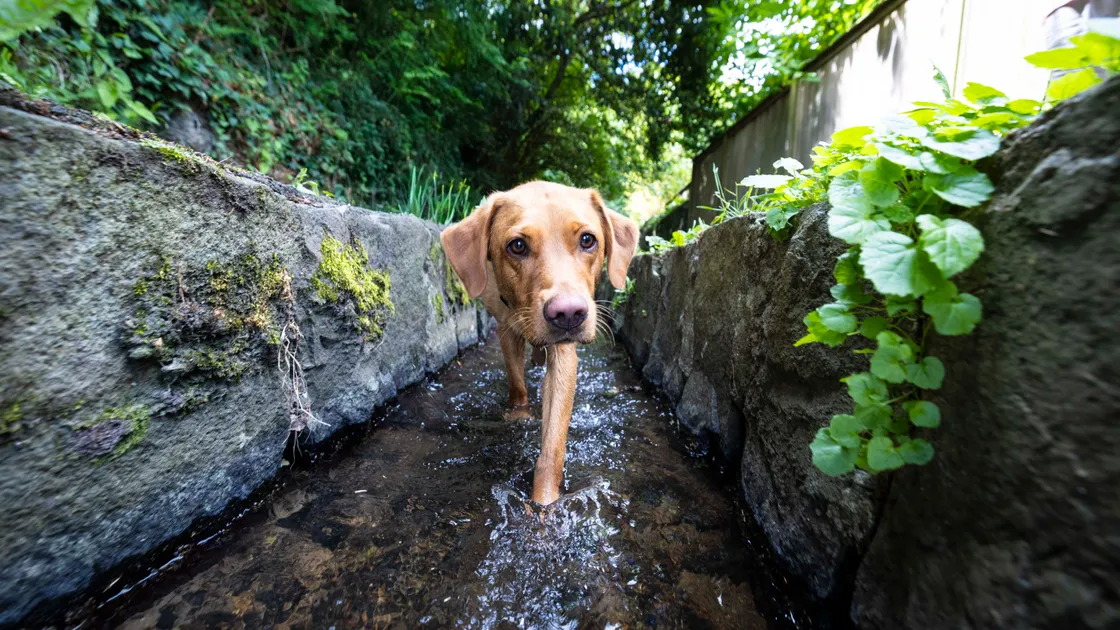
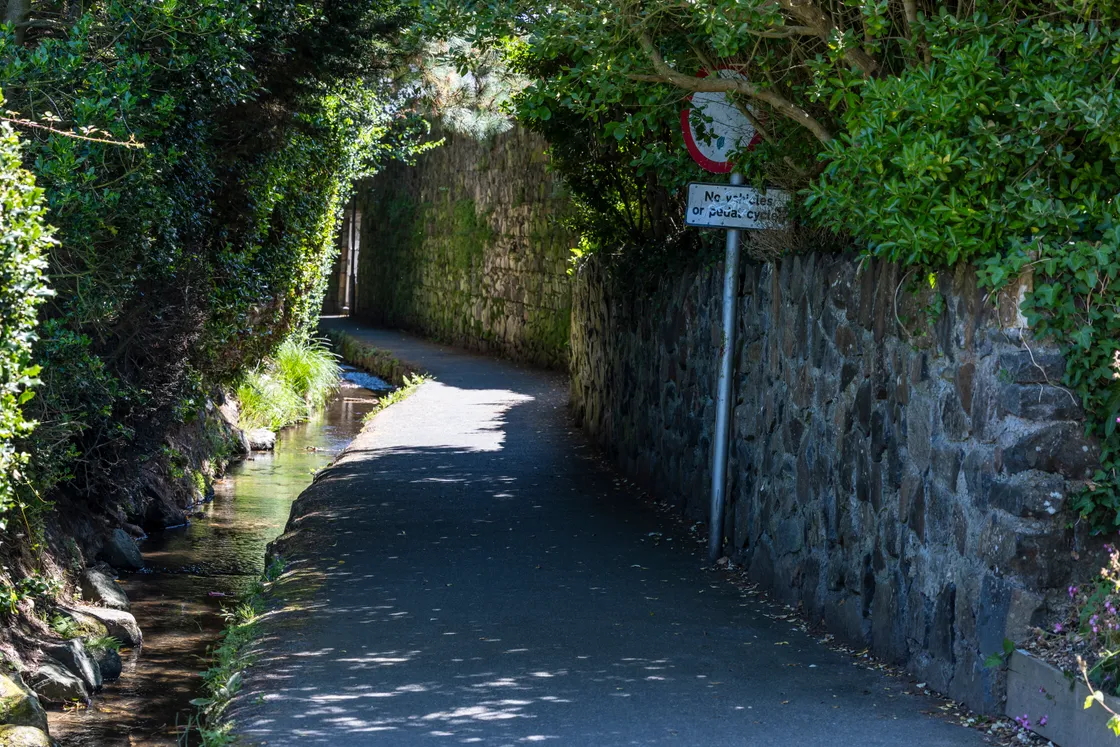
We read with concern about the recently suggested plan to place a grill over part of the Water Lanes stream for reasons of safety. This path is beautiful and such a development would detract from this significantly. In addition the stream is environmentally sensitive and its value to wildlife would be diminished by covering it. The path and culvert are also ancient and arguably parts should be listed as a Protected Monument.
The streams and douits of Guernsey are of high ecological importance. The gravel stream beds of the Water Lanes are a locally rare habitat and one that supports three-spined sticklebacks (Gasterosteus aculeatus).
This is a Red Data Book species and is classed as ‘vulnerable’ in Guernsey. The pollution-free waters are home to many aquatic insect larvae, including caddisfly trichoptera and mayfly ephemeroptera. These and other insects are preyed on by the stickleback – although small, and only weighing in at about 1g, it is a voracious predator. The Bailiwick Bat Survey has shown that the sheltered Water Lanes provide fertile hunting grounds for several species of pipistrelle. Many common species of birds nest in the vicinity, and at all times of the year, the stream is a resource for drinking and bathing birds. In the winter months it provides ideal habitat for the grey wagtail Motacilla cinerea, which can be seen looking for its insect prey in the stream. It is also a great resource for drinking and bathing birds.
Historically the Water Lanes stream is one part of a longer leat system (a man-made water course) constructed to supply the upper and lower watermills at La Vrangue. These mills, and by extension their leat systems, were in existence by at least the second quarter of the 14th century. They are mentioned under the entry for the parish of St Peter Port in the 1331 Extente of Edward III as possessions of the king and were valued at 17 and 16 livres tournois per annum respectively.
The earlier 1248 Extente of Henry III is unfortunately less detailed and only refers to ‘the seven mills of the lord the king’ rather than naming them individually like its later counterpart. However, it is reasonable to suggest that the mills at La Vrangue may have been extant as early as the middle of the 13th century. The 1248 Extente also lays out the obligations of the islanders and the king respectively regarding the mills with the islanders obliged to upkeep and repair the mill buildings, as well as the sluices and conduits, whereas the king, or the Bailiff on his behalf, was obliged to provide the mill stones, great beam and the mill irons. This is notable as it shows that the maintenance of mill leats such as the Water Lanes was a primary concern during the Middle Ages.
The watermills at La Vrangue continued to function into the early 19th century and the stream and leat system are clearly visible on the 1787 Duke of Richmond Map. The water still follows along the same course today, although in parts it has been culverted and can no longer be seen above ground. The stream begins in the grounds of Havilland Hall and after supplying the mills, the water would have ended up in the marshes around Le Chateau des Marais.
The Water Lanes is roughly in the middle of the leat system and considerable parts of the structure here are clearly of medieval origin. This can be shown by the use of large unshaped boulders to form the edges of the culvert. Where boulder boundaries like these exist elsewhere in the island, they are considered to have been created during early land clearances and thought to be at least medieval in origin.
The Vale Marais stream is another of Guernsey’s constructed watercourses, or douits, and also likely to be medieval in origin. Its purpose was to drain the large marais (marsh) to the south of Les Clotures – originally it discharged into the Braye du Valle at Pont Allaire, but today empties into the Vale Pond. This douit was scheduled as a Protected Monument in 1990.
Being of equal antiquity and equal if not greater historical significance, we believe that the Water Lanes leat is an important element of the historical built landscape of Guernsey and as such should also be considered for legal protection.
We understand that plans to develop the Water Lanes have been put on hold for the moment and will be reviewed.
It is our strong belief that this place, so beautiful and peaceful, so important for wildlife and so ancient, deserves protection and should be left unchanged.






You need to be logged in to comment.