

‘God gave all men all earth to love,
But since our hearts are small,
Ordained for each one spot should prove
Beloved over all.’
It rather proved Rudyard Kipling’s point that his words, written in Sussex, were chosen by their King’s representative – a man of Kent – to be heard by the 110 returning Alderney folk as they prepared to set foot on their home island after five years of exile.
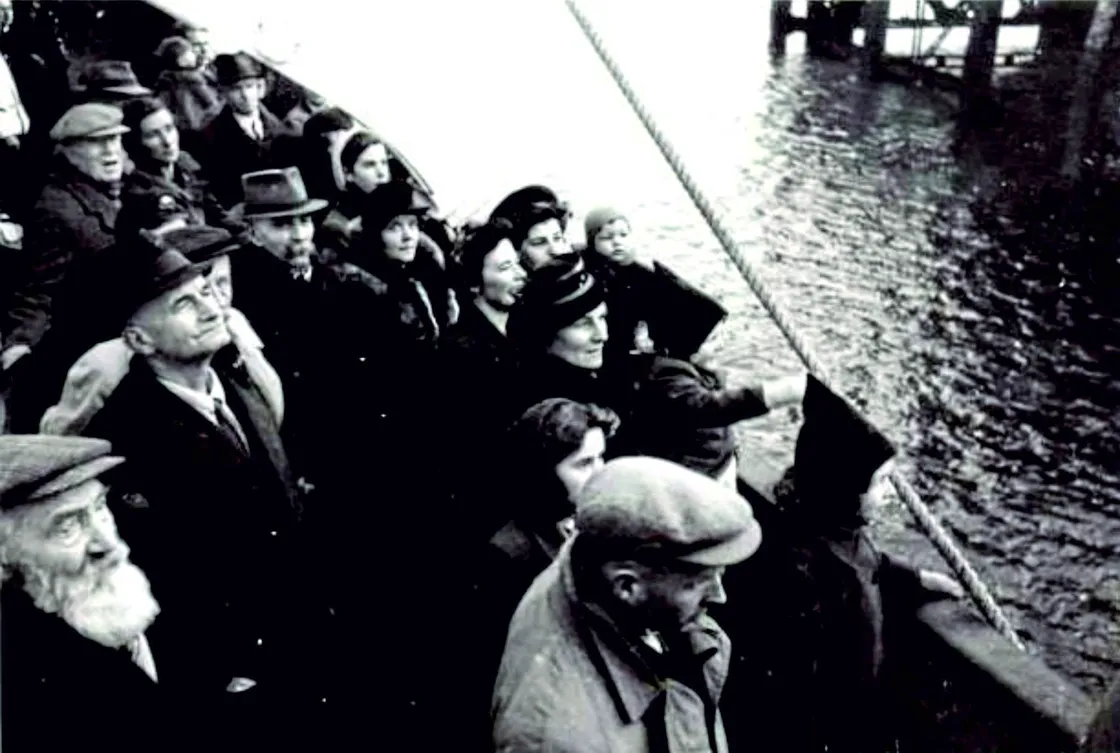
It was 80 years ago today that the Bailiwick’s new Lt-Governor Sir Philip Neame stood upon a German-built quay at Braye Harbour and spoke into a microphone – held for him by one of the hundreds of British soldiers who had spent seven months trying to make the island habitable – to the day’s passengers aboard the Southern Railway auto-carrier.
Alongside him were Colonel Power and Brigadier Snow who had arrived with the liberating Force 135, and Judge French who had led the Ridunians away from their island on that fateful day in June 1940, when they chose exile over Nazi rule.
With them on the quay stood the ranks of 614 Regiment, Royal Artillery and members of Guernsey’s Salvation Army Band who had come over on a Saturday, despite the risk of not making it back for Sunday.
Sir Philip kept the passengers waiting a little longer while he urged them not to fraternise with the 400 or so German prisoners of war who’d been retained to undo their own damage.
‘If you begin to feel sorry for them, remember they are the people, the very individuals who destroyed your island’s life,’ he said, ‘and more than that, go and visit the slave workers cemetery where there are many rows of graves, Russians, Poles and others of our allies, worked to death in this very island with starvation and ill treatment by German slave drivers.’
As one of 11 children aboard the first of three sailings to be bringing back whole families of islanders, Sally Hammond (now Bohan) won’t have been taking much notice of the ongoing oratory – even if it was being delivered by the only man ever to earn both a Victoria Cross and an Olympic gold medal, one of which he won for shooting deer.
‘There’s no way that boat was going anywhere without my mother on board,’ Sally told me from her Alderney home, explaining her presence on that first sailing.
‘People were very happy to be coming back but the island had changed so much. The place had been vandalised – that’s the only way you could describe it.’
Indeed, despite those seven months of hard graft, everyone from Neame to the lowliest POW seems to have understood that the returnees were in for a shock.
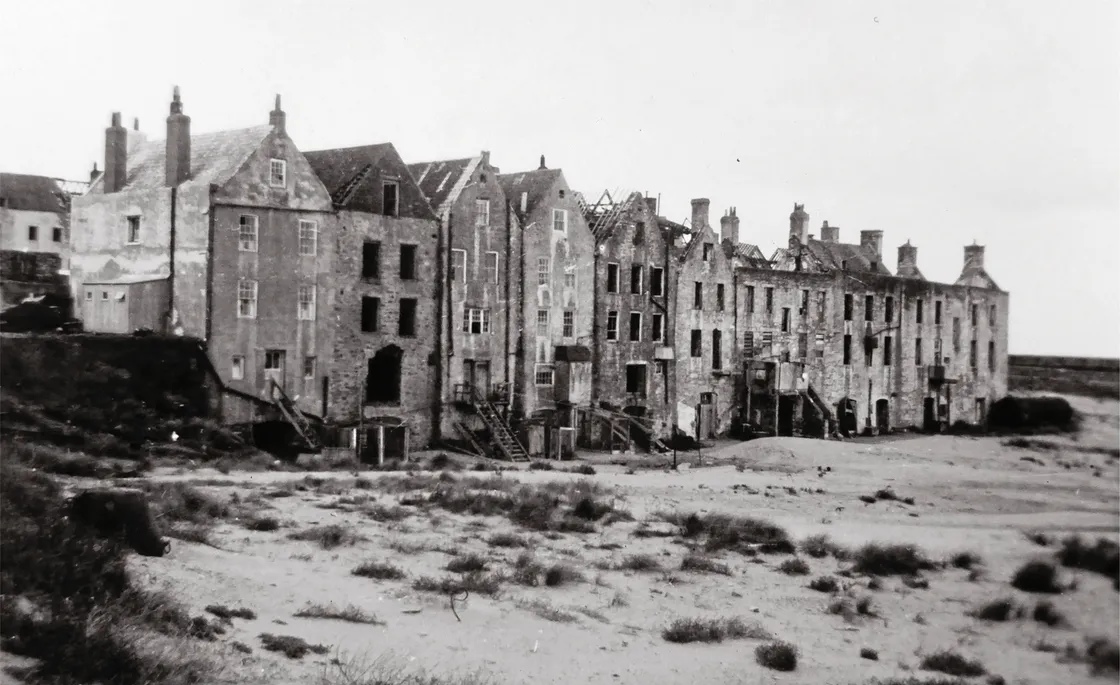
‘This will be no easy home-coming for you,’ Sir Philip said.
‘Your island has been devastated by a brutal foe.’
This foe had been forced to clear 37,000 mines, restore 350 houses out of the 650 that still stood – about 100 no longer did – and remove 135 roll bombs from the cliffs and 215 beach obstacles, or ‘metal hedgehogs’. They even made the airport runway fit for purpose.
‘Your houses were uninhabitable, the streets and roads blocked with debris, the fields and beaches sewn with wire and deadly mines. You would have been helpless and unable to live here.’
Alderney’s Homecoming Day has gravitated towards this date over the years despite the fact that the 110 who came ashore on that overcast Saturday represented only about one in 14 of those that had left in 1940.
It was a very significant arrival, however. Symbolically, this was the ‘farmer’s boat’, bringing those who would restore the island by means of resuscitating its primary industry, with the assistance of two separated herds of Alderney and Guernsey cows.
Two further sailings followed on the following Saturday and on 30 December, bringing 360 people between them.
And yet, looking at our own archives, there was no lack of fanfare much earlier in the month, when the vanguard arrived.
‘Alderney will be reborn this week’ claimed our edition of 26 November, announcing a historic Alderney States meeting which was slated to take place in London.
‘For the first time in recorded annals of the four Channel Islands... a legislative assembly will officially meet outside its own shores.’
And then, following the meeting, we claimed on 30 November that ‘tomorrow will be the greatest day in the history of Alderney’.
A delayed boat saw to that, but the day after had become a ‘crowning day in the long history of the “Cinderella” of the Channel Islands’ by the time we reported on it on 3 December.
Arriving aboard the American-built Guillemont after their original boat was forced to turn back, that vanguard consisted of Judge French, our reporter and several enthusiastic members of the Women’s Voluntary Service. In fact, some of those WVS women had made their way to Alderney almost a month earlier with Neame to assess conditions and make recommendations – quite an adventure with about 99% of the mines still in place at that time.
In a foreshadowing of Homecoming Day, Judge French no sooner stepped onto the quay than he turned and gave an address to the assembled before they could disembark.
He professed himself overwhelmed at the greatness of the army’s achievements in restoring the island to a liveable condition.
Taking a ‘what did the Romans ever do for us?’ approach, our reporter highlighted the building by the occupiers of the best and biggest bakery in the Channel Islands, the installation of electric power to all remaining homes, connections to the main drain and the building of a ‘supercinema’.
Also in this edition was a reminder that Alderney was never entirely abandoned by its people.
‘I called on one of the few “stayers” of Alderney’s 1,500 – 66-year-old Frank Osselton – who remained in his island home throughout the Nazi’s five-and-a-half years occupation,’ our reporter wrote.
‘They chased him from pillar to post, kicked him out of three different farms (razing his own farm to the ground in the process) but despite this Frank maintained his British doggedness and defiance and took his precious herd of seven cattle with him wherever he went. They are alive today, and Frank Osselton tends his cows and yearns for the day of his wife’s return from London.’
There were more sailings on 4 and 6 December which brought jurats, the douzaine and their wives, more members of the WVS and shopkeepers.
On Friday 7 December we carried news of a discussion in the House of Commons earlier that day, during which Home Secretary James Chuter-Ede reassured his questioner that all sailings back to Alderney were free of charge for islanders.
The transformation had been profound during the months before those free sailings took place – not only in terms of the infrastructure and environment but also in terms of the atmosphere.
It may be true, as frequently reported, that the birds were all but absent and did not return for several years and in Michael Packe and Maurice Dreyfuss’s The Alderney Story 1939-1949, they describe 150 rats being found in a single haystack, but another story of theirs from this recovery period conjures a scene of noisy joy.
‘The Germans, who had seen the British troops bathing, sought permission to do the same, in large batches of 200 at a time. After some hesitation, Major Arnold agreed. He could see no harm in it, provided that a Bren gun post was ostentatiously set up to command the beach. The day was warm, the sun was bright – everyone, guards and prisoners alike, gladly stripped, ran down to the sea, and splashed about together. To his consternation Major Arnold realised that he could no longer distinguish friend from foe. Naked, they all looked exactly the same. His Bren gun nest was useless – potentially, the situation was out of hand. Fortunately, no one seemed to have thoughts of malice. In due course, they all got dressed again and normal identity was resumed.’
‘There were about 3,200 German personnel in Alderney at the time of liberation but the vast majority were removed to POW camps in the UK in the ensuing days,’ says Occupation historian Colin Partridge, a former Channel Island Occupation Society president and contributor to Lord Pickles’ Alderney expert review.
The review concluded that just under 8,000 slave workers had been sent to Alderney, of whom about 1,000 died there, though the report acknowledges it could be anywhere between 641 and 1,134.
‘The number of slave workers on the island dramatically reduced after D-Day in the summer of 1944,’ Colin says, ‘as their labour was desperately needed elsewhere by the Germans.’
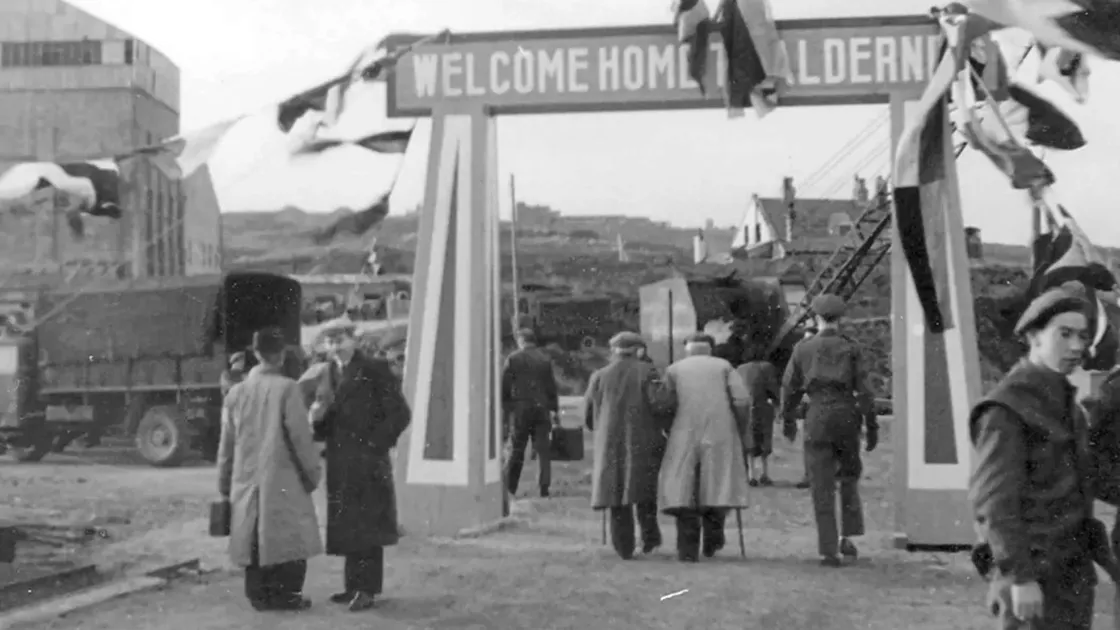
Finally, after the speeches were over, those on the Farmers’ boat were able to head onto the quay and get a closer look at the Welcome Home To Alderney sign in two-foot white letters on a scarlet background that had been readied for them. With field boundaries now unclear and trenches and defences littering the island, they had a communal farming system to get used to and houses to inspect.
But first they were taken to the Grand Hotel for a warming cup of tea and then to the WVS headquarters for some breakfast.
The group included 82-year-old John Sebire and his five-year-old grand-daughter Avril Sebire, who had been weeks old when they were forced to leave the island. Between them, they inspired our reporter to philosophise on the northern isle’s prospects.
‘Was this not the start of a new, broader, grander life? Did it not open for her young soul a new age in the history book – this landing on a shore that was “foreign” to her, and yet all the time, her life, her new Home? Avril stood with firmly planted feet, looking strongly into the unknown future. She was typical of young “Mr, Miss or Mrs Alderney”. The path that lies ahead of them will not be one for easy feet. The road will be strewn with obstacles, and life for Alderney people – as for their brothers and sisters in Guernsey – will at times be grim and hard. But I read in the eyes of young Avril and the 10 other children who came with her, the resolute determination that, come what may, they will not be found wanting in the spirit and willingness again to put Alderney on the map.’
Inspiring stuff. But as Kipling was getting at, it’s not your prominence on a map that matters, it’s knowing that you’re home.


You need to be logged in to comment.