The record for the traditional Liberation Day 7-mile road race could be under serious threat this year.
I’m not referring to the fastest time, of course. Dave Kreckeler’s legendary run of 34:39 has stood for 60 years and is generally regarded as the most inviolable benchmark in Guernsey athletics history.
Nor am I referring to Louise Perrio’s women’s record from 2017. She finished fourth overall that year with 40:24, which has been threatened since but not bettered.
No, the record which nobody would be at all surprised to see fall is from 2019. In that year, 201 runners got over the North Beach finish line in times ranging from the 36:39 achieved by winner Ryan Burling to the 82:32 achieved by ‘DQ Headphones’. In fact, four runners were disqualified for wearing headphones that year, so perhaps we should call it 197. But if so, that’s still the record year.
It’s all a far cry from the origins of the event – long before the days of mass participation, couch-to-5k and parkrun – when persuading anyone to don a pair of plimsolls and run from the west coast to Town via Bordeaux was evidently quite a challenge.
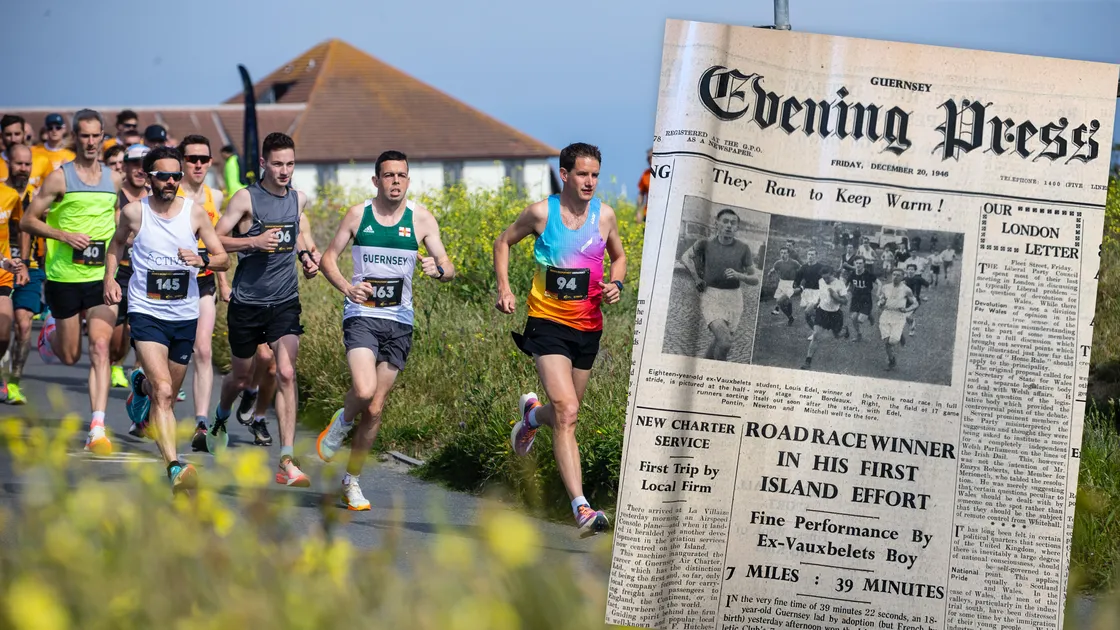
Our story begins on 16 September 1946, when the Guernsey Evening Press printed a letter sent in by a 24-year-old called Baron F L Pontin. He wasn’t a Baron, you understand – that was just his first name, although he did go on to become a sort of godfather of Guernsey hostelry and is perhaps best remembered as the man who booked The Beatles to play at Candie Gardens in 1963.
‘With so many keen athletes, both senior and junior, there is surely a need for an Amateur Athletic Association,’ he wrote.
‘At present, no official body exists to organise, train or encourage running. Many fine trophies exist with no really regular meeting to dispose of them.’
Despite a few sporadic road races and the more regular church-to-church walk, our sporting offerings of the time were disparate enough to prompt one GEP writer to bemoan, in early October of that year, Guernsey’s ‘lackadaisical attitude of staging sports meetings’.
The same writer credited the Occupation with rejuvenating athletics in the island, which had led to the successful meeting at College Field on 22 August which had inspired Mr Pontin – ‘a young Guernseyman with a pleasing energetic drive’ – to pen his appeal to GEP readers, which by now had led to the election, on 27 September, of a governing body.
‘Undoubtedly,’ wrote the scribe, ‘there is every reason to think that Guernsey, with these people at the helm, has a great chance of putting island athletics on the pedestal where it belongs.’
And he ended with a rousing ‘Forward! Guernsey Athletic Club!’
Well, things were destined to go backward before they went forward from there – at least as far as endurance running was concerned.
Faced with the harsh reality that only four runners had registered for a new 7-mile road race, Pontin – now GIAAC honorary secretary – again took to his writing desk at his home on Collings Road and announced to the GEP editor that he was postponing until 19 December and that ‘I intend to instigate training runs on alternate Thursdays and Saturdays [which] will take the form of hare-and-hound paper-chases – at first over a distance of four miles, increasing each week’.
He appealed to Guernsey’s Old Intermediates, Old Elizabethans and Vauxbelets Old Boys to ‘look out their shorts and shoes’ and cunningly let slip that ‘Jersey has sent two entries for the race and they will no doubt train more now’.
That may have been the spark of inspiration that created what is now our longest-established running event.
A much more verdant field of 17 runners gathered at the Houmet du Nord to start the first GIAAC 7-mile run, with French-born VOB Louis Edel, 18, finishing at the GWR mailboat berth in 39:22. At the presentation in the White Rock Cafe, president Eric Chambers handed him ‘the perpetual trophy presented for the event by the Pessimists AC, a cup valued at 15 guineas’.
That’s about £800 at today’s values.
Edel may have slightly irked those like Pontin who had trained for eight weeks or more, as he hadn’t trained at all and was running in his ‘first big race’.
Mention was also made in our report of 15-year-old David Druce of St Peter Port Boys Club, who finished in 48:15 ‘and was not at all distressed at the tape, finishing bright, fresh and unblown’.
Pontin, by contrast, dropped out with stomach cramp, but he ‘gained the praise of the runners and spectators’ for organising the race, while weather and illness prevented two Jersey runners from competing, leaving only A Gray of the Evening Post to represent the Caesarean cause with a seventh-place finish.
This meant he missed out on getting a prize from his rival publication, as the GEP had provided the awards for the first four runners home – Edel got a pigskin writing case, Tommy Mitchell a gold propelling pencil, Roy Battle a rolled gold cigarette case (yes, you read that right, a cigarette case) and Bunny Newton received a wallet.
With the new club up and running (pun intended), you might think the 7-mile run would be firmly established as a competitive event, but it promptly disappeared.
The GIAAC managed to hold an impressive sounding meeting at the College Field in 1947, which was attended by 3,000 spectators – some of whom will have been disappointed at the non-appearance of fog-bound Trinidadian sprinter E Macdonald Bailey, who jointly held the 100-yard world record of 9.6 seconds at the time. But there was no room in the sporting calendar for a 7-mile run that year.
It returned in 1948, when it was won by Frank Mellanby in 43:29, but it wasn’t until 1949 that the event was run during Liberation celebrations – albeit on 11 May.
Ever since then, the event has been focussed around our ‘national’ day with a steadily increasing number of people taking part, who have boasted an ever-widening array of expected finish times. And the event has taken on a significance that has widened beyond those who assemble at the start line.
Deputy Andy Cameron is the States’ designated driver of all things Liberation Day and describes the run as ‘one of the great traditions of our celebrations, bringing together sport, community spirit and remembrance in a way that reflects the very best of Guernsey’.
‘I was disappointed that this year we were unable to have the race finish along the Town seafront, but with the parked cavalcade and the large numbers of people gathered there, it was rightly considered safer for runners and spectators to finish at North Beach,’ he said.
‘Looking ahead, I would very much like to see events like this taking centre stage on our seafront as part of future Liberation Day celebrations, showcasing both our heritage and our sporting community.’
A move of the finish line to the Crown Pier may be a pier too far for health and safety but perhaps one day we might see it nudged across the car park to the Liberation Monument, which was placed at the landward end of the White Rock because of the powerful historical connections of that place with the Occupation experience – scene of the evacuation, the bombing raid of 28 June 1940 and the exact spot where islanders were first able to embrace the liberators. The first run in 1946 appears to have acknowledged this, with runners obliged to run to the end of the jetty before doubling back to finish at the GWR berth. Easier to manage with 17 runners than with 170, I suppose.
Or perhaps it will be more? A new record of 202? I’ve done my bit towards achieving that by registering for my first ‘Liberation 7’ and if you wish to do the same, the deadline is midday on Friday 8 May. See you at the start line!
To register for the Source Recruitment Liberation 7 running event, go to guernseyathletics.org.gg/liberation-7 before midday on Friday. Entry is £8 and participants must be 16 or older. The race begins at Rousse at 9am on Saturday. A kit van will be available to take participants’ bags to the finish.
The very upright figure of Dave Kreckeler towers over the history of Guernsey’s most venerable running event. It’s not just that he still holds the record after 60 years, it’s also his extraordinary run of 13 victories between 1954 – when he won as a 19-year-old in a time of 40:53 – and 1966, culminating in that unbeaten run of 34:39. The record books show that his winning time in 1963 was only 30:37 but the race had been shortened to six miles that year, to accommodate a visit to the island by the Queen. The race wasn’t held in 1967 and 1968, when the athletics club temporarily folded due to a lack of volunteers, and Dave ran in Jersey instead in 1969, but he was back for one last go in 1970 and won again at the age of 35, before retiring from the event having never been beaten.
‘The course itself has evolved and the original would almost certainly have been a little short,’ says Paul Ingrouille, ‘but that doesn’t take away from the fact that Dave Kreckeler’s time was outstanding. He was one of the top handful in the British Isles over that distance at the time. We shouldn’t snub old records just because we’ve found a discrepancy. It will have been more than made up for by modern advances in running shoes, nutrition and so on. His 1966 time is one of the outstanding endurance records of Guernsey Athletics.’
One man who might have been expected to go close to eclipsing Kreckeler’s mark is Olympian Lee Merrien. Indeed, Paul has calculated that when Lee set his own half-marathon Guernsey record, he ran the 13.1 miles at exactly the same pace per mile – 4:57 – but for almost twice as long. But at the peak of his career, Lee naturally had to prioritise Olympic and Commonwealth Games goals, in which he would be representing GB&NI and Guernsey respectively, meaning that even when able to participate, he would not be able to shift his training programme around in order to guarantee getting the best out of himself on the day. His time of 35:21 in 2014 was his best, and so Kreckeler’s record still stands.
And who knows how much longer it will remain in the record books?
‘One factor is that this used to be the one big island road race between April and September, whereas now there are marathons, half-marathons, 10ks and the Easter festival – the strongest runners will often have other priorities or be preparing for meetings elsewhere,’ says Paul.
An example of that is that sometimes – like this year – the event clashes with the Hampshire Track and Field Championships, to which Paul and a team of local elites will be travelling this weekend.
‘It doesn’t have a big effect on the overall numbers but it can affect the sharp end.’