
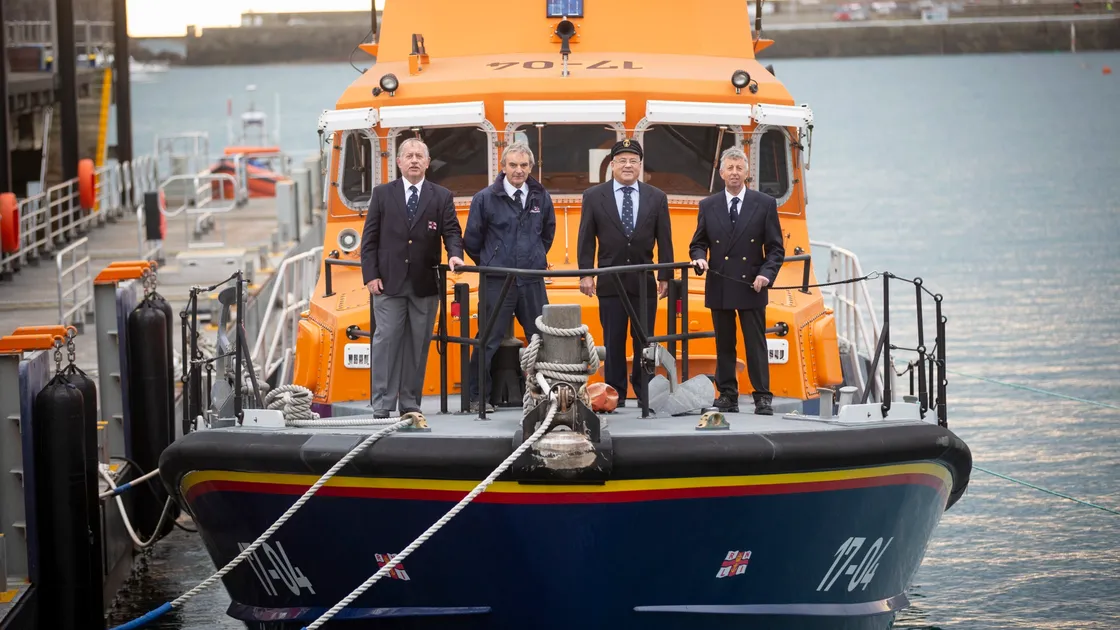
Guernsey Press reporter Nigel Baudains and former crew member John Webster managed to get four members of the 1981 crew together again on today's Spirit of Guernsey lifeboat to mark the famous Bonita rescue.
We also spoke to former coxswain Mike Scales, who left the island many years ago. The full story, and the interviews with the crew members, appears in today's centre pages.
The Channel Islands and the south coast of England was being battered by storms when, at 1pm on Sunday 13 December 1981, a mayday call was put out by the 8,000-tonne Ecuadorian cargo ship MV Bonita, in trouble in the English Channel.
The ship was sailing from Hamburg to Panama, loaded with fertiliser, with 36 people aboard – Ecuadorian crew plus engineers and an electrician from Spain and Norway, and a couple of wives and children on
board.
Huge waves lashed the Bonita’s port side and caused her to list heavily to starboard, shifting the ship’s cargo. She was unable to right herself and the ship’s engine lost power.
The RNLI’s volunteers on St Peter Port’s Sir William Arnold lifeboat launched to the cargo ship at 1.23pm.
The vessel broached – keeled over to one side due to the force of the wind and waves – soon after they left St Peter Port, the first of many times the crew would experience that effect.
By the time they reached the stricken vessel, a Royal Navy rescue helicopter had headed to the scene and successfully managed to take four people, including the captain’s wife and toddler, off the Bonita, now listing at 45 degrees.
But the helicopter’s rotor blades started to ice up, forcing the aircraft crew to retreat.
‘The first view of the ship, it was dusk, it’s snowing, the seas were 15 metres high. It’s not until you see the daunting sight of a ship laying on its side knowing the amount of people that have to be rescued and the precarious position they are in, then you have a thought “well, how am I going to get these off safely, or as best you can”,’ said coxswain Michael Scales, in an interview published at the end of last week and issued to all Guernsey media by the RNLI itself.
John Bougourd had joined the crew the year before.
He spent 27 years on the RNLI crew but said he never experienced such a dramatic rescue again.
‘As we approached we could see the Bonita on its side,’ he told the Guernsey Press. ‘It was like a beached whale, silvery and grey in the fading light. We could only see the hull as it was leaning away from us.’
The lifeboat came alongside and crew started to jump from the stern of the ship. But one misjudged the jump and was seriously injured. He later died in hospital.
Mr Scales changed the plan and the lifeboat crew threw lines to the Bonita so crew could throw themselves into the sea and be pulled aboard.
‘I had great respect for those crew members onboard Bonita who decided “well we’re going to jump” because personally I wouldn’t have liked to,’ said Mr Scales.
‘I wasn’t thinking about my state of mind, I was thinking about the state of mind of the people we had to persuade to jump.’
Mr Scales said that the rescue drained the entire crew.
‘Halfway through, we had 16 people on board, we had a serious injury and the crew were exhausted. I was exhausted because it is concentration. Eventually the master of the Bonita was rescued and then I went “oh, thank you God”.’
In total 29 people were rescued by the lifeboat and taken to the Torbay lifeboat station in Brixham, as, having drifted during the rescue, they were now closer to the UK than to Guernsey. The lifeboat reached Devon after more than 10 hours at sea.
The Guernsey crew spent the night there before returning to the island in the morning.
Two Bonita crew members died. One fell and hit the side of the ship during the rescue, killing him instantly, while the man who sustained the head wound jumping from the ship died later in hospital from his injuries. In May 1982, the St Peter Port crew attended the RNLI’s Annual Presentation of Awards. Mr Scales received a gold medal for gallantry while his crew all received a bronze.
‘I look at some of the photos, a few of my crew have since passed. I look at 40 years and think, “where did that go?”,’ Mr Scales said.
‘I look at what the RNLI is doing now in their construction, their training, the college. It’s a new generation, but it’s still get out there and save lives.’
Comment, page 15


You need to be logged in to comment.