

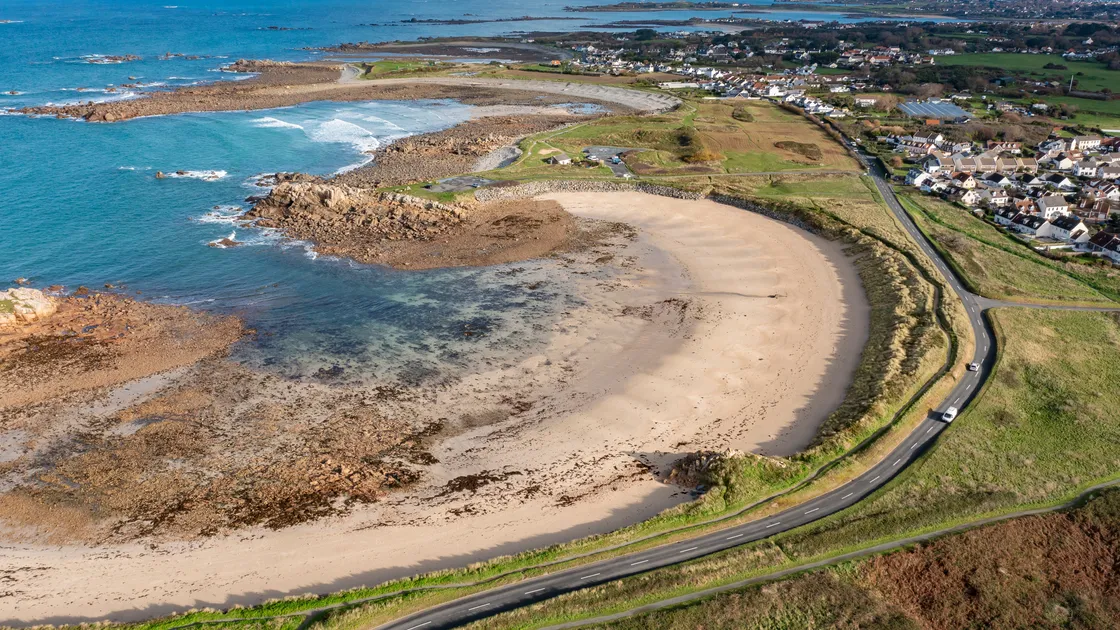
It intends to carry out further investigations on the coast there.
Earlier this week Deputy Marc Laine said that water testing at the bay, which he had paid for privately, had shown that one rock pool contained nearly 1,000 times more lead than the maximum UK drinking water standard of 10 micrograms per litre.
The area, popular with surfers, backs onto the Guernsey Clay Target Shooting Club’s range and the use of lead pellets had been blamed for the contamination.
Director of Environmental Health and Pollution Regulation Tobin Cook said samples including sediment, seaweed and shellfish had last been taken from the area in 2022, but arrangements were currently being made with a laboratory to submit further samples.
‘Four samples were taken of water from rockpools and only one sample exceeded the drinking water standard, at 12ug/l,’ he said.
‘The seawater samples taken in 2022 all had lead levels less that 1ug/l.’
He said it should be noted that the UK drinking water standard was not an environmental standard.
‘The local groundwater/surface water standard, as set within the Environmental Pollution (Water Pollution) Ordinance 2022, is 7.5ug/l. There are no environmental seawater standards in Guernsey.’
He said Environmental Health & Pollution Regulation had worked with the Guernsey Clay Target Shooting Club since 2022, and numerous measures have been put into place to reduce the amount of lead being released into the environment.
‘These include the creation of the earth bund and increasing the efficiency of shore-cleaning activities,’ he said. ‘We will continue to work with the shooting club and will review the latest test results when they are available.’
La Societe marine biology section secretary Nicky Harris said La Societe was concerned about the recent reports of high lead levels recorded at Portinfer.
‘Heavy metals and pollutants can enter marine environments in a range of ways, such as from run-off and leachates of nearby industry, and from the direct deposition events – such as old lead pellets,’ she said.
‘However, the presence of lead pellets still in the rockpools and beaches does indicate that a main reason for the high levels is directly attributed to the old shot in this instance.’
She said La Societe would support further testing on fish and shellfish samples from the area to check the exposure level and how this compared against safety standards.
‘Lead can certainly bioaccumulate in the food chain, not as efficiently as mercury or other substances of concern such as forever chemicals, but still enough that we need to be very aware of it.’ She added that as with other heavy metals, high concentrations of lead can have numerous negative effects on marine flora and fauna.
‘This has the potential to disrupt development right through from larval stages, to growth impairments, issues with reproduction and overall leading to earlier mortality,’ she said.
‘This of course depends on the level of exposure – both at a water concentration, and with sediment contamination.’

You need to be logged in to comment.