
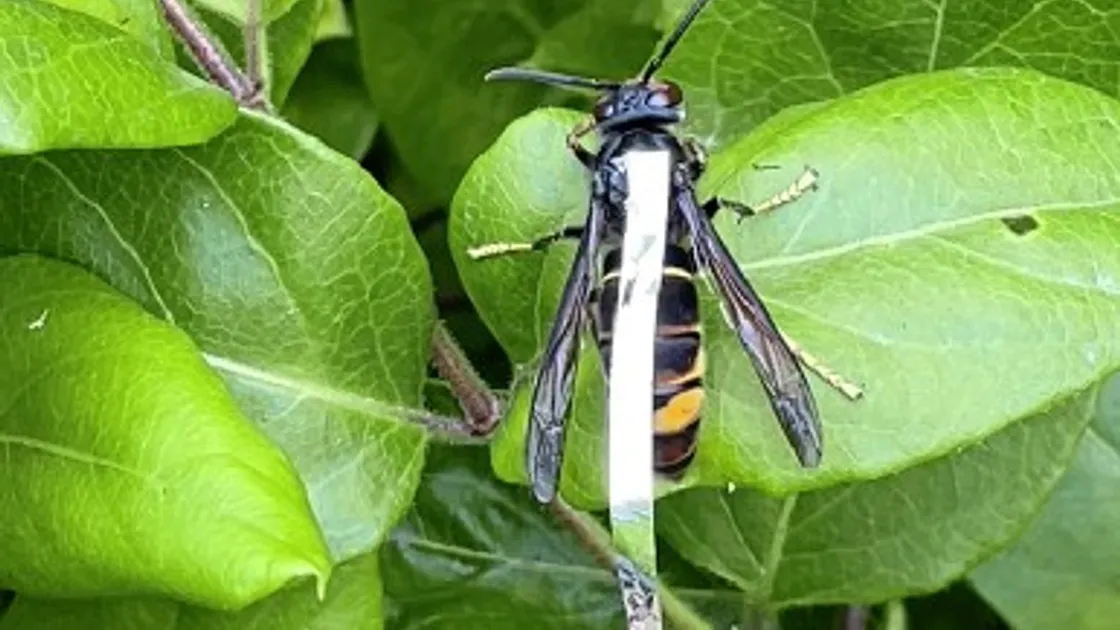
Islanders have always been a huge help in spotting invasive Asian hornets, but finding the nests, which are often high in tress, has proved to be a challenge.
But the new idea sees a small piece of tinsel attached to the hornets, so they can be more easily spotted as they return to their nests.
Asian Hornet Strategy project coordinator Francis Russell said while the tinsel tracking was new for Guernsey, it was following an ancient idea.
‘If we look at hornet tracking in Asia, they have been doing it like this with feathers,’ he said.
‘The tinsel tracking technique proved to be a game-changer in our latest Asian hornet encounter. The nests we’ve discovered this summer appear to be more developed than those found in previous years, as the fine weather seems to have allowed for uninterrupted nest building and foraging. These more innovative methods of tracking will therefore be instrumental in helping identify and remove nests more quickly.’
Jersey hornet researcher Chris Isaacs devised the latest tinsel tracking incarnation and passed it to Guernsey’s Asian Hornet team.
Mr Russell said a small device was used to carefully hold a captured hornet to allow a small spot of glue to be applied, which allows the streamer to be attached.
The streamer is about 5cm long and shiny.
Mr Russell said the hornets would sit for a few minutes after the attachment, fiddling with their new ‘tails, before adjusting and flying off.
‘The only down side if they can chew them off back at the nest, but with a full streamer it glints in the light,’ he said.
He also has three coloured pens, which allows them to identify different hornets by colour. So if a red or yellow spotted hornet returns to a feeding station, the team can know how long it has been gone and get a rough idea of how far away a nest is.
These low-tech methods, combined with the local trackers’ good instincts for finding nests, have been very successful. But more high-tech methods are being developed.
A Dutch company is developing a new generation of lightweight transmitter tags, which allow the hornets to be tracked back to the nests.
Trackers have been brought into Guernsey before.
The first-generation devices were much heavier, meaning only larger, heavier hornets could carry them. And by the point they got to that size, there was a risk queens were being released.
But the new lighter trackers can be attached to smaller hornets – so much earlier in the season, when nests are smaller and before queens are released.
Mr Russell said they had looked at the devices.
‘They are smaller and rechargeable,’ he said.
‘Sark is looking to get one and Jersey is investigating getting one. They are looking to spend the money and it seems like a solution to find a nest quickly.’
But the £2,500 cost for the frugal Guernsey department, which has tracked nests successfully using bait stations, binoculars and leg work in past, made them pause.
‘We are holding back, as we don’t want to spend the money until the technology is proven,' Mr Russell said.
'So we are going to see how it goes in Jersey and Sark.
‘But it is something we are interested in.’
The low-tech tinsel option has been working well.
‘It’s like monitoring a kite – you can see it with your eyes.’
They can then see which direction the hornets fly in and this helps find the nest.
While the original tinsel strips were gifted to the team, Mr Russell said it would be cheap to buy more.
‘Compared with £2,500, a bit of foil will not be a huge expense.’
Jersey has also been using the tinsel method, but with the team there finding around five nests a day, they face a bigger task.
The hornets have been a problem in the UK, but the publicity has not always successfully reached people. Mr Russell said determination by local bee-keeping groups, especially along the south coast, was finally paying off to get the problem in the public eye. But the problem may already be quite a big task. Guernsey has worked hard to ensure hornets are not over-wintering. But they likely already are in the UK.
‘The national organisation has tried hard,’ Mr Russell said.
‘But now they have hornets in Kent, which have been born there from the year before, so they are seeing early hornet numbers, so they need to get on top of it. The message is finally getting out, which is brilliant.’





You need to be logged in to comment.