

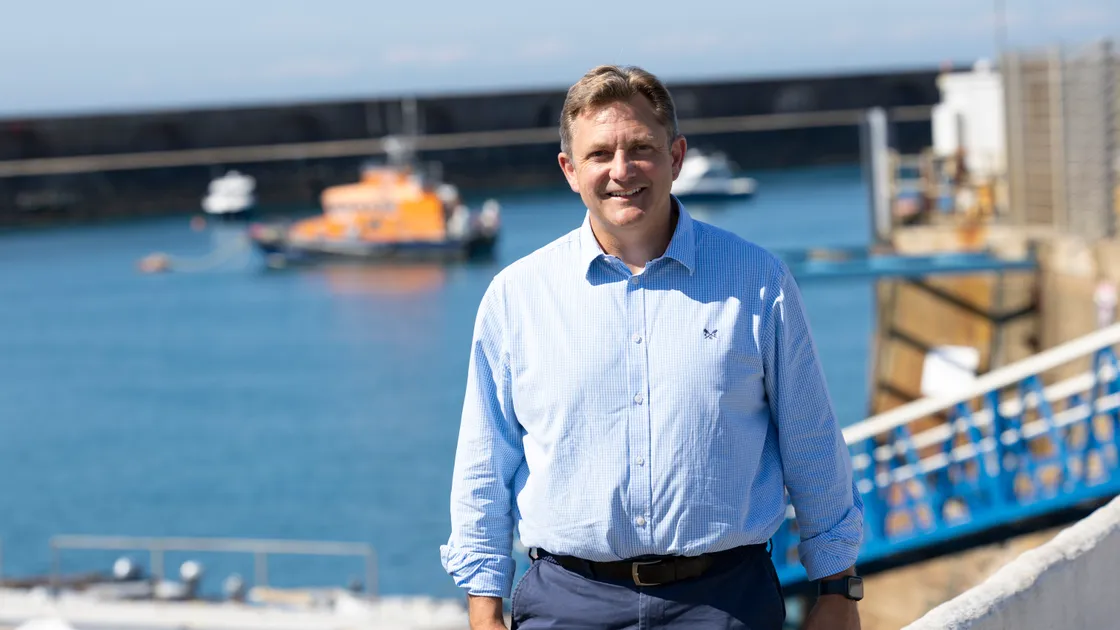
Managing director Chris MacGregor said he would be closely monitoring trials for the tidal power company Spiralis Energy, now taking place in Orkney.
Although the company stepped back from testing in the island, it has said it remains committed to Alderney’s tidal power potential.
‘Spiralis Energy’s design has matured heavily in the past six months,’ said Mr MacGregor who took over at Alderney’s sole power company in July.
‘They have berths at the European marine energy centre where they’re testing their power barge design next year, and that gives us an amazing opportunity to look at the performance data and then really make an informed decision at the back end of next year about whether or not it is actually viable.
‘So far, it’s all looking really good – it looks more like a viable tidal project than anything that has come before it.’
Rather than a turbine on the seabed, the Spiralis’s Axial Skelter power barge uses a helical turbine attached to a floating catamaran capable of generating power as the tide moves in both directions. The company are due to build the hulls for the barges later this year before testing in 2026.
Mr MacGregor said he planned to visit the Spiralis team in Scotland in the near future to see how work was progressing.
‘Alderney would be the first location for Spiralis to actually supply, other than the testing or proving they’re doing in Orkney,’ he said.
‘That would be really exciting. The Bailiwick could be on the leading edge of that technology.’
He believed the earliest Alderney could see any domestic supply from tidal power would be mid-2027.
‘That really is not that far away. When you are my age, you start to think that’s very close,’ he said.
‘We only need three to five barges off Alderney to power 50 to 70% of the island. And then, if that works, that’s the gateway to an offshore array that you could then produce gigawatts of electricity for export.
He added that there was enough power in the waters around Alderney to equate to one and a half nuclear power stations.
‘If we could access that, it would be a game-changer for us, but also the Channel Islands,’ he said.
‘If we invest in tidal and offshore wind together we’ll be able to sell that back into France or the UK, and then the islands will get a subsidy from that, which in our current economic climate, would be quite helpful.’
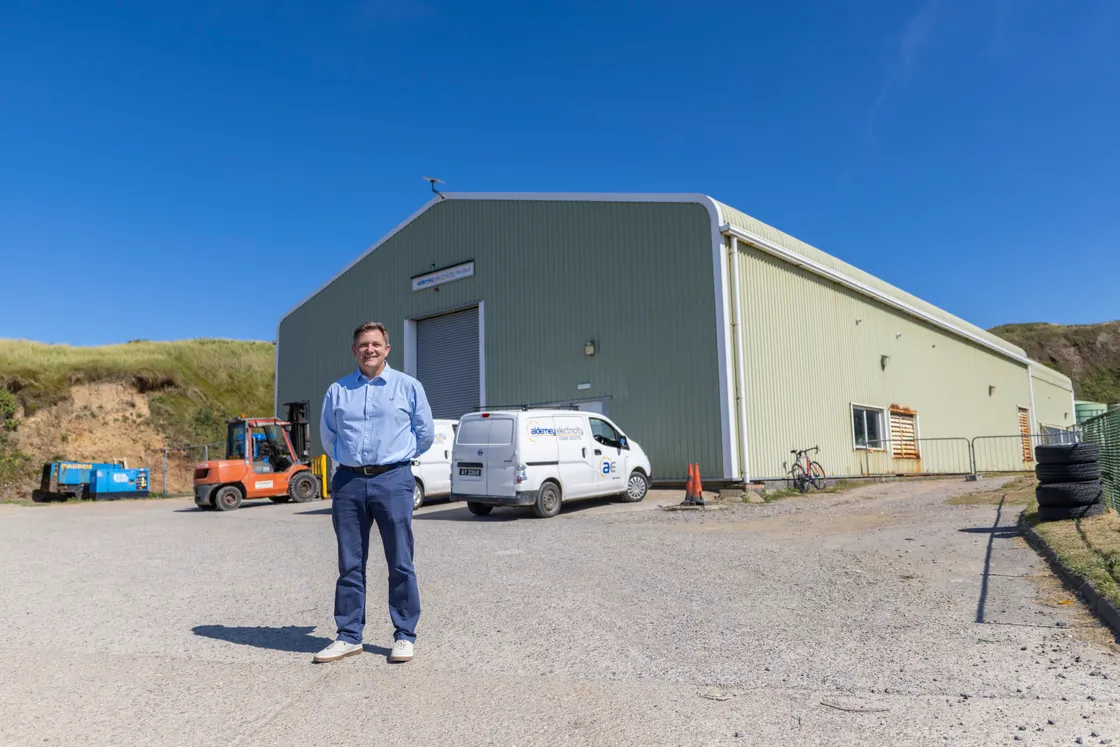
AEL changes direction over renewable energy
Ambitious plans to develop renewable energy in Alderney are being adapted by the island’s electricity company.
The island announced plans for a large solar array and onshore wind farm at the end of last year.
It was hoped that they could provide at least a third of the island’s power.
‘We’ve moved away slightly from the idea of a very large solar array on agricultural land,’ said Alderney Electricity managing director Chris MacGregor.
‘We’ve scaled it down slightly so that we can start to invest in a more achievable sort of evolution, rather than quite a big bang.’
The first step that the company now plans to take is to put solar panels on the roof of their own offices.
‘Then on our power station, then at the back of one of the quarries that we’re not using now,’ he said.
‘It’s what we can do cheaply and quickly and efficiently to allow people to see it actually coming online.’
He added that there was going to be an inevitable rise in the use of domestic solar in Alderney.
‘Instead of trying to discourage it, my view is we embrace it and I’ve asked the team to look really carefully at how we to integrate it,’ Mr MacGregor said.
‘We should be doing the office by the end of the year and then the power station at the beginning of next year, and then some ground-mounted solar around the island.’
He said with those solar arrays added by the end of 2026, the company and the island should be in a position to decide which renewable route to follow.
‘That’s when we get to decide about whether we’re going to go down the tidal route, or whether we’re going to go solar and wind, or what optimal mix of the three we’re going to do, but I think by 2028, we should be well up and running.’
Despite the change in focus, Mr MacGregor had nothing but praise for his predecessor at the company.
‘I think we should applaud what James Lancaster and the team have done over the past decade, because they have set the conditions for the transition to green energy,’ he said.
‘The company is in a really good financial position.
‘They have an amazing energy management system, which is top of the range.
‘And they’re now at a point where renewables can be integrated.’
The island currently burns 1.6m. litres of diesel a year to generate electricity, and another 2m. litres a year on kerosene for heating.
‘Although we’re a tiny little island, we’re producing 10,000 tons of carbon a year, and our mission is to transition to renewables,’ he said.
‘Decarbonisation is a really crucial element, but for the people of Alderney, so is reducing the cost, because it’s roughly 40.5p a unit, which is really expensive, and we’ve got to get it down.
‘We’re looking to do that over the next three years and and become greener at the same time.’

New MD has family links in Alderney
Despite having only recently moved to Alderney from Dorset, the electricity company’s new managing director already has multiple ties to the Bailiwick.
Chris MacGregor took over as managing director at the island’s only power company in July.
‘I am related to a number of people on Alderney, and I’ve been going there for a long time,’ he said.
‘As a child I remember being put on a little yellow plane at Shoreham airport with my sister and flown over to Alderney for the summer holidays.
‘So I still have family here, and cousins who live in Guernsey. In fact, my mum did some research and found out that our family had moved to the Channel Islands in 1774.’
It had been friends and relations who had informed him that the top job at the power company was available.
‘They saw the job come up and said, “Hey, you should apply for this, we think you’d be a perfect fit”,’ he said.
‘The job opportunity was too great to miss, because it’s a fantastic company doing a really meaningful job.
‘We generate the power, distribute it and then retail it. So like Guernsey Electricity, we do every stage of the energy pathway. The difference, the crucial difference, is that there’s no interconnector on Alderney.’
Mr MacGregor has now spent six weeks in the island.
‘I have to admit that it is quite a steep learning curve.
'When you move from a large city in the UK to a small island, you do have to approach everything differently with a different mindset, so I’m still finding my way.’
Beyond the family links, he also has ties to one of the island’s most senior figures through his previous career in the military.
‘I worked in a previous life with Lt-Governor Richard Cripwell, in Afghanistan, where we worked in the same Nato headquarters on operations, and in the Allied Rapid Reaction Corps, which is based in Germany,’ he said.
‘I think part of the criteria for the job is having that relationship with the Bailiwick.’



You need to be logged in to comment.