

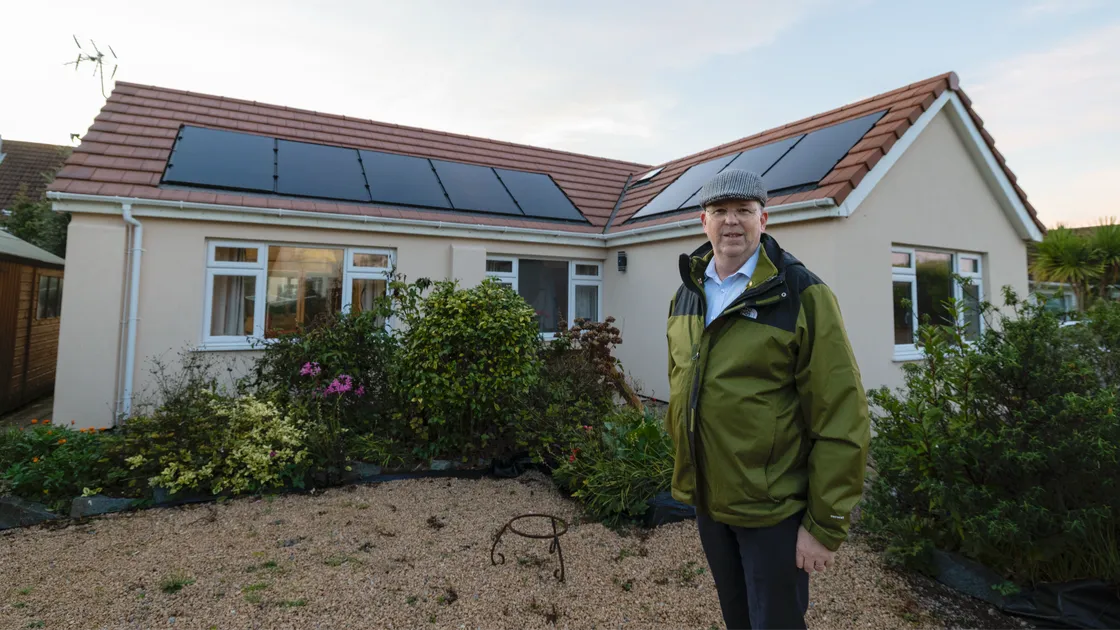
Tens of thousands of homes that had this insulation fitted under two government Energy Company Obligation schemes aimed at cutting energy use have been found to need remedial work after the installations were ‘botched’, according to reports published last month.
But the Guernsey Building Trades Employers’ Association said the sort of systemic problems that these installations suffered had not been seen in Guernsey.
‘We certainly would not want the problems with the UK Eco scheme to put off any Guernsey homeowner installing external insulation on existing or new buildings,’ said a spokesman.
‘The UK National Audit Office blamed the problems on failures in the design of the scheme, a lack of quality control and unscrupulous contractors abusing the scheme, which has resulted in poor-quality installations and suspected fraud.’
External insulation normally provided excellent thermal performance and damp-proofing, he said, and this offered many advantages both for the environment and the occupant of the property.
‘The GBTEA always recommends employing a competent reputable contractor,’ he said, and referred people to the GBTEA directory at gbtea.gg/members.
Paul Watts, a chartered surveyor and director at Savills, had external insulation fitted on his own property last year, He said it had almost halved his heating bill. ‘Our house is in two sections, with the 2006 part having a reasonable amount of insulation and then there is the original, a 1960s solid-built building, which has nothing at all,’ he said. ‘We chose external insulation because if done properly, it’s the best place to apply it.’
At the same time the interior walls were re-plastered.
While there can be issues with both interior and external insulation, Mr Watts said that generally problems with external were easier to spot.
Any problems with internal insulation can be hidden between the insulating material and the wall, while external insulation issues can manifest on the inside walls.
But heating the property was important, he said.
‘It’s an insulation system that’s designed to keep heat in and if you don’t heat the building and you have any defects allowing moisture in the interior, walls will still get cold.’
Stuart Leslie, Savills’ head of residential sales, said that having something like external insulation on a house was a positive thing since it showed that the owner had taken care of the property.
‘There’s a lot of single-block properties over here that get problems with damp and condensation,’ he said. ‘External insulation is a big tick in the box.’
And it was becoming more and more common in the island, he said. ‘I think people like the idea because it doesn’t take up space on the interior of the house and it’s much more efficient.’


You need to be logged in to comment.