

Deputy Neil Inder was elected to replace Deputy Yvonne Burford in October, after she became a member of the Policy & Resources Committee.
He has made clear that choosing the right locations for housing was one of his priorities.
‘We’ve made some moves already,’ he said, speaking on the Guernsey Press Politics Podcast.
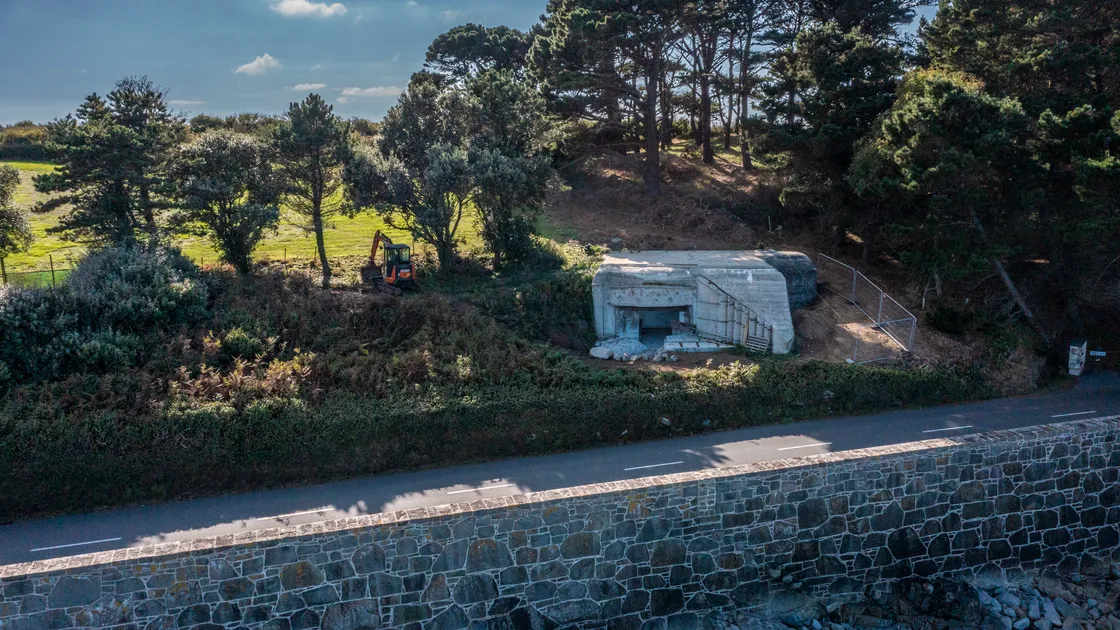
‘We made moves on listings, and we’re starting to look at that. We’ve overturned the bunker decision at Perelle. That’s now gone from monument back down to protected building. If I’m anything, I’m active.’
Hear an in-depth interview with Deputy Inder on his planning priorities on the Guernsey Press Politics Podcast
Last summer the owner of a bunker on Rue Du Catioroc applied for planning permission to build an extension and convert the empty structure into a one-bed house. But during the planning process it came to light that the structure was a rare type of bunker, adapted for both air and coastal defence.
Planners felt the degree of special interest was high, with its rarity value said to be of European importance, leading to the bunker being added to the protected monuments list. This also led to the rejection of the conversion application. Protected monuments are usually a structure, artefact, cave, ruin or remain with special interest, and they and their surroundings are given significant protection, limiting changes.
Examples include Fort Hommet, Ivy Castle and the Jerbourg earthworks.
Protected buildings are also given protection, but owners can carry out repairs, maintenance and minor alterations without planning permission, and there are also some other limited exemptions.
Batterie Strassburg – a series of bunkers and machine gun posts around Jerbourg – was given protected building status in 2023. The bunker next to Fort Richmond also has protected building status.
The owners of the Perelle bunker said they were now considering their options in the wake of the change.
Memebers of the Development & Planning Authority were unanimous in supporting the redesignation of the bunker at Le Catioroc, describing it as ‘a pragmatic step’.
It said it would provide greater flexibility for the owner while safeguarding the important heritage of the property.
The authority is now exploring a wider project to assess whether the ad hoc listing of buildings and monuments was still appropriate.
It was introduced in 2012 when the States was criticised for not having procedures in place to enable ad hoc protection of buildings that were considered to be under immediate threat.
But recent listings have followed the purchase of buildings or been triggered by planning applications and the committee has considered that this is not fair on applicants and purchasers.
Officers have now been instructed to bring all future ad-hoc listings to the committee for approval.
‘I can understand people’s frustrations with this. You buy an old house, you want to restore it, so you do all the right things and submit a planning application, and then seemingly out of nowhere, it’s listed,’ said DPA president Deputy Neil Inder.
‘It might have been done for a good reason in the past, but it doesn’t seem fair any more.
‘So we’re going to look at this and see what it would take to change it. We can’t promise it’ll be easy, but we have to explore it.
‘We can’t be punishing the very people who are trying to improve our heritage buildings.’




You need to be logged in to comment.