
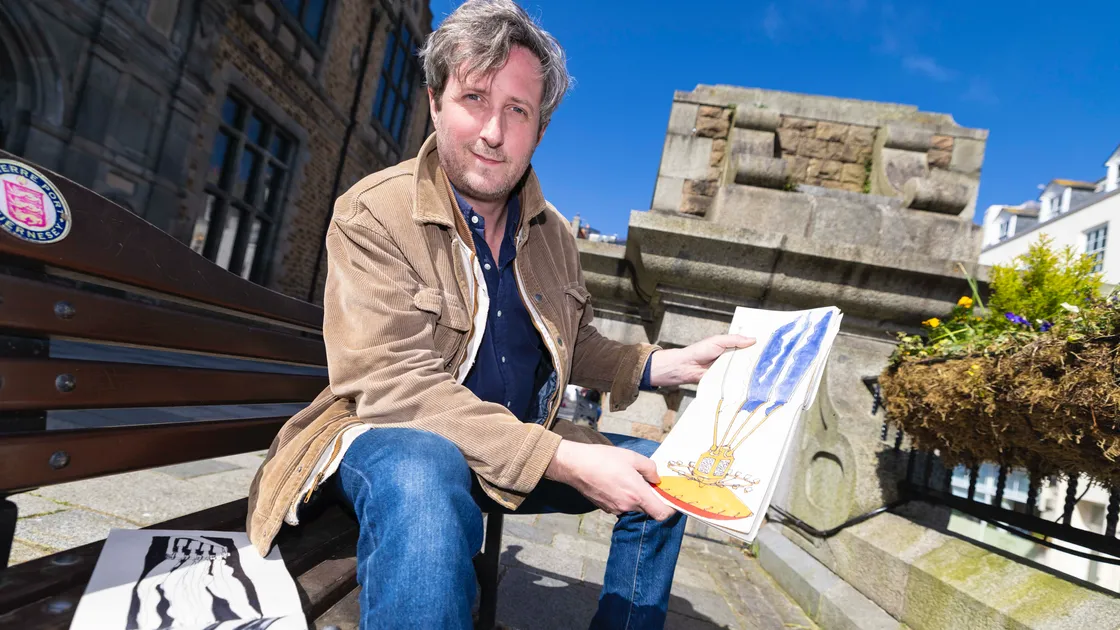
The potential artworks are intended to be a community project, constructed with and for islanders, and using local engineers, apprentices and welders to do the job.
‘We don’t want to be outsiders foisting our art on Guernsey,’ said businessman and local resident Nick Cragg, who is helping to head up the project.
‘We want these sculptures to be by Guernsey, for Guernsey, about Guernsey and made in Guernsey.’
Today the people behind the project will pitch the idea with the aim of securing funding.
If enough backing is secured, sculptures would be commissioned, built and installed. After a while on display they would be offered for sale, with proceeds potentially reinvested into future artworks.
‘We’ve spoken to many people and interest has already been shown,’ said Mr Cragg.
‘We want it to be a real community project – the artworks would be Guernsey’s story as told through modern art. We’ve been to the technical college here and Channel Welders so far, and we’d want locals to be able to contribute, like with bits of boats, buoys, industrial parts – things like that.’
Though plans are far from concrete, or set in stone, the current vision for the project would involve a robotic floral sculpture, known as a piece of biomimicry.
Mr Capper has previously completed a similar project, creating the sculpture ‘Camellia’ which, based off the real camellia flower, features robotic ‘petals’ which react to the light. Camellia, whose creation Mr Capper described as ‘quite efficient’, is now located in All Saints Square, Rotherham.
One idea for a Guernsey-specific sculpture was to tie in the island’s rich maritime heritage into the artwork, such as by having the flower open and close in synchronisation with the tides, or making the two supporting works either side of the principal sculpture nautical-themed sail-like structures.
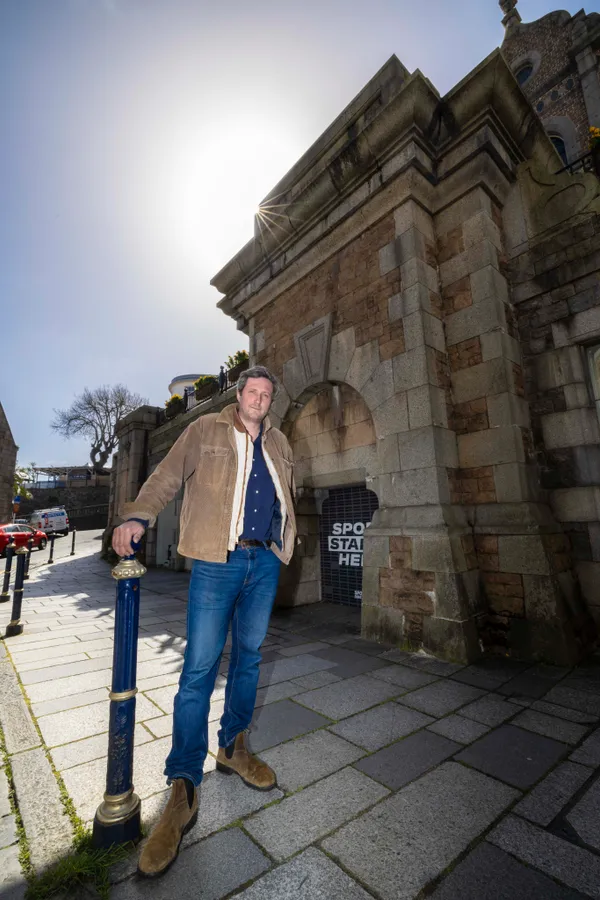
The principal sculpture is intended to be placed on the large plinth in front of the Market building, to the left of the Market Steps. The two supporting works would be placed on the smaller plinths either side.
This idea was inspired by the fourth empty plinth in the north-west of Trafalgar Square, which is regularly used to exhibit visiting contemporary artworks.
Mr Capper has himself exhibited his artwork in London, albeit in a slightly more unconventional way than placing it in Trafalgar Square.
His robotic walking boat, Mudskipper, navigated the Thames for some time as a functional craft, lowering her mechanical legs to walk out of the water onto the bank.
‘It was 10 years of my drawings, and it took five years in production, although that was partly down to the pandemic,’ said Mr Capper.
‘Camellia was much faster, which is more like how long it would take for the project in Guernsey.’
Although the length of a Guernsey project depends on what final designs Mr Capper was to settle on and the resources available to him, Mr Cragg said it could be about 15 months before anything was installed.
The artwork would likely stay in situ for a similar time.
While the project may be relatively quick to complete, it is not for its lack of novelty. Mr Capper himself was not very familiar with robotic sculptures at the start of his career, originally focusing on mechanical sculptures and hydraulic engineering, before becoming more acquainted with electrical engineering, computer programming and robotics later on.
‘It was definitely a learning curve,’ he said.
‘I’ve been building machines for many years – I started in a very simple way with hydraulic controls, and it slowly got more complex.’
With parents who met at art school, Mr Capper was destined, by nature or nurture, to an artistic life. During his teenage years, he variously worked at a garage doing mechanical work, on a farm handling agricultural machinery, and also gained some experience in welding.
‘I took all that to art school with me, so I had that big sort of lump of knowledge outside the curriculum,’ he said.
Following his more recent learning about robotics, Mr Capper has even gone on to do some tutoring at Imperial College, London, focusing on AI and computer engineering.
‘Hydraulics aren’t used much anymore – it’s all electrics,’ he said. ‘I think that can be really exciting.’
Also on the Fourth Plinth Project team is modern artist Gordon Young, who is working as a consultant or guide for the project. In his own artwork, he has had a focus on text, with one example being his Comedy Carpet, a 2,200sq. m granite typographical pavement made up of jokes, songs and catchphrases of comedians and writers, which was installed on the promenade in front of Blackpool Tower.
‘I’m dyslexic, so my art is my vengeance on words,’ said Mr Young.
Now, with more than two decades spent creating art, Mr Young is hoping to help Mr Capper as he endeavours to create a sculpture for Guernsey.
‘I won’t be around forever, and now what I do I want to do for the right places and the right people,’ he said.
‘The first time I came to Guernsey, my wife and I went to a music festival at St James, and it was a performance by a group of children who had special needs, and it was amazing. The room was packed out, and they were so talented. That was the fastest impression of a place I ever got.’
The Fourth Plinth Project team is hopeful that, if the project can move forward, it will become a boon to the community, attracting international interest by bringing novel artistic excellence to St Peter Port.
The sculptures would be a temporary installation, kept in place for roughly a year, before being sold and replaced with a new set of artworks.


You need to be logged in to comment.