

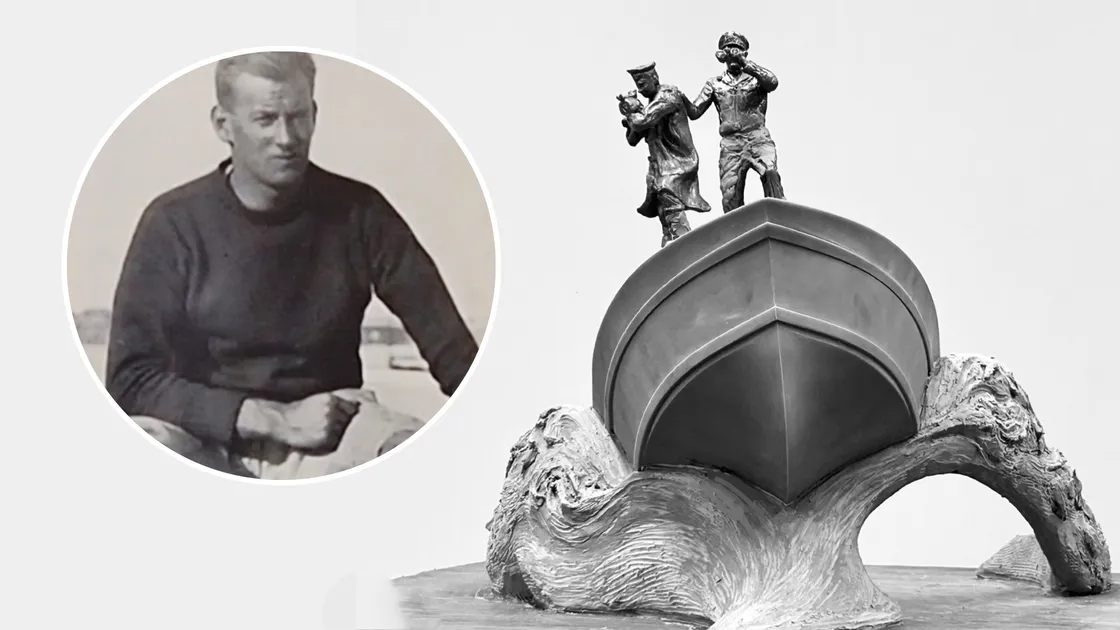
During the Second World War, Lt-Cdr Robert Hichens was awarded three Distinguished Service Crosses, two Distinguished Service Orders and was mentioned in dispatches numerous times as he became the most decorated member of the Royal Naval Volunteer Reserve before his death in 1943, aged 34.
A four-day crowd-funding campaign begins today, during which all donations will be matched by secured sponsors until a maximum of £100,000 is raised to enable a four-metre high sculpture to be erected at a prime site near the entrance gates of Portsmouth Historic Dockyard.
Artist Amy Goodman has already begun work on a five-metre-wide wave structure, on which will be built a steel replica of a motor gun boat upon which three bronze figures will stand – Lt Cdr Hichens, Leading Seaman Seymour Pike, who played a pivotal role in a famously daring raid on St Nazaire, and the first Wren to be immortalised as a statue, Eve Branson.
If the crowd-funding is successful, the Coastal Forces Heritage Trust – a registered charity with Dame Penny Mordaunt among its patrons – will unveil the completed monument in May next year. It will honour the men and women of the Royal Navy’s Coastal Forces and the RNVR.
Hichens first came to Guernsey as a 13-year-old in 1922, when his father retired and his family lived at Havelet House – now the Hotel de Havelet. Although he went away to boarding school, and was therefore not educated locally, he quickly got to know the islands and in particular its waters through his enthusiasm for sailing. He studied at Magdalen College, Oxford, from the age of 18, and was in the Territorial Army before joining the RNVR and then requesting to join Coastal Forces – a branch of the Navy which earned more than 3,000 bravery awards, sank 400 enemy ships and lost 300 of their own during the conflict. Hichens’ grand-daughter Tamsin Clive described his determination to serve in Channel Island waters, having family in occupied Guernsey.
‘Robert was very keen to go back with the motor gun boats back to the Channel Islands,’ she said.
‘Obviously, he knew the waters, so it was very valuable, but he was also very concerned about having his brother-in-law there... and he took any opportunity he could to go back to Guernsey to see if there was anything he could do to help.’
Coastal Forces were involved in commando raids around the islands, as well as convoy interceptions, reconnaissance sorties and fierce firefights with enemy coastal forces. During one mission, ‘Hitch’ – as he was affectionately nicknamed – ordered engines to be stilled on a flotilla of boats as they passed through the Swinge between Alderney and the Casquets, which flows like a turbulent river past the island and the rocks.
‘He knew the waters from childhood, because he’d sailed there a lot,’ Mrs Clive said.
‘They allowed the current to take them under the German guns and in his book he describes the boats looking like seagulls on the water, swirling down in the moonlit night, and they got under the guns and away.’
During his period of service, Hichens gained a reputation for his willingness to engage the enemy at extremely close quarters, taking advantage of the high manoeuvrability of the craft at his disposal. However, it was during one such engagement off the coast of the Netherlands on 13 April 1943 that he was killed when his boat received a direct hit.
He had been decorated for a variety of actions including the evacuation from Dunkirk in May 1940, where he organised small boats collecting soldiers from the jetty and volunteered to stay on even after his ship sailed, returning on three separate sailings to rescue more troops.
The following year, he led the mission which resulted in the first capture of a German E-boat and kept its Nazi ensign as a trophy.
Mrs Clive said the new monument would go a long way to changing perceptions about Coastal Forces, which has been an under-recognised element of Britain’s defences during the Second World War.
‘The charity has managed to secure the most unbelievable spot in the historic dockyard at Portsmouth – the heart of the Royal Navy,’ she said.
‘It’ll be the first thing you see as you come through the gates. I think it’ll become an iconic image.’
Donations can be made via www.charityextra.com/coastal_forces_appeal between today and Monday only. Donations made during that period will be matched pound-for-pound by the charity’s sponsors, meaning every contribution is doubled until the £100,000 target is met.





You need to be logged in to comment.