
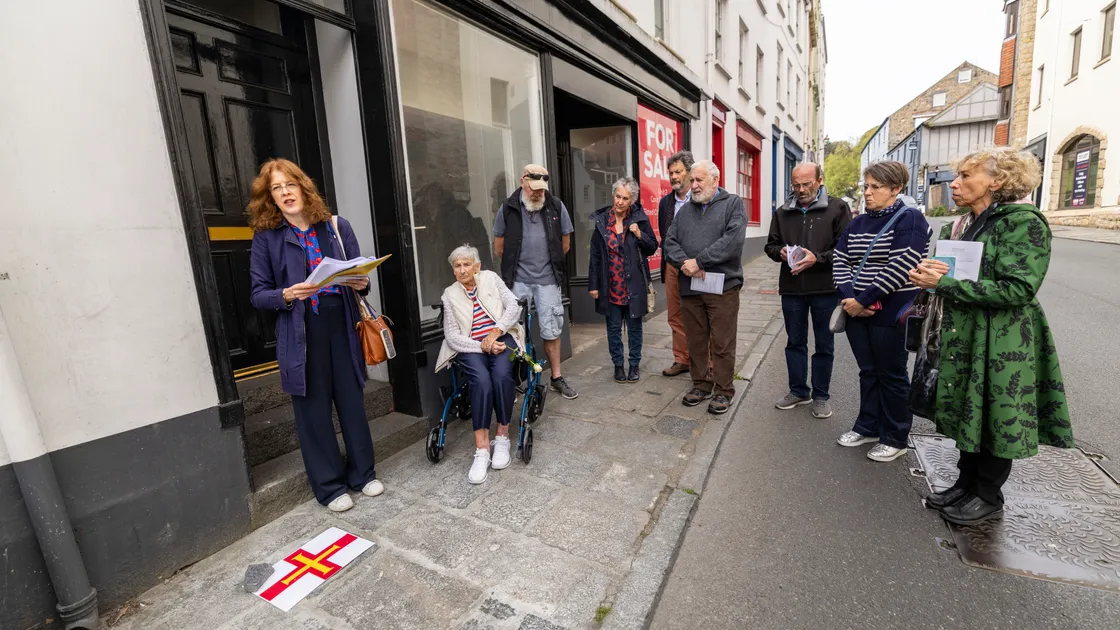
Mr Legg’s family, including his two nieces – his closest living relatives – attended the unveiling, which was conducted by archaeologist, Cambridge professor, and expert on the Channel Islands in war time, Dr Gilly Carr.
‘I think it’s a great honour,’ said Jean Harris, one of Mr Legg’s nieces.
‘I’m sure he would be very surprised – he was never one for publicity.’
At the unveiling ceremony, Dr Carr gave an account of Mr Legg’s life during the Occupation, telling his story of joining Guns and his subsequent deportation and imprisonment at both Frankfurt am Main Prison and Naumburg Prison – imprisonments which led to lifelong injuries and a close brush with death.
The story of his life comes largely from a memoir written by Frank Falla, one of his Guns colleagues, who was also deported and imprisoned alongside him.
Mr Legg, along with his sister Henrietta, would listen to BBC broadcasts on their illegally-possessed radio and write down the news to pass on to the Guns ringleader Charles Machon.
Henrietta was married to another Guns member, Joseph Gillingham, and withdrew from the organisation after becoming pregnant in 1943 – early enough to escape the later prosecutions and punishments that faced her colleagues.
Mr Legg, however, was tried and sentenced by a German military court in April 1944, where he was handed down a sentence of a year and 10 months. His first two months were spent in prison in Guernsey, before he was taken to Frankfurt am Main Prison in Germany for a month.
According to Mr Falla, who was imprisoned with him, and Mr Gillingham, the prisoners were forced into hard labour, regularly beaten by wardens and confined to cells crawling with bugs. The memoir also states that Mr Falla would be able to hear the cries of prisoners being guillotined – he heard that same year that as many as 30 prisoners were being guillotined every week at the prison.
‘The conditions of Frankfurt Prison were really grim – many people, including Channel Islanders, died there,’ said Dr Carr.
It was only four weeks after being moved to Frankfurt that Mr Legg was relocated once more – this time to Naumburg Prison.
It was here that he suffered an injury that he would carry with him for the rest of his life, which he sustained at the hands of a sadistic senior prisoner, who threw him down a flight of stone stairs.
‘Ernie just rolled and bumped down those steps – and we helpless bystanders thought he’d been killed,’ Mr Falla wrote in the memoir.
‘But he struggled to his feet and somehow carried on. For days his leg was stiff and swollen and to this day he suffers from a limp as a result of his fall.’
It is considered likely that the fall left him with a fractured hip that was never treated.
Both Mr Legg and Mr Falla were liberated from Naumburg by the Americans in April 1945, at which point Mr Legg was affected with dropsy, and had to be taken to a local hospital. Mr Falla did not think he would survive, describing his body as ‘flooded with water, his legs and belly swollen to twice normal size. The water only had to reach his heart and … he would have died.’
Mr Legg pulled through, however, and eventually made his return to Guernsey. For a time he lived with his sister, who had been widowed since Mr Gillingham had died in Germany, and her family – including the nieces who attended the unveiling of his stone.
‘We were all very close,’ said Sheila Brehaut, the other of Mr Legg’s nieces.
‘My father didn’t come back from Germany, so when he was living with us he became sort of a father figure,’ said Mrs Harris.
‘I can remember saying to him once, “Can I call you Daddy?” and he said, “Absolutely not!”.’
Though they were very close to Mr Legg, both nieces testified to his being very private about his war experiences.
‘I think of him alone in his room up there, and I think he must have had so many thoughts and memories, but he never talked about any of that,’ said Mrs Brehaut.
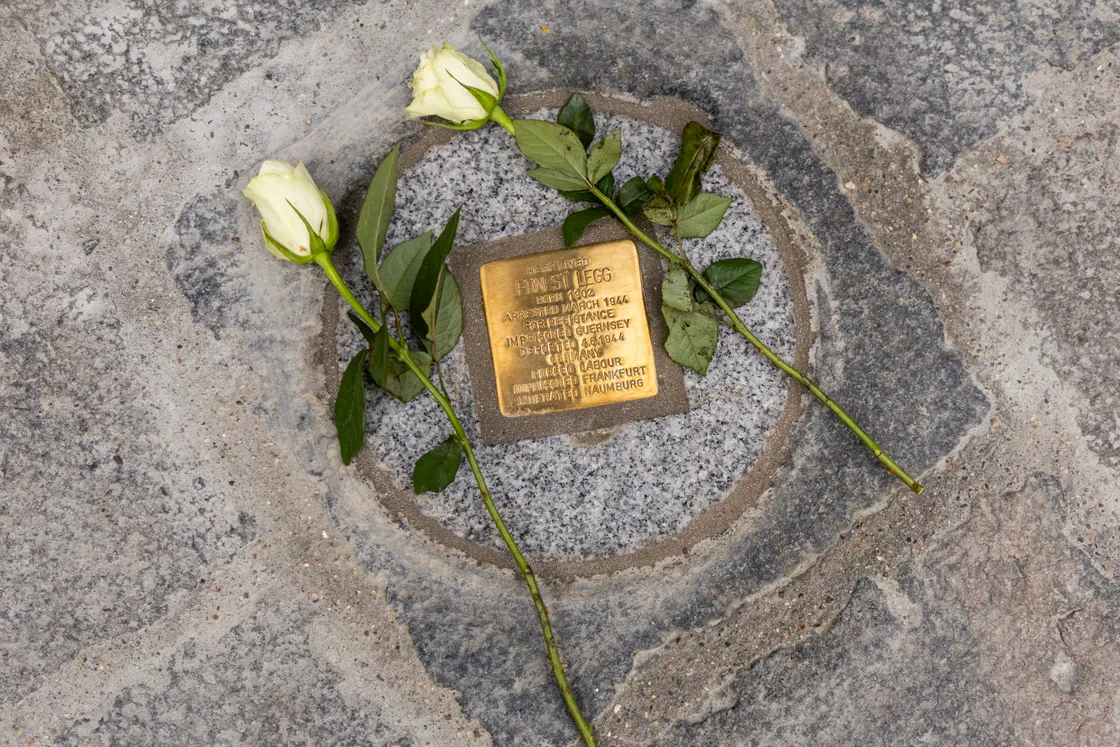
At the conclusion of the unveiling ceremony, both Mrs Harris and Mrs Brehaut laid white roses beside the plaque in memory of their uncle.
Mr Legg’s commemorative stone is one of a series installed around the island over the past few years.
‘It’s an opportunity for Guernsey to memorialise the islanders who resisted or suffered during the war,’ said Helen Glencross, head of Culture and Heritage Services.
The scheme is part of a Europe-wide initiative to recognise and remember the many people affected in different ways by the Second World War.



You need to be logged in to comment.