
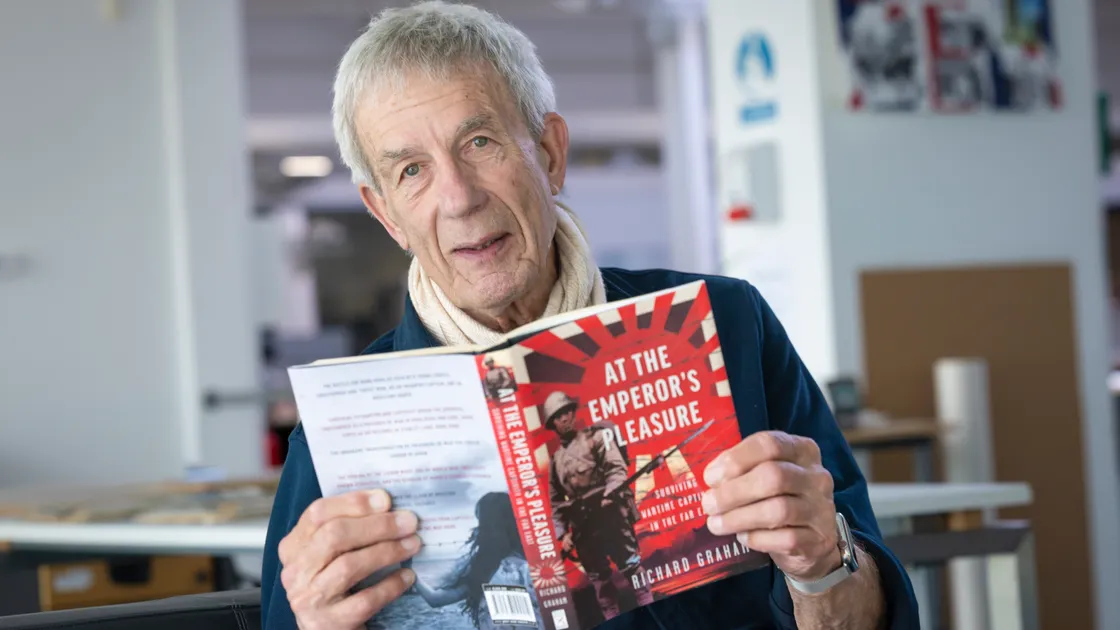
At the time of the sinking of the Lisbon Maru in 1942, Richard Graham was just two years old, but he has gone on to become something of an expert on what he describes as one of the Second World War’s worst but least-known war crimes.
So much so, that he has been invited by the Chinese Embassy in London to visit the island of Qingbang and the site of the sinking, along with some of the descendants of the Chinese fishermen who saved hundreds of British soldiers who were prisoners of war.
‘Some of those survivors later were my brothers-in-arms and friends,’ he said.
‘When I joined the Army in my early 20s, there were still a handful of them around in the regiment. Of course, they’re all gone now, and somehow I feel I’m on a mission to say thank you.’
Although the men he served with rarely spoke about their past experiences, he learned about the incident after seeing a pencil drawing on the wall of the officers’ mess, depicting a sinking ship with lots of people bobbing around in the sea.
‘I asked about the history and they said, “Ah, that’s the Lisbon Maru”. That drawing is now in the National Army Museum.
‘Those who survived the sinking, whether they were rescued by the Chinese or just swam ashore anyway, were then prisoners of war in Kobe in Japan, where they worked as slave labourers, and during the three and a bit years that they were there, they found that among them was an American prisoner of war who was a professional artist. They asked if he would draw the sinking of the ship that they escaped from.
‘And so this chap spoke to as many survivors as he could and, using their collective memories, he drew this ship sinking, and that was on the wall in the mess, and that led to an understanding of the story.’
After leaving politics in 2020, Mr Graham decided to write a book about the incident, which he said he wrote for love, not money, and as a way of paying his respects to all those who lost their lives.
The central figure in the book is Christopher Man, who was taken prisoner in Hong Kong at the fall of the battle. His wife Topsy, a nurse, was captured by the Japanese and interned in Hong Kong for the duration of the war. Neither knew that the other had survived.
‘But then when peace came and they were all making their separate ways home to the UK, when they were being repatriated, they bumped into each other by accident in Colombo in Sri Lanka.’
Although he does not recall it himself, Mr Graham’s wife, whom he married a couple of years after joining the army, claims he told her soon after they met that one day he would write Christopher and Topsy’s story.
‘I eventually got around to it 60 years later, and that’s really what inspired that book.’
He was fortunate when it came to research because one of the survivors in his regiment had kept a secret diary on little scraps of paper during his time in captivity in Japan and his son was able to provide Mr Graham with a printed copy. He also got to see letters that Christopher and Topsy had written to each other, but which were never delivered during the war.
The resulting book, At The Emperor’s Pleasure, took him three years to write and was published in 2024. And it is because of that book that Mr Graham is heading to Shanghai on 17 May.
Last year, on the orders of President Xi Jinping, a memorial to the fishermen was unveiled in Qingbang.
‘There is a cynical side to this, because the Chinese like my book because it shows them in a good light.
‘The Chinese Embassy in London bought a few hundred copies and gave it to all sorts of people. But on the other hand, it isn’t all cynical, because I’m going with a small group of people who are descendants themselves, of either survivors who were saved by these Chinese fishermen, or they are the family descendants of those who didn’t survive.’
The seven-day trip will include visiting one of the principal islands where the fishermen launched their daring rescue.
‘The Chinese fishermen did so at considerable risk because, of course, at that time they were under military occupation by the Japanese and were being treated very harshly.
‘They could see that the Japanese were shooting at survivors in the sea because the Japanese were intent on nobody surviving. They had locked the prisoners down in the holds of the ship, 1,800 of them.’