
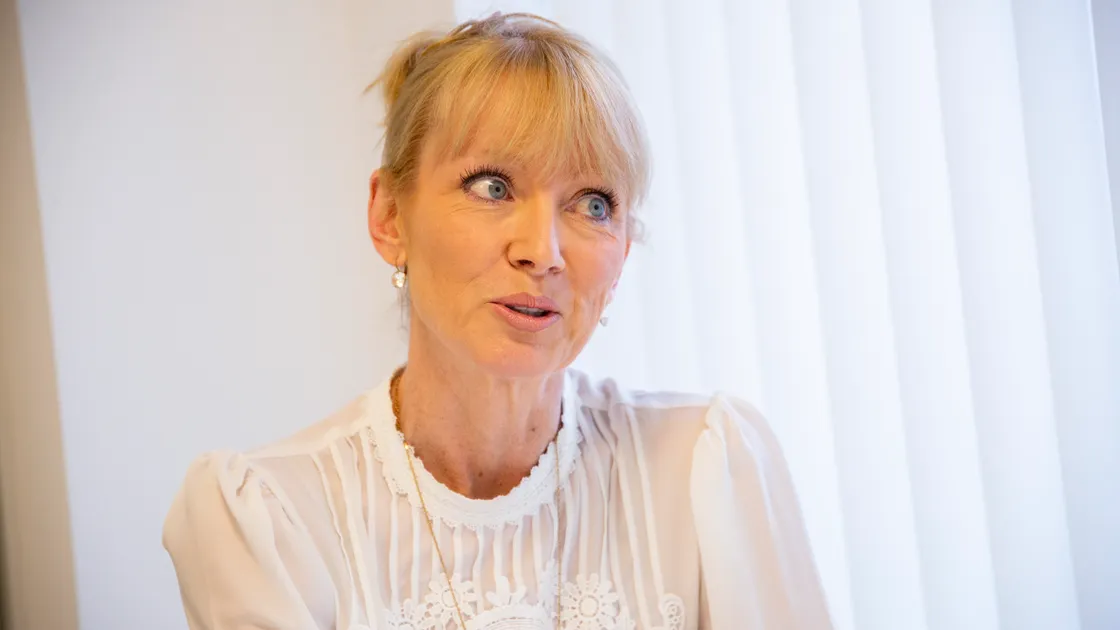
AS A PARENT herself, data and ethics expert Emma Martins has skin in the game when it comes to the impact of social media and smartphones on children.
She has long spoken out about the need for action and made a submission to a UK scrutiny panel looking at online harms last year.
At the Unplugged event on Saturday, Ms Martins will address how addictive digital business models are built to capture children’s attention and what communities such as Guernsey can do in response.
‘I think that the business models and algorithmic building blocks of the social media platforms most frequented by children and young people are hugely problematic because very harmful content is not only made available, it is actively pushed to them,’ she said.
‘They are designed for maximum attention and addiction – and it works.
‘There is little to indicate that the tech giants are prioritising the wellbeing of children and young people. The ability for them to make huge profits from their business model means that there is little incentive for them to do so.
‘It is not easy for individual governments, especially in small jurisdictions like ours, to effect real change but there is too much at stake for them to do nothing. We need a moral awakening as well as better legal protections.’
Even though her professional work means she knows more than most about the potential dangers, as well as the benefits, of modern technology on young minds, she knows it is a difficult issue to navigate, particularly for parents.
‘Ultimately parents are overfaced,’ she said.
‘There is a huge imbalance of power, so to put responsibility on parents is unfair and unproductive. But we do need to educate ourselves better about what is actually going on. So much of the online world our children inhabit is hidden from us and unless we understand that better, we have no chance of responding to it.
‘Things that we would not tolerate in the real world are accepted online. That needs to change.’
As well as announcing a social media ban for under-16s this week, UK Prime Minister Sir Keir Starmer recently told tech companies such as Apple and Google to either activate built-in features or update software to prevent children from taking, sending or viewing sexually explicit images on their phones and other devices.
That is an issue that Ms Martins has long been concerned about.
‘I remember hearing about a 14-year-old boy in the UK that was the victim of a sextortion scam,’ she said.
‘Having sent intimate photos to someone he thought was a teen girl, the perpetrator (definitely not a 14-year-old girl) threatened to share them with his parents and friends. Rather than risk that, he took his own life.
‘There are entire business models, employing thousands of people, built around this kind of extortion. They have one job – extract an intimate photo from someone, then blackmail them. Young people are particularly susceptible.
‘At the time, my son was the same age, and I remember sitting down with him to talk about it and explain something I had previously assumed did not need explaining – that there was nothing he could do that would ever stop me loving him.
‘For a parent, an intimate photo versus your child’s life is not even a comprehensible question. So, we need to have these conversations, however difficult.
‘The thought of a child choosing death over having an intimate photo shared is just so unspeakably sad but we cannot simply wring our hands in despair, we need to work out ways to stop it happening again.’
She said that the dangers of giving a child unfettered access to an online world, including violence, extremism and pornography, were obvious.
‘I cannot imagine any of us think it is a good idea to expose children and young people to that in real life and the online world is no different, despite us treating it differently,’ she said.
‘It would be extraordinary to suggest that the environment children experience as they grow up did not influence them and shape the children they are and the adults they become. If, for example, a boy aged eight is exposed to horrific content in such a way that it normalises it, and the society around him does not intervene in some way, and if that child ends up as an offender, we surely have some questions to ask ourselves – however difficult that may be.’
But despite her concerns, Ms Martins believes that technology can be useful for children. She said that smartphones themselves are not inherently good or bad. As well as providing access to potentially harmful content, they can be used in a myriad of beneficial and benign ways, including as research tools, for accessing online banking, buying tickets, emailing and socialising.
‘These are all very different things with very different contexts, impacts, risks, and benefits,’ she said.
That is also why she thinks it is important to think carefully about what we mean when we talk about the use of smartphones in school.
‘Are we talking about the principle of a child having something which is potentially distracting them from their lessons and learning? Are we talking about screen time? Or are we talking about what the child is able to do on that phone? The distinction matters because, as the questions are different, so the answers will be too.’
She said the danger of conflating these things is that we see phone bans in schools as being the answer to ‘the problem’, without properly defining what the problem actually is.
‘If we consider the problem to be one of attention and distraction, then my personal view is that phones should not be allowed in the learning environment, unless they are a core component of it – and we absolutely need to be teaching digital skills.
‘If we consider the problem to be one of screen time, I think we should heed the health professionals’ advice.
‘If we consider the problem to be the nature of the content which children are exposed to, it is entirely reasonable for a school to seek to prevent their pupils accessing such material while at school and in their care. Apart from anything, it can be a safeguarding issue. But we need to acknowledge that school bans will not solve the problem because many children will be on their devices outside of school hours. This is not a school problem, it is a society problem. Schools have a part to play, but they are not the only part.’
As for legal restrictions and regulations such as bans, she said she does not underestimate the challenge of implementing and enforcing them, not least because the platforms which are the most problematic are in a different jurisdiction.
‘But even when enforcement is difficult, it is vital for governments to clearly signal society’s standards of right and wrong by enacting laws that reflect shared values and seek to prevent harms to its citizens,’ she said.
‘Laws shape norms, guide behaviour, and affirm the moral as well as legal principles a community stands for. The alternative is to do nothing, which I do not think should be an option. If we accept the situation, we condone it, and in doing so risk normalising an environment which is insufficiently responsive to risks and harms.
‘Indifference legitimises, and there are lots of us who are not indifferent but as individuals there is a limit to what we can do and how we can influence things. We need government, as part of the social contract we have with it, to step in when we are not powerful enough.’
She said we should look at data and the digital world in the same way we do other areas of risk. Using air travel as an example, she said that is an industry with safety at its heart, with safeguards, oversight, accountability, and assurance built in.
‘Why? Because the law requires it, governments require it, and we require it,’ she said.
‘We would not fly if we did not think it was safe. We understand the risks, and we understand the harms, but crucially we are not left to manage them ourselves.’
She would like to see the same approach to data because, although we are beginning to understand how harmful it can be, more education, awareness and action is needed.
‘Government has a role in supporting all those things. We should not be left to navigate and manage the harms ourselves. But if government and citizens work together, with shared aims and shared values, that can be a powerful force.
‘I do think better protections are important and necessary, but we should not fall into the trap of thinking that legislation is the silver bullet. It is one piece of the jigsaw, albeit an important one.
‘Individually we can try to support our children to make good decisions, we can try and help them navigate the risks, ensure channels of communication are always open, and we can try and ensure privacy settings are a default measure on all devices. But we are also part of a bigger ecosystem of influence and risk which our children have been deliberately sucked into and over which we have little, if any, control.
‘Many of these platforms are designed to be as addictive as possible and they are very successful, meaning it can become a battleground for parents, which is both unfair and sad.
‘But better-informed parents and citizens can start to demand more, and that pressure can be powerful.’
n Unplugged is a free community event taking place at Les Beaucamps School on Saturday, starting at 10am, including talks from Emma Martins and David Smith, headteacher of Fulham Boys School, which was the first secondary school in the UK to ban smartphones across Years 7 to 11. Tickets are available via Eventbrite at www.eventbrite.com/e/1988303065994.
There will also be a showcase of alternatives to smartphones taking place 12-1pm, which is open to all with no tickets required.