

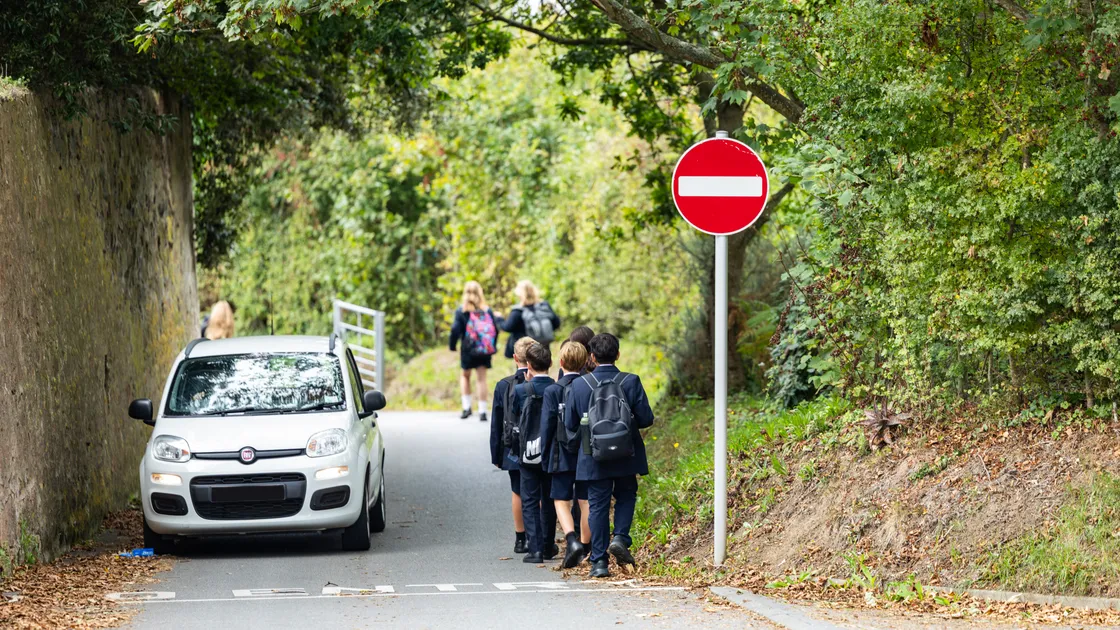
A newly published report from the Health Improvement Commission’s School Active Travel Surveys, conducted over April and May this year, showed that rates of active travel at primary schools have remained the same compared to the May 2025 audit, while secondary schools saw a slight decrease in rates of active travel, falling to 36% from 2025’s 38%.
The results come even as several schools have, over the last year, trialled or permanently introduced ‘school streets’ – although schools which did introduce such initiatives saw more positive results than those that did not.
‘While overall trends remained steady, there were notable increases in active travel at schools that have recently introduced initiatives to encourage walking, wheeling and cycling,’ the report states.
‘Vale Primary and La Houguette Primary, both of which run weekly walking buses during the spring and summer months, saw increases in active travel of 12% and 5% respectively compared to the October 2025 audit.
‘Castel Primary, which launched a pilot School Street scheme in April, recorded a 5% rise in active travel over the same period.’
Given the rise in active travel in primary schools with school streets, and the overall steady rate of active travel, it can be gathered that rates of active travel among other primary schools have dropped from last year.
‘This demonstrates that when schools can introduce practical, sustainable initiatives that make active travel safer and more accessible, it can have a real impact on families, empowering them to make a healthier choice,’ said Health Improvement Commission active travel officer Amy Woollaston.
‘The more attractive the active option becomes, the more likely it is that walking, wheeling and cycling will become the norm for children and their journeys to school.’
In secondary schools, rates of active travel decreased 2% from last May, and 7% from last October – the latter of which marked an all-time high.
However, there was a 1% increase on journeys to school in the morning, with the overall decrease being linked to the return home in the afternoon.
‘Two secondary schools have been piloting the School Street initiative, which may have encouraged families to consider alternatives to driving in the mornings,’ said the report.
While primary school students have been increasingly likely to use active travel for school journeys over the past six years, the trend is less clear for secondary school students.
The average rates of active travel this year appear to equal the rates reported in the first 2020 survey, with some fluctuation in between from an all-time low of 29% in October 2021 to the high of 43% in October 2025.
The report defines ‘active travel’ as walking, cycling, scooting and blended travel, which refers to travelling part of the journey by motorised vehicle and completing it by an active travel mode.

You need to be logged in to comment.