
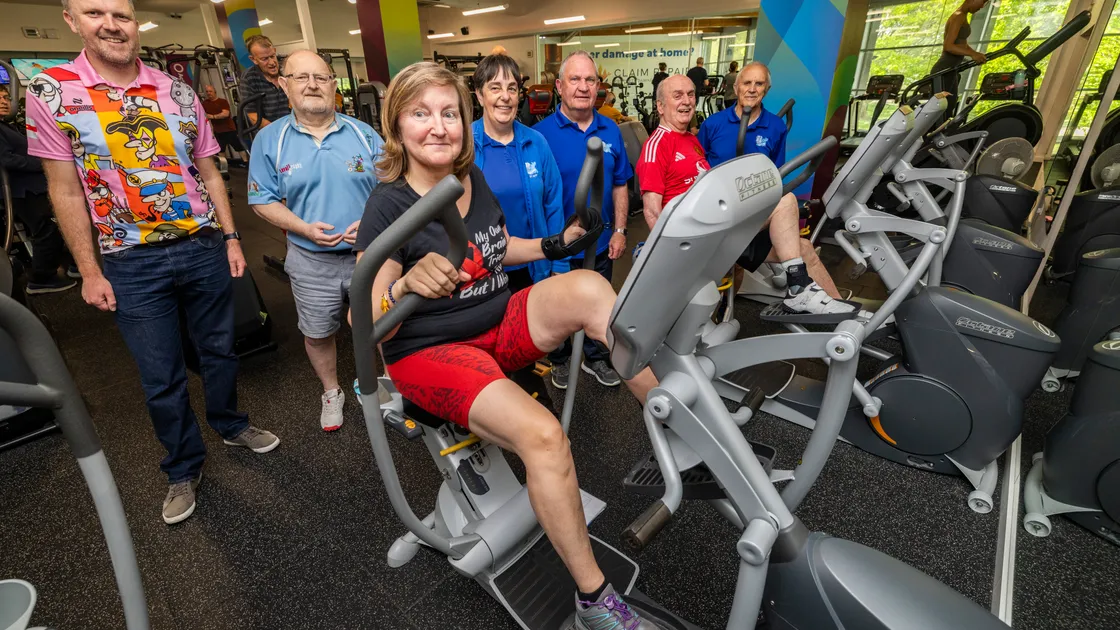
SUPPORTING islanders living with acquired brain injury as well as the neurophysios who support them is the aim of Headway Guernsey’s gym buddy programme.
The programme has been running for 12 years and was set up with the aim of helping patients stay motivated to complete their rehab work, and reducing waiting list times for neurophysiotherapy.
‘They typically would treat somebody and do their physical rehab in the hospital, and then when people are discharged home, typically when they’ve had a stroke because of the right and left-sided weakness, they will get sent home with their exercises and a programme from the neurophysios. The physios go back and start dealing with other acute patients,’ said Headway Guernsey chief executive Philippa Stahelin.
‘What typically happens is that people’s motivation drops when they get home, they’re dealing with all the issues surrounded by the fact they’ve had a serious brain injury and actually their rehab tends to be the thing that stops.
‘So you’ve then got a situation where people might be more susceptible to falls, or their mobility is just not improving, so they would then ring the hospital, the neurophysios would come out and do a short course for them, but that would mean it would take them away from their core work.
‘Their waiting lists were just growing and growing and growing.’
Following a conversation with the then head of the Guernsey Therapy Group the programme was born. The physio said that it was a case of helping patients stay fit by going to a gym or taking part in some gentle exercise.
‘For a lot of our guys to go to a gym, it’s just too difficult from a physical point of view, but also from a psychosocial and cognitive point of view – actually, how do they get to the gym? What do they do when they get there? How do they get on and off machines?
‘It just wasn’t really an option, so I said, well, if we could get some volunteers who could take the guys under your instruction, because you’re the neurophysios, we’re not, we can start working through their rehabilitative programme,’ said Mrs Stahelin.
The programme reduced waiting lists for the neurophysios from 12 weeks to three weeks. The neurophysios are involved with the programme, but having volunteers reduces the time that they have to put into the programme.
‘They know all the guys that we’ve got and the point is that when we ring them up, however busy they are, they come out because they know the value of the service. For them, it’s half an hour out of what would have been a three-month programme so we’re in regular contact with them,’ said Mrs Stahelin.
Exercise is important for everyone, but is vital for those who have acquired brain injury.
‘It’s absolutely vital because if you think about it, when you go home, you’re already in a space where your brain isn’t doing what you want it to do, so you’re struggling to find yourself cognitively and processing information and finding your way back into your house – if you’ve then got the added complication that you’ve got physical disability along with it, you’ve got things like, how do I get in and out of the shower?’ she added.
‘How do I get up and off chairs? How do I get in and out of bed? How do I navigate steps up and down? So that physical fitness and your core strength is absolutely vital.
‘If you don’t have that, what happens is that you start going into decline, then accidents happen, and then there’s the risk of medical intervention, going back into hospital – and nobody wants that. The hospital doesn’t want it, our members don’t want it, the family members don’t want it, and we want to keep people independent as possible in their own homes.’
Ken Brouard is one of the programme’s volunteers and said that seeing the progress that Headway members would make is one of the highlights as well as getting to know them.
‘It’s just lovely, you know, he’s more like a mate than a client,’ he said speaking about member Steve Le Lerre, who he supports on the programme.
Mr Le Lerre suffered a stroke which affected movement in his arm and leg as well as his speech and said that the programme had been a big help in his rehabilitation.
‘Now I’ll come down the stairs but when I first came here, I kept using the lift,’ he said.
‘I go up the stairs and come down the stairs. That’s a bonus. Every time I do that, it’s a bonus.’
Tracey Bran is another one of Headway’s members on the programme and she said that it had been a ‘game changer’ for her.
‘It’s made such a huge difference, and we do have a laugh as well – laughter is the best medicine,’ she said.
She is supported by Geraldine Williams, Headway’s activities coordinator.
‘Seeing Tracey using her left arm is amazing, I think I get as much of a buzz from it as she does,’ she said.
‘They’re so motivated and she proves to me how capable and strong she is.’
The programme is sponsored by Only Fools and Donkeys.
‘Our charity really promotes inclusivity, so any types of sport where we can promote inclusivity then we’re doing that, right from young people up to older people,’ said director Matt Collas.