

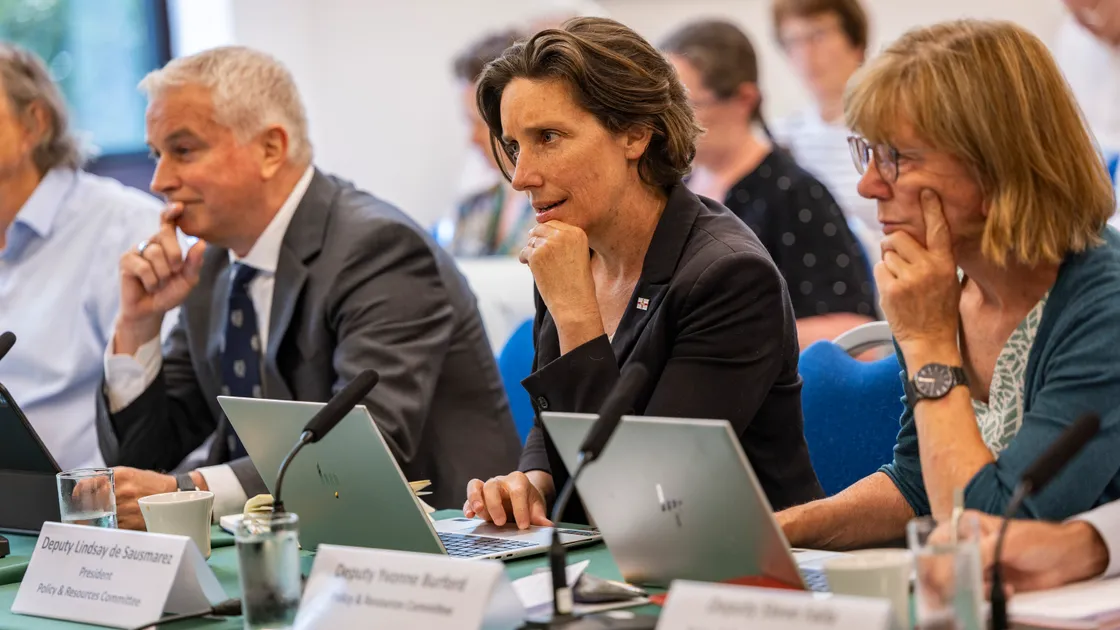
Yesterday’s session, when all five members of Policy & Resources appeared before the Scrutiny Management Committee, saw Scrutiny chairman Andy Sloan claim the package was just ‘designed to sell GST’.
He said that after 20 years in the making the committee had come up with a ‘stopgap measure for three years’.
The committee said that it welcomed the fact that, after mitigations had been exercised in its package, businesses and tourists would be responsible for bearing 80% of the remaining income, although Deputy Sloan appeared somewhat incredulous that the figures seemed to show that the introduction of GST on the public would only realise something like £4m. a year as the committee ‘presented a consumption tax as an extension of the welfare state’.
P&R members quickly rallied to the committee’s defence.
‘We looked at different scenarios, and felt at this time, with pressures on inflation and households, that it was perfectly prudent to bring this in for £40m. a year,’ said vice-president Yvonne Burford.
‘It is going to make a significant difference, it will stop our reserves running out, and we understand the value of diversifying the tax base not just by GST but also by making cuts in income tax.’
Deputy Andy Niles said the island’s tax system was far too predicated on income tax. ‘GST enables us to move forward in a far more sustainable way. At the moment we have a very narrow tax base.’
Deputy Niles admitted that the committee’s package was iterative.
‘Trying to achieve the art of the perfect has failed us for many, many years,’ he said.
‘The States has tried to achieve the art of the perfect and been unable to.
‘To try to achieve something nailed on for the next 40 years is absolutely the wrong thing to do.’
P&R said that so much was uncertain about the future of public finances, including Pillar II receipts and potential income streams from the likes of offshore wind.
Deputy Steve Falla said that the make-up of the committee and their voting history over GST belied the claim of designing the package simply to engineer its approval.
‘Look at us and our track record,’ he said.
‘It shows this wasn’t our predisposition.
‘We were hoping corporate revenues would bring us good news, but that outcome was disappointing, so we had to look at other issues.
‘The easiest thing of all would be to turn our back on the issue, but that is not what we felt we should be doing as the senior committee charged with resolving a sustainability issue.’
Scrutiny member Liam McKenna turned on his former ally against GST, P&R member Charles Parkinson, as to why he was letting down the generation which was now choosing to leave the island due to cost.
‘My intention was that we reform corporate tax before any new taxes,’ said Deputy Parkinson.
‘I chaired a sub-committee which looked into corporate tax reform – and our experts were firmly of the view that it was unwise to change the corporate tax system without Jersey and the Isle of Man on board, and I found myself in a minority on my own sub-committee,’ he said.
‘If you employ experts to give you advice you have to reflect their advice. I don’t want any more taxes on the local population until the corporate sector is paying its fair share and I think this package does exactly that, from companies employers and tourists.
‘This is not what I wanted, this is second best, we didn’t get the fundamental corporate reform I wanted but then I’ll get money from corporate sector this way.’
P&R president Lindsay de Sausmarez said that the package addressed the issues that Deputy McKenna was raising.
She bemoaned the fact that ‘there seems to be no awareness that this package delivers quite a significant tax break to the people who need it, who are struggling with the cost of living and the people we are so determined to help.’