


An amendment approved by the Assembly late on Friday directed inflation-only budget increases for each of the next three years. It will face a confirmatory vote when the tax and spending debate resumes in September.
Presidents of some of the committees with the largest budgets have vowed to fight to overturn the vote and warned of serious consequences for islanders if they fail.
Health & Social Care president George Oswald anticipated that his committee would need to make ‘significant cuts’ to maintain spending at its current level when the cost of medical equipment and treatment was increasing at two to three times the general rate of inflation.
Would you support a freeze on all public spending for the next three years?
- Yes64%
- No36%
‘Costs are rising by at least £5m. a year, driven predominantly by demographic and demand factors over which we have little control,’ said Deputy Oswald.
‘The demand will not go away. People would have to wait longer for treatment and some may not get treatment at all. I do not believe that the people of Guernsey wish to see such cuts to services.’
Policy & Resources’ tax package currently being debated assumes savings of about £7m. a year, in line with a previous States direction that general revenue expenditure should increase by not more than 1% below the rate of inflation.
Unlike that existing direction, the amendment for a total spending freeze approved on Friday included contributory social security schemes which fund the old age pension and long-term residential and nursing care. States expenditure on the old age pension and residential and nursing care is currently about £15m. a year more than it would have been if held in line with inflation over the past three years.
Watch: Matt Fallaize spoke to Deputy Mark Helyar about the successful amendment
Employment & Social Security president Tina Bury warned of ‘serious cuts and impact on people’ if her committee was drawn into the spending freeze, including cutting the value of the old age pension and increasing charges to occupants of care beds.
‘This amendment does not reduce the number of pensioners or the number of disabled islanders or family breakdown, domestic abuse, illness, unemployment or rising housing costs,’ said Deputy Bury.
‘It simply requires the social security system to absorb those pressures within a fixed spending envelope. For an entitlement-based system, that can only be achieved by reducing the real value of support to existing customers.’
Deputy Bury added that backing the amendment in a confirmatory vote in the autumn would also sink a five-year plan agreed by the previous States to pump more money into the long-term care sector to encourage greater supply of beds as the population ages.
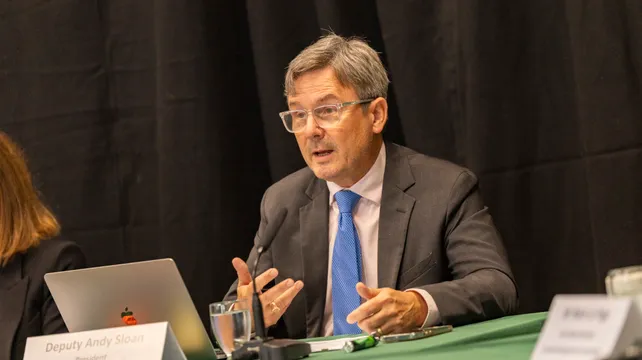
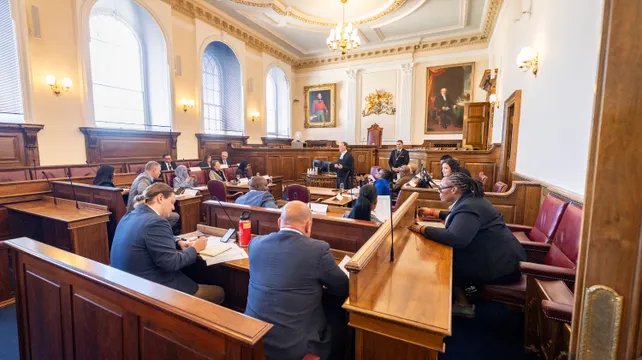
The spending freeze amendment, which had been submitted by Deputy Andy Sloan, was approved by 15 votes to 12. All five members of P&R abstained. Six members were absent, at least three of whom would have been expected to vote for it had they been present. Committee presidents critical of the vote are nonetheless hopeful of overturning it or reducing its impact when the tax debate resumes.
Deputy Bury said she held out ‘a little bit of hope that it might fall at the final hurdle’.
Deputy Oswald said he did not oppose a spending freeze in principle but would like to speak to the proposers of the amendment ‘to see if we can come to some arrangement’ to protect essential services.



You need to be logged in to comment.