
I am writing to urge E&I and P&R to make road safety improvements and active travel a top political priority for this term. Guernsey has a unique opportunity – right now, early in your mandate – to lead bold, necessary change that will directly improve everyday life for islanders and visitors alike.
You are politically responsible for the island’s transport network and road safety, and I believe there is a clear duty of care to put things right, especially for our most vulnerable road users: children, pedestrians and cyclists. We are long overdue a properly resourced and committed push for safer, smarter infrastructure – the kind that gives people real transport choice, not just the illusion of it.
A perspective from all sides of the road
I’m not just raising this as a concerned parent – I bring lived and professional experience from every side of the road.
I’ve been a commercial HGV Cat C driver in Guernsey since 2002, and I spent nine years working for Guernsey Electricity as a cable-jointer, digging trenches and working directly on our roads. Today, I still work on the roads with my tunnelling business, so I remain fully immersed in the reality of Guernsey’s transport network.
I also cycle with my son to school every day, rain or shine, before heading on to work by bike. That gives me a daily, first-hand view of how our infrastructure supports – or fails – the people who rely on it most.
This wide-ranging experience gives me a broader, more grounded understanding of the road network than most. And yet, too often, it’s those with the narrowest perspectives – people who only ever drive small vehicles – that dominate the debate and resist necessary change.
Unsafe has become normal
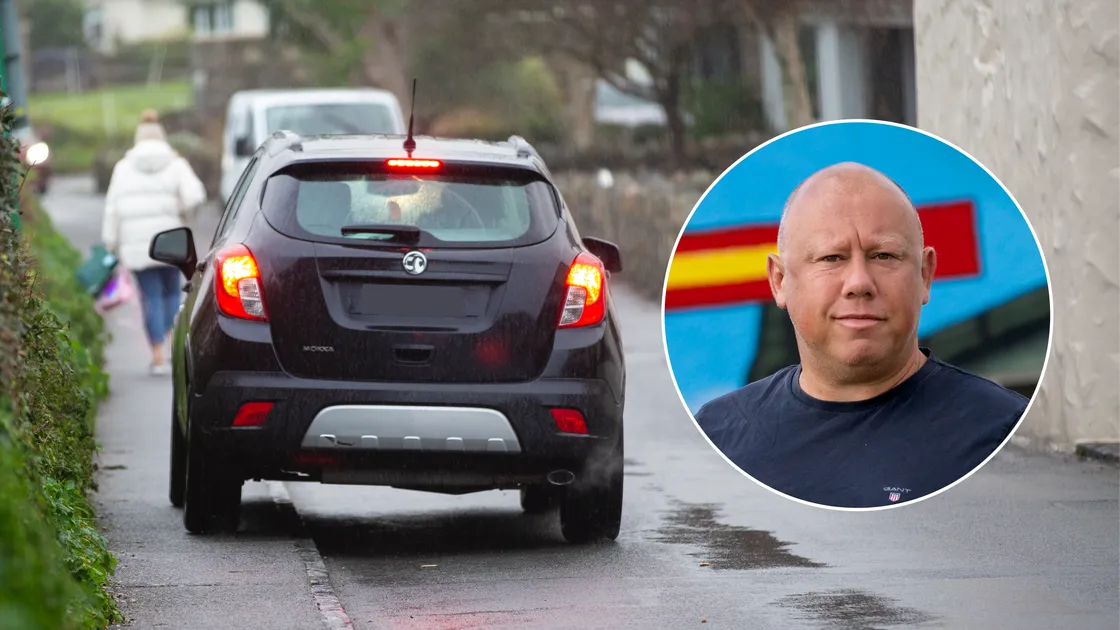
For years, for me it felt ‘normal’ to mount pavements to pass oncoming traffic on narrow two-way roads. But that changed in 2017 when my child was born.
Pushing a buggy made the risks obvious: wing mirrors brushing past, zebra crossings ignored, and no space to walk without fear. Later, cycling with my son, I saw aggressive overtakes, tailgating, and outright hostility toward anyone not in a car. It’s clear why so many parents feel they have no choice but to drive their children to school.
This daily reality has become so normalised that we’ve stopped questioning it. But we must.
Design – not bad drivers – is the root problem
Guernsey continues to prioritise vehicle flow over safety, even on roads far too narrow to handle two-way traffic. In some areas, there are no pavements at all. Elsewhere, kerbs are routinely mounted just to pass safely. This isn’t because people are driving carelessly– it’s because the road system itself forces bad behaviour.
As vehicles have become wider and heavier, the risks have escalated.
We already have a law from 1987 stating that any vehicle over two tonnes must:
Travel no faster than 25mph;
Display its weight clearly in two-inch-high markings on the front passenger side.
Yet this law is not enforced. There are now more than 7,600 vehicles over two tonnes on Guernsey’s roads. None are marked. None are held to their legal speed limit. I’ve been told by police that enforcement is avoided so as not to ‘upset’ owners of high-end cars.
These vehicles do real damage. An Audi Q7 smashed through three walls by the Telephone Museum last year. The vehicles protect their occupants – but not the people they hit. And due to their size, they are far more likely to cause pavement-surfing, pushing other vehicles dangerously close to pedestrians.
The human cost
From a recent FOI request, I found that in 2023 alone five pedestrians were hit on zebra crossings – with drivers admitting fault in each case.
In another FOI I found that in 2024 25 pedestrians were hit by vehicles and 64 cyclists were struck by vehicles.
These are real people. Children. Parents. Grandparents. They are being hit in places where they should feel safe – on crossings, on footpaths, on the school run.
One of the most powerful recent examples comes from a BBC article earlier this year about road safety in Guernsey:
‘I don’t feel that safe at all and I’ve nagged my mum to let me walk and cycle to school but I can’t because it is way too dangerous.’ Bertie, age 9.
'A family in the north of Guernsey says safety is a "real issue" due to speeding motorists in the area and believes plans for more housing will only make it worse. Bertie’s mum Claire, who has lived in Saltpans Road for four years, said she no longer walked her children up the road after a number of incidents involving traffic. She said her nine-year-old son was nearly hit by a speeding car while walking, and then he was verbally abused.’
Meanwhile, we continue to allocate road space based on driver convenience – like in the recent Saltpans resurfacing, which added on-street parking at the expense of any pedestrian space.
This is not a balanced or humane system. It’s one we’ve grown used to, but we shouldn’t have to.
Speed can be managed – by design
Some claim that turning narrow roads into one-way streets would increase
speeding. But the research shows road geometry doesn’t determine speed – design does.
In Denmark, one-way conversions with kerb build-outs, chicanes, and raised crossings led to lower speeds and reduced collisions.
A meta-analysis of 33 traffic-calming schemes found 15-25% reductions in injury accidents, especially on residential roads.
Speed tables, visual narrowing, and kerb build-outs change driver behaviour – even without enforcement.
Guernsey can adopt the same proven methods, and in doing so:
Prevent large vehicles from mounting pavements;
Create wider, safer pavements and segregated cycle lanes;
Let children travel to school safely and independently;
Encourage more people to walk, cycle, or use future options like e-scooters, as legalised in Ireland.
A suggested plan of action for your committee
Here are several achievable steps I believe you could take:
Create a dedicated road safety sub-committee to focus on these issues and reduce the burden on E&I;
Get the public to agree that making children safe to take themselves to school and out to play should be a goal;
Pilot one-way conversions in high-risk areas with calming design built in;
Enforce the existing 1987 law on vehicle weight limits;
Add better education on behaviour around people on foot, cycle and horse in the driving test;
Prioritise vulnerable users in a new directive for everyone doing any work in the road and in every infrastructure project, not just prioritising motorists;
Engage schools with active travel committees, giving children a voice in shaping the roads they use and the behaviour on them.
Our children are being taught about their rights through Unicef’s Rights of the Child framework – but they’re not being taught what their rights are on the road and how other road users should behave around them. I’ve helped out with Bikeability sessions at Castel School and know they aren’t being taught that drivers shouldn’t be taking risks around them and how to report it when they do, creating an ‘in plain sight’ problem with no recorded data to prove it.
They’re being asked to accept unsafe, car-dominated environments as normal.
This isn’t just about safety. It’s about shaping a better future.
Guernsey is falling behind
We market Guernsey as a place of walking and cycling. But both of the two most recent visitor exit surveys found the top complaint from tourists was too much traffic and not enough pavements or cycle paths.
We say we value active travel, but our infrastructure says otherwise.
Helping children get to school independently eases congestion. Creating safe streets addresses rising childhood obesity. Safer roads benefit tourism, wellbeing, and public health. And yes – they make life better for drivers too, including professional HGV drivers like me.
This is your moment
As a recent non-voting member of ESS for four and a half years, I know you are currently shaping your strategic priorities for this political term. I believe there is no better time to act boldly and set a clear direction and have a big impact on quality of life for Guernsey.
Guernsey could be a leader in liveability and people-focused design. But right now, we’re letting outdated norms dictate our future – and putting lives at risk.
Please make road safety and a rebalanced, people-first transport system one of your committee’s top priorities.
Thank you for your time and for your service to the community.


You need to be logged in to comment.