

‘I oppose the introduction or increase of taxes on the resident population until we ensure that companies doing business in Guernsey pay their fair share.’ – one of the opening statements from my 2025 manifesto.
So why am I able to support the 2026 tax package proposed by the Policy & Resources Committee? The answer is not that we are in imminent danger of financial collapse.
Again, referring to my 2025 manifesto, I said ‘Guernsey’s financial position is stronger than many would have us believe. We have a balance sheet with significant assets and a minimal amount of borrowing, but more importantly our revenue account is in better shape than most people think. In the debates about fiscal policy last year, I consistently said that the tax take from Pillar 2 of the OECD’s global tax deal would be much greater than Treasury had forecast.’
Indeed, the initial projections of revenue from this source (£10m.) have been revised up to £30m. and now £39m. I am confident that the total for 2025 will be significantly higher still.
Even accepting this projection, our 2025 accounts show a group surplus for the year of £106m. Guernsey is not a financial basket case. But there are clouds on the horizon.
Firstly, like most of the developed world, Guernsey has an ageing population. Our fertility rate is a miserable 1.4 per woman, well below the replacement rate of 2.1. Put simply, we are not having enough babies. Worse still, when we do have babies, we are not giving our children enough reason to come back to Guernsey after their education, and to build their careers and families here. This is building upwards pressure on our costs.
Secondly, much of our economy is based on financial services, and many of the jobs here are administrative in nature. Quite a few of these jobs could be replaced by artificial intelligence. This cuts both ways, however. On the one hand we could lose a lot of jobs in Guernsey, but on the other hand, if the impact of AI is to increase the productivity of the local workforce, perhaps we could see the reimportation of administrative jobs which have been outsourced to other, lower-cost, jurisdictions. AI could result in downwards pressure on our income.
Thirdly, we have under-invested in our infrastructure. For many years we have struggled to invest 1.0 to 1.5% of our GDP in capital projects, when the Fiscal Policy Panel advises us that we should be investing at least 2%, and ideally 3%, in our infrastructure. In 2025, we did in fact hit 2.5%, but we should invest more. In calculating our funding gap, we use the 2% of GDP target.
Adopting this target, the projections show that we have a shortfall in revenue of about £50m. per annum. However, in accordance with principles laid down by the IMF, in assessing this shortfall we ignore our investment return. In 2025, this was about £120m.
After the 2025 election, I was fortunate enough to be elected a member of the Policy & Resources Committee. I was also invited to chair a sub-committee to investigate the scope for corporate tax reform, and lucky to be able to attract some eminent tax experts to join the sub-committee.
However, I was disappointed that the sub-committee did not feel able to recommend any fundamental changes to our corporate tax system. The view of the majority was that more fundamental reforms could only be accomplished alongside Jersey and the Isle of Man. So, the sub-committee recommended minor but useful changes to the Guernsey corporate tax system which could bring in about £6m. per annum, and that consideration should be given to extending the Guernsey tax base to include the profits of all retailers (not just the large retailers who are currently taxed at 20%) and the construction industry.
So, where are we now? The States of Guernsey is in a relatively healthy financial position, but we need to take a longer-term view. To me the critical issues are as follows:
a) The income from Pillar 2 is a real windfall, and as I have said, seems to me likely to exceed the official projections for 2025. However, in the longer term, the existence of Pillar 2 gives multinational groups less reason to move business offshore. Over time, I expect the revenues from this source to erode.
b) While there is potential upside in the forecasts, such as potential revenue from offshore wind, the impacts of demographic change, climate change and technological change could have severe adverse effects.
c) We are very dependent on taxes and social security contributions paid by our resident population. The advent of zero-10 in 2008 resulted in a significant shift of the tax burden on to the shoulders of local people, and away from the corporate population. With our ageing demographics, the burden threatens to be become unsustainable.
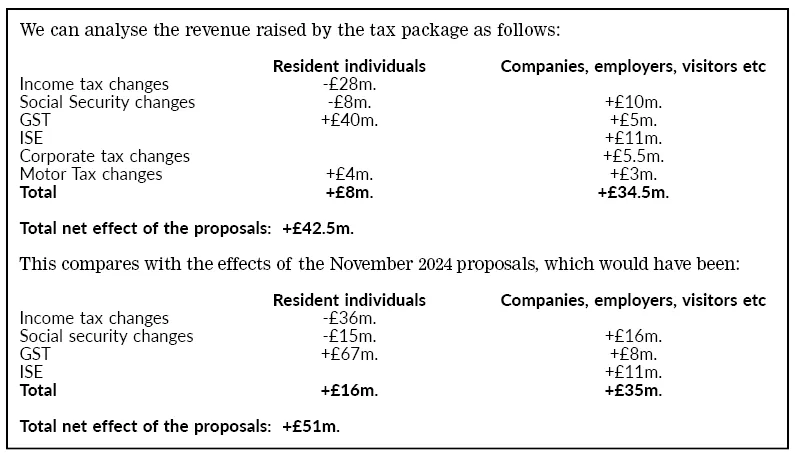
So, how does the 2026 tax package begin to address these problems? Firstly, it marks a significant shift of the tax burden back to the corporate population.
It will be seen that, while companies/employers will be paying much the same as under the previous proposals, the additional tax burden on the local population will have halved. And within the effect on the local population (£8m.), there is some redistribution, so that the net effect (£8m.) will be born by the top 25% of earners, while the majority will be better off.
In effect, these proposals are more about rebalancing the tax burden between local residents and companies/employers than they are about GST.
Secondly, the 2026 tax package would create a broader, more sustainable financial base for the States going forward. We would be less dependent on taxes on the earnings of the resident population than we are now.
That is why I am able to support these proposals as a compromise, in the absence of wider corporate tax reform.




You need to be logged in to comment.