
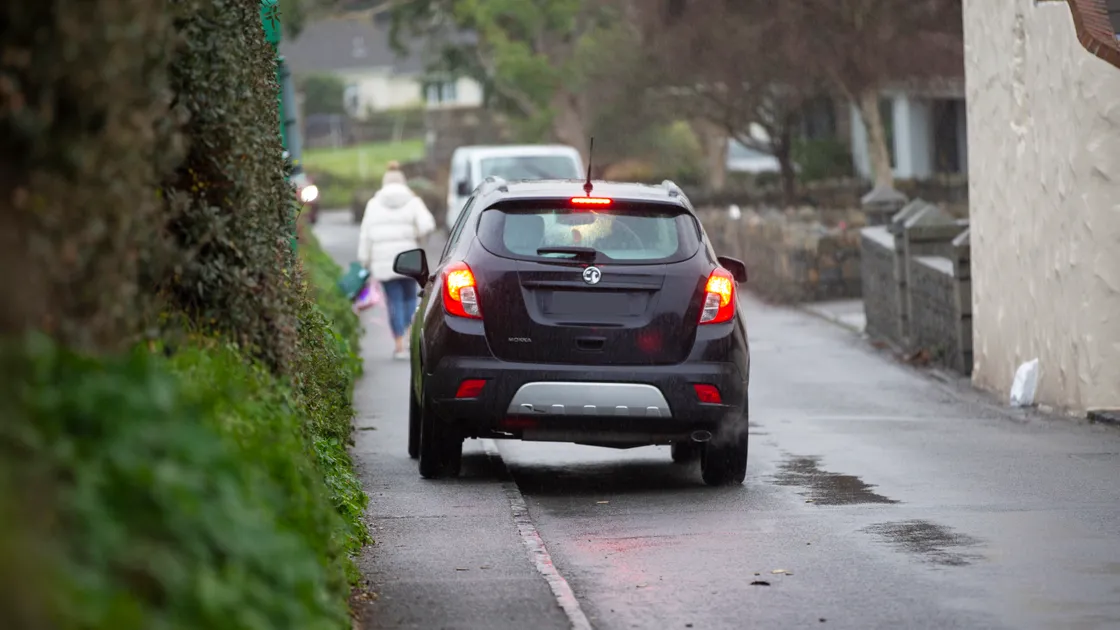
There is a quiet, everyday reality across Guernsey that we have come to accept without question: the prioritisation of vehicle movement over the safety of people.
We see it in our narrow lanes, our pavements, and our shared spaces — where pedestrians, parents with pushchairs, children, the elderly, and even animals are routinely forced to step aside for vehicles. In some cases, they are forced off the pavement altogether.
The debate around the school street trial at La Mare de Carteret was about much more than a temporary restriction outside a school.
Reading the Guernsey Press article of 3 June, one comment stood out to me. A parent who walks his daughter to school said there wasn’t much of a problem because when larger vehicles come along on the pavement, children can simply step into gateways while they drive past.
I don’t think he could really hear what he was saying.
To me, that does not demonstrate safety. It demonstrates how normal this has become.
Think about what is actually being suggested. Children walking to school are expected to move out of the way because the pavement, the one space designed to keep them safe, has been taken from them to keep vehicles moving.
Like the boiling frog, we have let it happen around us.
A sobering fact is that Guernsey is highly unusual in that it appears to be the only place in the world where its Highway Code not just tolerates this behaviour, but provides guidance on how drivers may drive the pavement at their own discretion, but just ‘please try to drive on the pavement safely’ (a more obvious oxymoron would be hard to find). Nowhere else in the world does the government appear to formally sanction using a pedestrian’s only refuge in this way.
There is a growing body of research around a concept called ‘motonormativity’, coined by world-respected environmental psychologist Ian Walker. The idea that we have become so accustomed to prioritising vehicles that we accept things we would never accept in other aspects of life.
Guernsey definitely suffers from this. A child stepping aside in to a gateway for a vehicle driving on a pavement feels normal, but asking a vehicle to slow down or take another route feels controversial.
Combined with a small, spatially-constrained island, with a road and parking network that simply cannot accommodate unlimited vehicle use, it becomes clear that our challenges are not just about infrastructure, but about culture and choices.
This is not just anecdotal. In a recent public survey I conducted, a consistent pattern emerged across the island. Many respondents reported feeling unsafe walking, frequently encountering vehicles on pavements, close passes, and regular near misses. Some described being physically struck by wing mirrors. Crucially, these experiences were not isolated but repeated across multiple parishes and road types. Many people said they now avoid walking routes, choose to drive short journeys instead, or do not allow their children to travel independently.
We even have schools needing to use playgrounds during school hours as car parks. If we allowed large numbers of unchecked individuals into a playground during school hours, interrupting lessons and creating safeguarding concerns, it would rightly be seen as unacceptable. Put the people in vehicles, however, and it becomes normal, like Trojan horses.
Our roads are narrow. Our pavements are often narrow or absent. Yet we routinely expect pedestrians, including children, to adapt to vehicles, rather than the other way around. As per the response to the worsening problem not being increased enforcement, or network adaptations but to just change the rules in a new 2019 Highway Code For Guernsey.
What’s hard to understand is that this political term has made sure 16-year-olds are protected when it comes to things like piercings, and we’re now looking at how to keep under-16s safe online with mobile devices and app use, yet every day we ignore the very real risk of physical harm on our roads. Our children are being exposed to it constantly, and we barely question it anymore. It’s become so normal that we’ve stopped seeing it. Completely motonormative.
But that is beginning to change.
During the recent by-election I spoke out openly about these issues, calling for improvements to road safety and active travel infrastructure. A key part of that was a proposal for a user-led commission to review how our road network works in practice and how space is allocated, guided by a simple principle: if a road is not safe for a child to use independently, it cannot be considered fully safe.
What has been particularly striking is the level of public support the idea of a culture and infrastructure change is now receiving. The more these conversations happen, the more people recognise the problem. That support is not coming from one group, it is coming from people I have spoken to across the community. I am hearing it from articulated lorry drivers, utility engineers, resurfacing crews, motor traders, mechanics, bus drivers. People who rely on the road network every day for their work. They see the pressures, the constraints, and the risks first-hand.
There is a growing recognition that what we have today is not inevitable, and not optimal.
Momentum is building and it needs to, to persuade this government that what we have now, leaving the most vulnerable at risk, in contravention of our obligations towards the UN conventions of human rights for people and children and the Vienna Convention, of the most vulnerable being safe from danger, is not sustainable or acceptable, or internationally a particularly good look.
Instead of asking whether a school street causes inconvenience to drivers, we should be asking a simpler question: would we feel comfortable allowing a child to use that road alone?
If the answer is no, then we know something needs to change.
As a professional HGV driver of 24 years here, I understand the importance of keeping the island moving. Deliveries must be made, businesses must operate, and vehicles are essential. Lots of us need to drive every day.
But roads are not just for vehicles. They are shared public spaces for all modes of transport.
We should judge them not only by how efficiently vehicle traffic moves, but by whether a child, an older person, or someone in a wheelchair can use them safely and confidently.
School streets are not about making life difficult for motorists. They are about creating safer environments, supporting walking and cycling, and giving people genuine choice. And a direct result of roads that are not properly or safely accommodating active travel, especially around schools where hundreds of vehicles are converging in the same place at the same time. Mostly driving to avoid children walking or cycling in this road network and the way its being used.
The evidence of the problem is in plain sight yet we became blind to it.
We can’t just keep looking the other way and telling ourselves things are working, because they clearly aren’t. So much so we changed the rules in 2019 to allow it, rather than increase enforcement or adapt the network.
Vehicle numbers and manufacturers sizes continue to grow and we now have nearly six times more square metreage being taken up by vehicles on Guernsey than 50 years ago. 30% more than just 10 years ago. With projections showing a further 30% in the next 10 years. The problem is not going away, it’s getting worse and needs urgent intervention.
We need a shift, both in how we think and how we design. Our obligations – internationally, morally and in law – mean we should be prioritising people’s safety.
My ambition is simple. Parents should feel comfortable allowing their children to get to school independently. Walking and cycling should feel safe and normal. Children should not have to step into gateways because a vehicle wants the pavement.
Children deserve safe routes to school.
That should be the easiest part of this debate to agree on and if you do agree, add your voice now in calling for better, before it’s too late.



You need to be logged in to comment.